
Stable Diffusion Online vs Local
Stable Diffusion Online vs Local connects choose online or local Stable Diffusion to a curated English SEO page with model notes, prompt patterns, FAQ coverage, real examples, and related internal links.
Editorially reviewed by GPT Images for prompt usefulness, internal links, FAQ coverage, and source-aware model context.
What this workflow covers
Stable Diffusion Online vs Local is designed for users deciding where to run image prompts and how to adapt them inside a specific tool. It targets the intent to choose online or local Stable Diffusion, but the page avoids thin keyword stuffing by connecting the topic to prompt structure, real prompt examples, internal links, and FAQ answers.
The practical goal is simple: help someone understand what to write next. The page explains how Stable Diffusion Online vs Local prompts should define subject, constraints, references, style, and output checks before a model or generator is blamed for a weak result.
- Use this workflow when the search intent is "choose online or local Stable Diffusion" and the visitor needs examples before writing from scratch.
- Choose it when Stable Diffusion Online vs Local work requires visible constraints such as subject, angle, lighting, composition, text, aspect ratio, or editing target.
- Use the real prompt examples below to see how other prompts structure the same problem, then adapt one variable at a time.
- Keep it as an internal link target for related prompt collections so users can move from broad discovery into specific prompt pages.
Recommended Stable Diffusion Online vs Local workflow
show how to prepare prompts for the tool interface while keeping the reusable prompt library as the source of truth. A good workflow should be repeatable, inspectable, and easy to adapt across tools. The same prompt can behave differently in GPT-IMAGE-2, Nano Banana 2, Stable Diffusion, Midjourney, Jimeng AI, or a local ComfyUI setup, so this page keeps the reusable structure separate from tool-specific adjustments.
- Start by defining the job: what the image must communicate, where it will be used, and what failure would make the result unusable.
- Translate the job into a prompt skeleton for Stable Diffusion Online vs Local: subject, scene, medium, camera or composition, style constraints, and output constraints.
- Pick one example prompt from this page and copy only the structure that matches the job; avoid copying decorative phrases that do not serve the image.
- Run a first generation, then change one variable at a time: framing, lighting, color palette, reference strength, text content, or background density.
- Save the winning prompt with notes about model, tool, aspect ratio, and any reference images so the pattern can be reused later.
- prepare inputs, choose prompt examples, run controlled variations, and save winning structures
Quality checks before publishing
Before using a generated image in production, review the output against the original job. The best prompt is not the longest prompt; it is the prompt that makes the model spend attention on the details that matter.
- Stable Diffusion Online vs Local should have a clear subject and a visible hierarchy; if the prompt gives equal weight to every detail, the image often becomes noisy.
- The prompt should separate content from style, especially when moving between GPT-IMAGE-2, Nano Banana 2, Stable Diffusion, Midjourney, or other image models.
- If the output needs readable text, keep the phrase short, quote it exactly, and verify the final image rather than assuming the model handled typography perfectly.
- If the output must match a brand, character, room, product, or reference image, name the fixed traits and describe what is allowed to change.
- Avoid stacking too many model-specific shortcuts on a reusable prompt page; keep the main prompt portable, then add model notes as a final layer.
- Review whether the page sends visitors to deeper prompt examples, related use cases, and FAQ answers instead of trapping them in a generic SEO article.
Common mistakes to avoid
Most failed image generations are not caused by a missing magic word. They usually come from unclear hierarchy, mixed intent, unsupported text requirements, or a prompt that asks for too many changes at once.
- Writing a Stable Diffusion Online vs Local prompt as a pile of keywords without a production goal.
- Changing model, tool, aspect ratio, and reference image at the same time, which makes it impossible to learn what improved the output.
- Using vague quality words such as beautiful or professional without defining the visible evidence of quality.
- Ignoring downstream use, such as ecommerce crop safety, ad text legibility, app store screenshots, or poster readability.
- Treating Stable Diffusion Online vs Local as a final answer instead of a starting point connected to prompt examples and iteration notes.
Stable Diffusion Online vs Local prompt patterns
Production brief prompt
Create a Stable Diffusion Online vs Local image for [audience] that communicates [message]. Main subject: [subject]. Scene: [setting]. Composition: [camera angle, crop, spacing]. Style: [medium, lighting, color direction]. Constraints: [aspect ratio, readable text, brand colors, negative space]. Avoid: [visual mistakes, clutter, wrong mood].
It separates the job, subject, scene, style, and constraints, which makes the prompt easier to test across different image models.
Reference-aware prompt
Using the reference as the fixed source of truth, generate a Stable Diffusion Online vs Local variation. Preserve [identity traits, product shape, logo placement, character features, room layout]. Change only [background, lighting, camera angle, outfit, color palette]. Keep the output consistent with [use case] and do not invent extra objects.
It tells the model what is fixed and what can change, which is critical for image editing, character consistency, product shots, and brand work.
Iteration prompt
Revise the previous Stable Diffusion Online vs Local result by improving [one problem]. Keep [successful elements] unchanged. Adjust [single variable] to [specific direction]. The final image should feel [desired mood] and remain suitable for [placement or channel]. Do not change [protected details].
It controls iteration by changing one variable at a time, so you can learn which instruction improved or damaged the output.
Model transfer prompt
Rewrite this Stable Diffusion Online vs Local prompt for [target model or tool]. Keep the core subject, composition, and constraints. Convert unsupported syntax into natural language. Add model-specific notes only at the end: [aspect ratio, style strength, reference strength, negative prompt, seed, or typography instruction].
It preserves the creative brief while allowing each model or tool to receive the instructions in a format it can use.
Prompt examples for Stable Diffusion Online vs Local
These examples are selected from the current English prompt catalog so the page links visitors into real prompt detail pages instead of stopping at generic advice.

Silhouette Universe Narrative Poster
Automatically generate a high-aesthetic "Silhouette Universe / Collector's Edition Narrative Poster" based on [theme: xxx]. Do not default to common containers such as bottles, hourglasses, glass domes, or pocket watches. Instead, let the AI choose the most symbolic, visually strong, and narratively suitable outer silhouette for the theme. The silhouette can be an artifact, building, gate, tower, archway, dome, stairwell, corridor, statue, profile, eye, hand, skull, wing, mask, mirror, throne, ring, crack, light curtain, shadow, geometric form, spatial cross-section, stage frame, abstract symbol, or any more creative contour that best represents the theme.

The goal is not to simply place a world inside an object, but to make the entire themed universe grow naturally within, around, and through the silhouette itself. The silhouette should be elegant, recognizable, and compositionally dominant. Inside or along its boundary, generate a rich and layered narrative world strongly tied to the theme, including iconic scenes, key architecture or spaces, symbols and metaphors, traces of characters or civilizations, foreground-midground-background depth, and atmosphere with emotional tension. Elements such as doors, staircases, bridges, water, smoke, paths, light sources, ruins, mechanical structures, landscapes, abstract forms, creatures, or props should all feel unified and organically integrated rather than pasted together.

The final composition should feel like a premium collector's poster with strong design value. The large shapes should feel stable, the main silhouette should be unmistakable, and the inner world should have depth, structure, and breathing room. Details should be rich but not crowded. You may add small human silhouettes, distant buildings, beams of light, doorways, bridges, steps, corridors, reflections, skylight, or far-background structures to enhance scale, story, and epic atmosphere. The overall mood should be quiet, grand, refined, and lingering rather than noisy or overloaded.

Blend the feeling of a collector's edition film poster, high-end narrative visual design, dreamy watercolor texture, and fine printed paper. Emphasize paper grain, feathered edges, watercolor brush marks, gentle diffusion, atmospheric perspective, soft haze, selective volumetric light, light passing through mist, generous negative space, and restrained layout. The image should feel premium, poetic, majestic, sacred, nostalgic, quiet, and mythic.

Let the AI choose an elevated color palette based on the theme, but keep it unified, restrained, tasteful, low-saturation, and premium. Avoid chaotic high saturation, cheap neon effects, or plastic digital color. Suitable palette families may include black-gold-gray, cool blue-gray, mist white-gray, brown-red with off-white, dark copper, aged paper tones, deep sea blue, twilight purple, or silver-gray, as long as they serve the theme.

Final requirement: the first glance should give strong theme recognition and a memorable silhouette, the second glance should reveal a complete narrative world, and the third glance should still reward close inspection with depth and aftertaste. Avoid generic backgrounds, hard cut-and-paste compositions, templated fantasy assets, video-game promo art vibes, excessive cartooning, or realism that kills the artistic mood. If appropriate, subtle titles, numbering, signatures, or marks can be added as part of the poster design, but they must never overpower the image.
Silhouette Universe Narrative Poster
Automatically generate a high-aesthetic "Silhouette Universe / Collector's Edition Narrative Poster" based on [theme: xxx]. Do not default to common containers such as bottles, hourglasses, glass domes, or pocket watches. Instead, let the AI choose the most symbolic, visually strong, and narratively suitable outer silhouette for the theme. The silhouette can be an artifact, building, gate, tower, archway, dome, stairwell, corridor, statue, profile, eye, hand, skull, wing, mask, mirror, throne, ring, crack, light curtain, shadow, geometric form, spatial cross-section, stage frame, abstract symbol, or any more creative contour that best represents the theme.

The goal is not to simply place a world inside an object, but to make the entire themed universe grow naturally within, around, and through the silhouette itself. The silhouette should be elegant, recognizable, and compositionally dominant. Inside or along its boundary, generate a rich and layered narrative world strongly tied to the theme, including iconic scenes, key architecture or spaces, symbols and metaphors, traces of characters or civilizations, foreground-midground-background depth, and atmosphere with emotional tension. Elements such as doors, staircases, bridges, water, smoke, paths, light sources, ruins, mechanical structures, landscapes, abstract forms, creatures, or props should all feel unified and organically integrated rather than pasted together.

The final composition should feel like a premium collector's poster with strong design value. The large shapes should feel stable, the main silhouette should be unmistakable, and the inner world should have depth, structure, and breathing room. Details should be rich but not crowded. You may add small human silhouettes, distant buildings, beams of light, doorways, bridges, steps, corridors, reflections, skylight, or far-background structures to enhance scale, story, and epic atmosphere. The overall mood should be quiet, grand, refined, and lingering rather than noisy or overloaded.

Blend the feeling of a collector's edition film poster, high-end narrative visual design, dreamy watercolor texture, and fine printed paper. Emphasize paper grain, feathered edges, watercolor brush marks, gentle diffusion, atmospheric perspective, soft haze, selective volumetric light, light passing through mist, generous negative space, and restrained layout. The image should feel premium, poetic, majestic, sacred, nostalgic, quiet, and mythic.

Let the AI choose an elevated color palette based on the theme, but keep it unified, restrained, tasteful, low-saturation, and premium. Avoid chaotic high saturation, cheap neon effects, or plastic digital color. Suitable palette families may include black-gold-gray, cool blue-gray, mist white-gray, brown-red with off-white, dark copper, aged paper tones, deep sea blue, twilight purple, or silver-gray, as long as they serve the theme.

Final requirement: the first glance should give strong theme recognition and a memorable silhouette, the second glance should reveal a complete narrative world, and the third glance should still reward close inspection with depth and aftertaste. Avoid generic backgrounds, hard cut-and-paste compositions, templated fantasy assets, video-game promo art vibes, excessive cartooning, or realism that kills the artistic mood. If appropriate, subtle titles, numbering, signatures, or marks can be added as part of the poster design, but they must never overpower the image.
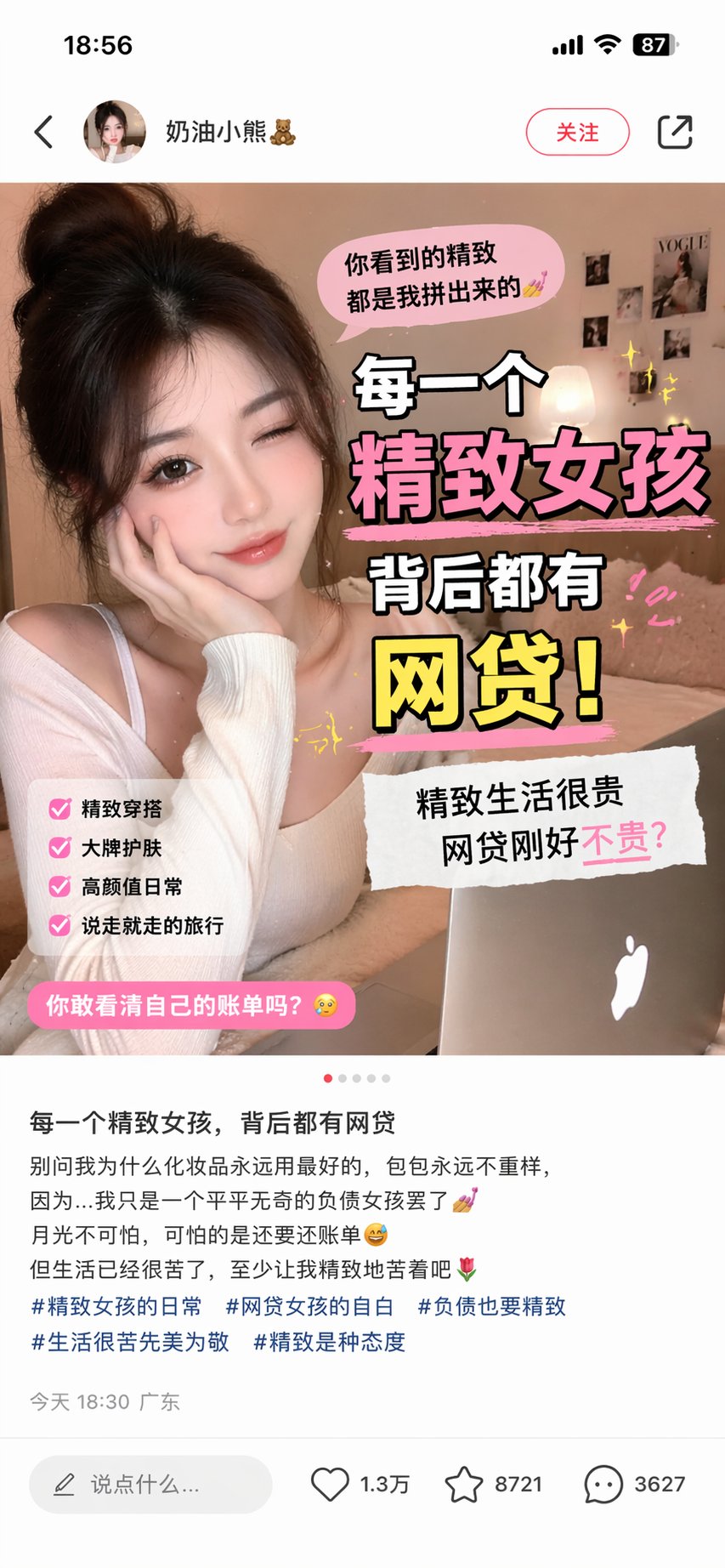
The truth behind online loans for sophisticated girls
Generate Xiaohongshu content screenshot, theme: Behind every exquisite girl there is online loan, iPhone size
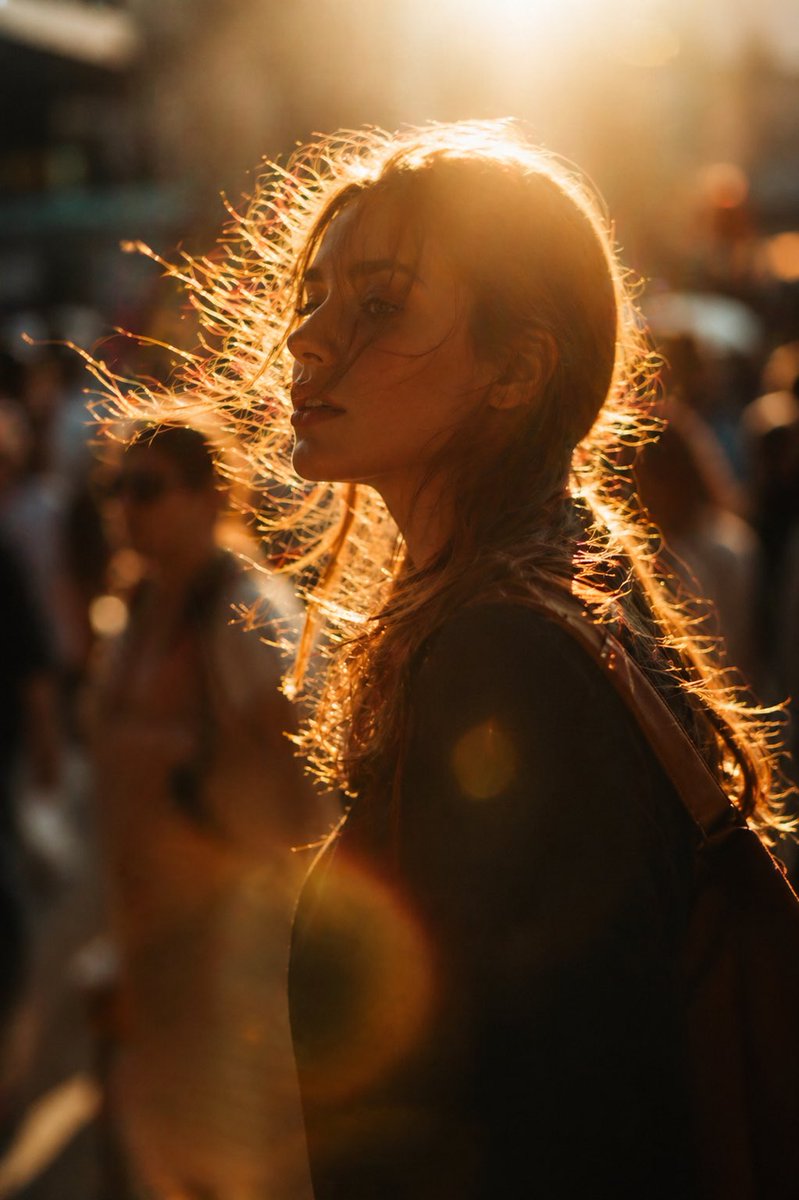
Collectible Figure Workspace Photo
Photorealistic high-quality studio photo of a modern digital art workspace, showing the concept of “from 3D virtual character to real collectible figure.”

In the foreground, a highly realistic collectible figurine of [Character Name / Character Identity] is placed on a round wooden display stand. The character has [facial features / appearance], [hairstyle], and a [expression / personality vibe]. The figure is wearing [outfit / costume]. The overall design is refined, premium, and instantly recognizable. The figurine should have realistic collectible statue quality, with subtle resin/sculpture material feel, while still looking highly believable and visually realistic.

The pose is [character pose], natural, stable, elegant, and display-worthy. Shot from a low-angle close-up perspective with slight wide-angle distortion, vertical composition, emphasizing the full figure, clothing structure, leg lines, and pose.

In the background, there is a professional 3D character design workstation with two large curved monitors. Both monitors must show the exact same character as the foreground figurine — same face, same hairstyle, same outfit, same pose, and same overall vibe — clearly expressing the idea of turning a digital 3D character into a real physical figure.

The left monitor shows a gray sculpt / clay model view in a professional 3D sculpting software interface, similar to ZBrush. The gray model must match the foreground figure exactly in character design, pose, outfit structure, and facial identity.

The right monitor shows the fully rendered colored version of the same character, also matching the foreground figure exactly in face, hairstyle, outfit, pose, and temperament. Together, the two monitors reinforce the workflow of “digital character design → physical collectible statue.”

On the desk are a keyboard, mouse, monitor arms, drawing tablet, stylus, and other 3D modeling tools. The workspace is clean, professional, and visually premium. Optional extra elements: [weapon / accessories / theme props / IP-style design details].

Lighting is a mix of soft studio lighting and indoor workspace lighting. The foreground figurine is evenly lit with clear facial and material detail, while the monitors emit cool-toned tech light. Overall mood is realistic, clean, premium, slightly shallow depth of field, ultra-detailed, emphasizing the collectible figure quality, professional 3D design studio atmosphere, and the visual concept of “from digital model to real figure.”

photorealistic, ultra detailed, cinematic studio lighting, realistic figurine, collectible statue, 3D character design studio, from digital model to real figure, vertical composition
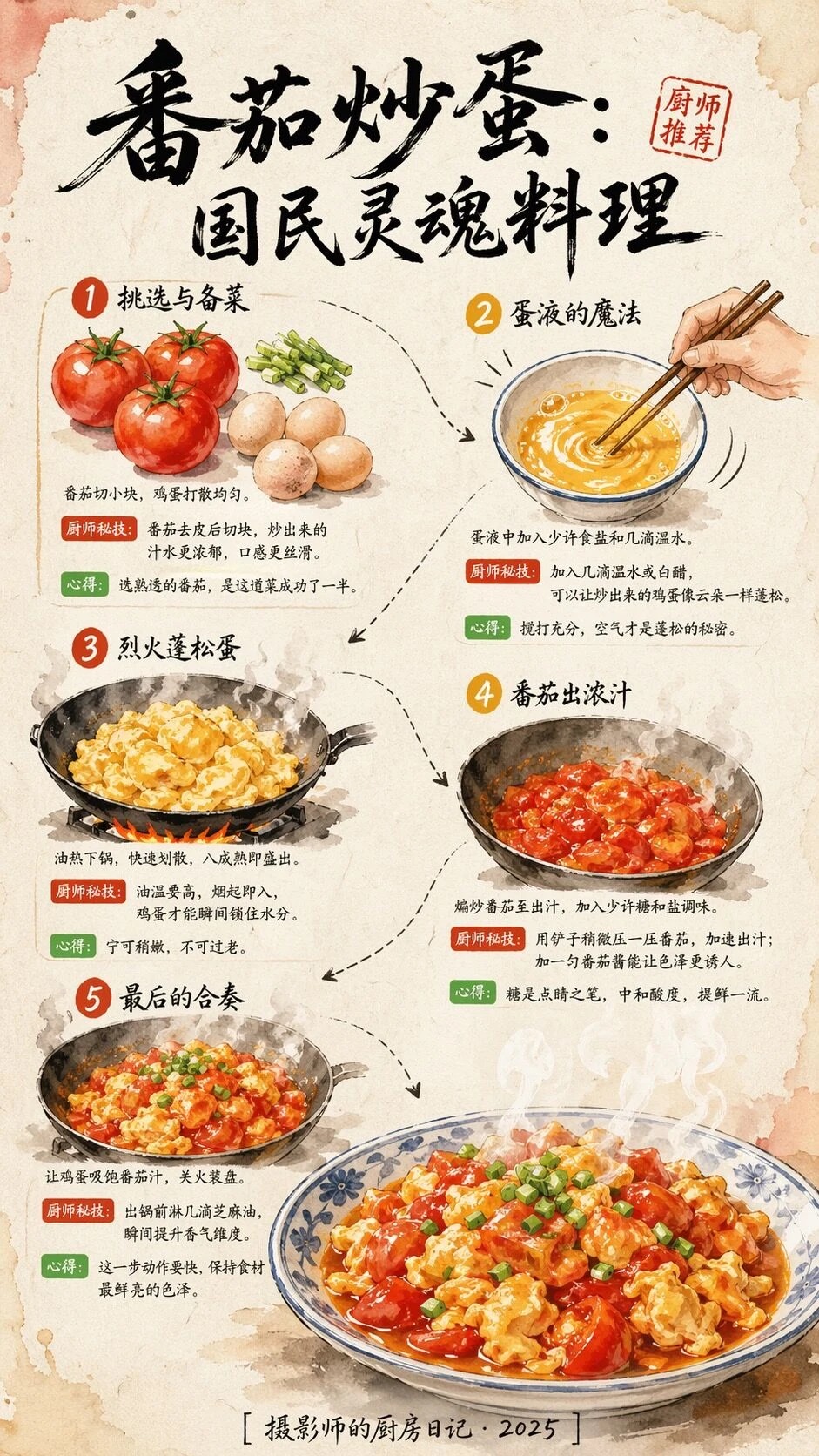
Infographic Visualization Design
Visual design specifications: Aspect ratio 9:16 (vertical phone infographic); background texture is beige handmade washi paper with a breathing feel, featuring fine fiber texture and slight water stain diffusion at the corners; color scheme includes ripe tomato red (#E23A28), extra virgin olive oil gold (#F2C94C), tender grass green (#6FCF97), and carbon black ink lines; layout logic features large title at the top, Z-shaped flow in the middle, panoramic finished product at the bottom, and artistic white space treatment.

Recipe content planning: 1) Top title "Tomato and Egg Stir-fry: The Soul Dish of the Nation", in hand-drawn calligraphy style, with a small red "Chef's Recommendation" seal on the side. 2) Step sections (Z-shaped flow layout): Step 1 Selection and Preparation (top left): Three tomatoes, four free-range eggs, one bunch of green onions; Instructions: Dice tomatoes into small pieces, beat eggs evenly; Chef's tip: Peel tomatoes before dicing for richer juice and smoother texture; Insight: Choose fully ripe tomatoes, and you're halfway to success. Step 2 The Magic of Egg Mixture (top right): Rapidly beating egg mixture with chopsticks, creating bubbles and dynamic lines; Instructions: Add a pinch of salt and a few drops of warm water; Chef's tip: Adding warm water or white vinegar makes eggs fluffier; Insight: Beat thoroughly, as air is the secret to fluffiness. Step 3 High-Heat Fluffy Eggs (middle left): Egg mixture rapidly expanding like clouds in an iron wok, with watercolor effects showing steam; Instructions: Pour into hot oil, quickly scramble, and remove when 80% cooked; Chef's tip: Use high heat, add when smoke appears to instantly lock in moisture; Insight: Better slightly undercooked than overcooked. Step 4 Rich Tomato Juice (middle right): Tomatoes rolling with semi-melted edges and bright red juice flowing; Instructions: Stir-fry until juice releases, add a little sugar and salt; Chef's tip: Lightly press with spatula to speed up juice extraction, add a spoon of tomato paste for color; Insight: Sugar neutralizes acidity and enhances freshness. Step 5 The Final Harmony (bottom left): Eggs returned to the wok to intertwine with tomato juice, sprinkle with green onions; Instructions: Let eggs absorb tomato juice, turn off heat and plate; Chef's tip: Add a few drops of sesame oil before serving for aroma; Insight: Work quickly to maintain vibrant colors. 3) Bottom finished product illustration: Tomato and egg stir-fry served in a deep blue-and-white porcelain plate, bright red sauce enveloping golden chunks of eggs, garnished with green onions, watercolor rendering of translucent sauce texture, with wisps of steam at the edges; Visual appeal: Makes you want to immediately serve it with a bowl of rice. 4) Bottom center signature: [ The Photographer's Kitchen Diary · 2025 ].
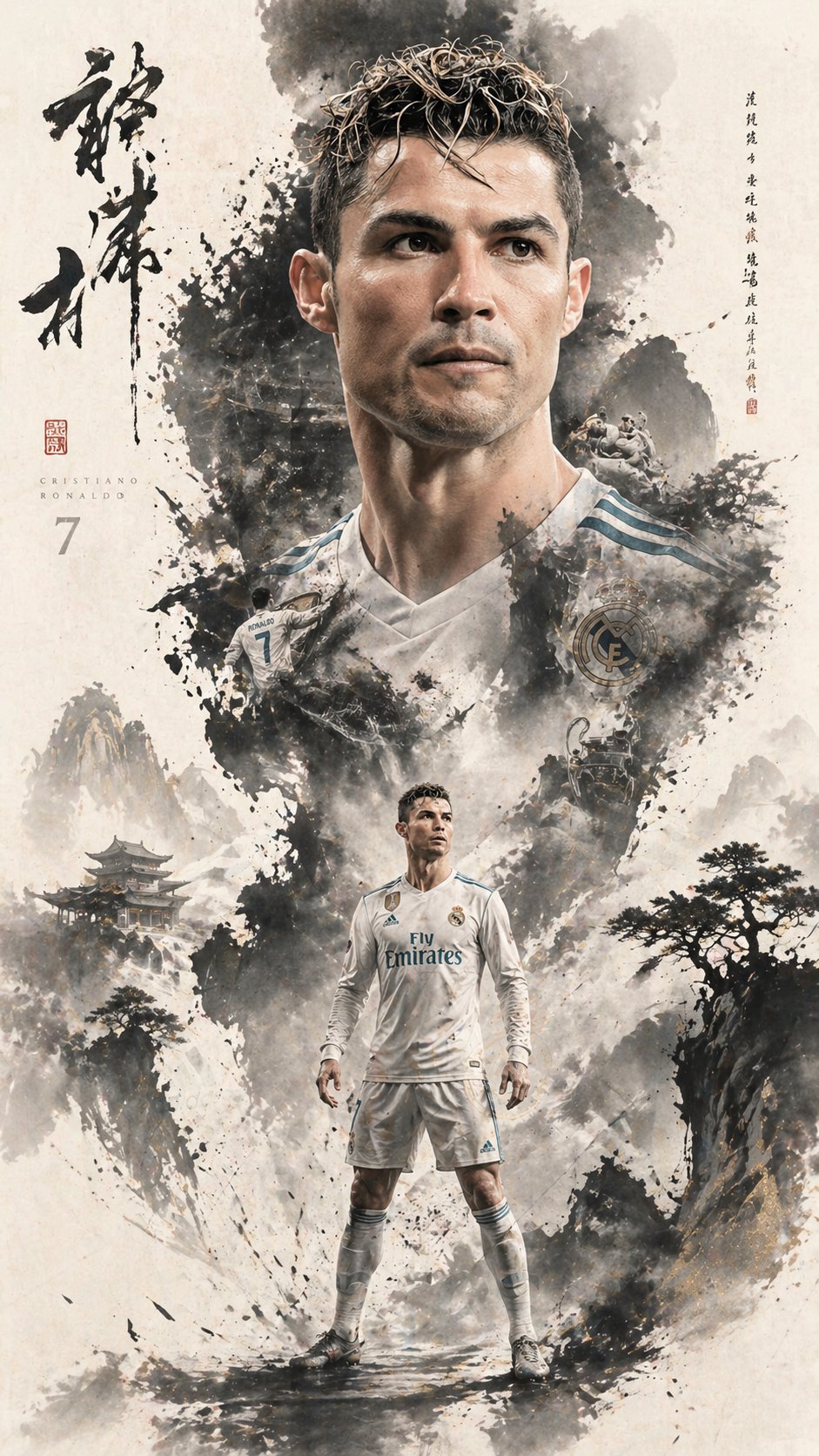
Ink wash double exposure character poster
A cinematic character promotional poster of [SUBJECT], vertical composition (9:16), designed with a refined East-Asian ink aesthetic and high-end visual storytelling.

STRUCTURE:
Top-heavy hierarchical layout. The upper half features a large, highly recognizable silhouette of [SUBJECT]'s head / face / mask / upper body, forming a bold, iconic primary shape. The silhouette should be instantly identifiable.

The middle-lower section contains the full-body version of [SUBJECT] as a secondary subject, standing in a stable pose or subtle action stance, forming the visual core.

COMPOSITION STYLE:
Inside the large silhouette and around the character, use double exposure and collage storytelling. Integrate multiple elements:
- key scenes related to [SUBJECT]
- symbolic imagery and environment
- small narrative figures and interactions
- supporting visual motifs

Blend everything seamlessly using clouds, mist, ink diffusion, and negative space.

VISUAL FLOW:
Create a continuous flowing visual path from top to bottom, connecting:
- upper silhouette
- inner collage elements
- full-body subject

Ensure smooth eye guidance and compositional cohesion.

SIDE ELEMENTS:
Add balanced supporting elements on left and right sides to create tension, depth, and spatial variation.

STYLE & ATMOSPHERE:
- Large areas of negative space
- Ink-wash diffusion edges, soft fading, subtle fragmentation
- Eastern aesthetic: balance of emptiness and detail
- Calm, premium, restrained, cinematic tone

QUALITY:
Ultra-detailed, high resolution, layered depth, soft lighting, atmospheric perspective, cohesive series-style design.

OUTPUT:
9:16 aspect ratio, poster-ready composition.
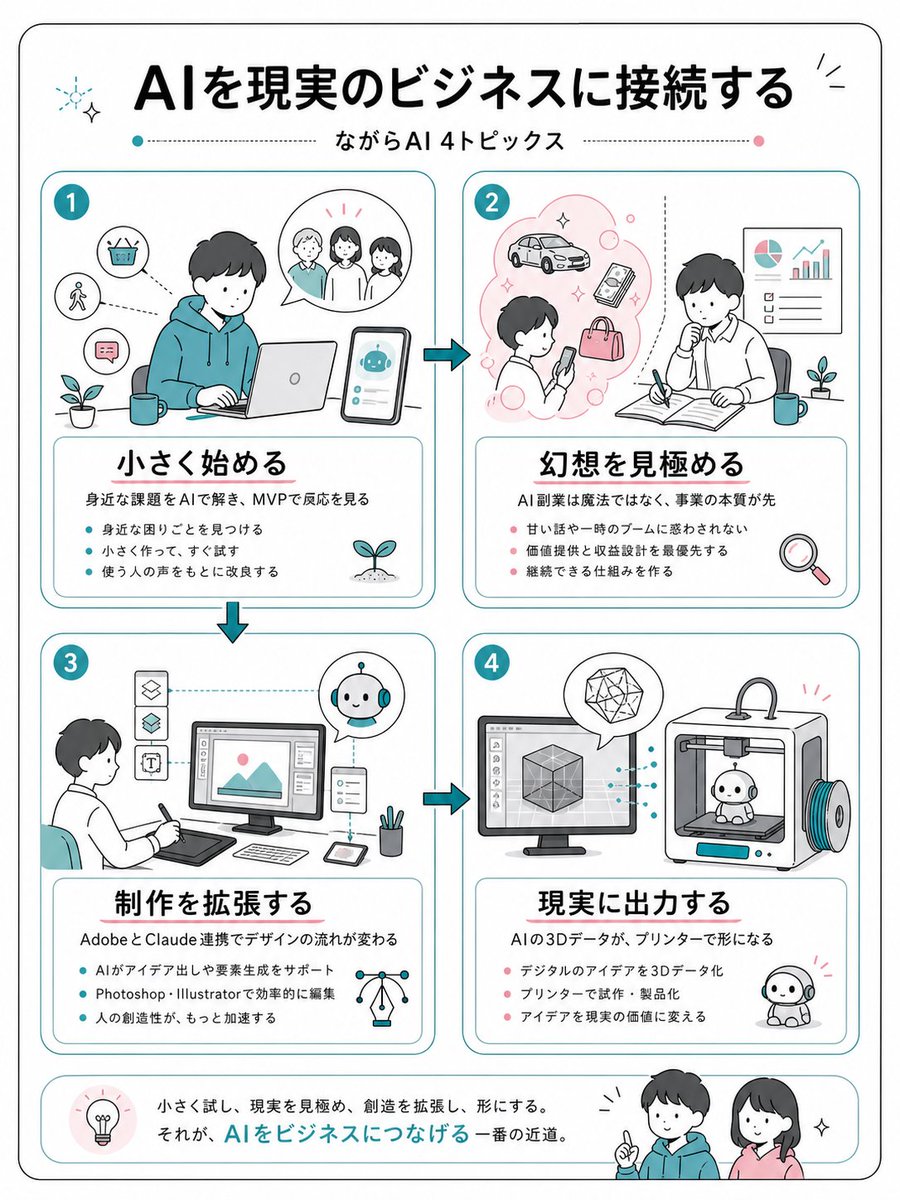
Infographic / Edu Visual - Japanese AI Business Infographic
{"type":"clean Japanese business infographic poster","format":"vertical A4-like page with rounded black outer border on white background","style":"friendly flat line illustration, minimal teal and coral accent colors, soft rounded rectangles, hand-drawn business sketch feel, black Japanese gothic headline typography, thin teal dividers, small sparkle and plant icons","language":"Japanese","headline":"{argument name=\"headline text\" default=\"AIを現実のビジネスに接続する\"}","subtitle":"{argument name=\"subtitle text\" default=\"ながらAI 4トピックス\"}","layout":{"top":"large centered headline with small decorative sparkles, subtitle below between dotted horizontal lines with teal and pink dots","main_grid":"four equal rounded cards arranged in a 2 by 2 grid, connected by teal arrow icons showing flow from 1 to 2, down to 3, across to 4","bottom_banner":"rounded summary strip with a lightbulb icon at left, Japanese closing sentence in the center, and two friendly characters at right"},"sections":[{"number":"1","position":"top left","title":"{argument name=\"section 1 title\" default=\"小さく始める\"}","main_illustration":"young person in teal hoodie working on a laptop at a desk, smartphone beside them showing a cute AI robot chat interface, speech bubble with three people, small icons for basket, walking person, chat message, plant and mug","description":"身近な課題をAIで解き、MVPで反応を見る","bullet_count":3,"bullets":["身近な困りごとを見つける","小さく作って、すぐ試す","使う人の声をもとに改良する"]},{"number":"2","position":"top right","title":"{argument name=\"section 2 title\" default=\"幻想を見極める\"}","main_illustration":"person looking at a smartphone inside a pink idea cloud with car, phone, bag and bubbles; second person thinking while writing in an open notebook, wall chart with pie chart and rising bar graph, plant, mug, magnifying glass icon","description":"AI副業は魔法ではなく、事業の本質が先","bullet_count":3,"bullets":["甘い話や一時のブームに惑わされない","価値提供と収益設計を最優先する","継続できる仕組みを作る"]},{"number":"3","position":"bottom left","title":"{argument name=\"section 3 title\" default=\"制作を拡張する\"}","main_illustration":"designer seated with pen tablet facing a desktop monitor showing an image editing interface, vertical tool icons at left, small AI robot assistant in circular bubble, tablet, stylus, pen cup, network lightbulb icon","description":"AdobeとClaude連携でデザインの流れが変わる","bullet_count":3,"bullets":["AIがアイデア出しや要素生成をサポート","Photoshop・Illustratorで効率的に編集","人の創造性が、もっと加速する"]},{"number":"4","position":"bottom right","title":"{argument name=\"section 4 title\" default=\"現実に出力する\"}","main_illustration":"desktop monitor with 3D cube modeling software connected by dotted teal lines to a 3D printer printing a small cute robot figure, geometric crystal in speech bubble, finished robot mascot on the floor","description":"AIの3Dデータが、プリンターで形になる","bullet_count":3,"bullets":["デジタルのアイデアを3Dデータ化","プリンターで試作・製品化","アイデアを現実の価値に変える"]}],"bottom_summary":{"icon":"lightbulb in a pale pink circle","text":"小さく試し、現実を見極め、創造を拡張し、形にする。\nそれが、AIをビジネスにつなげる一番の近道。","characters":"two smiling young people, one in teal hoodie pointing upward and one woman in pink top, with small sparkle marks"},"visual_requirements":"Use exactly 4 numbered topic cards, exactly 3 bullet points in each card, Japanese text must be crisp and readable, maintain generous margins, rounded corners, teal card borders, coral bullet dots in sections 2 and 4, teal bullet dots in sections 1 and 3, no photorealism."}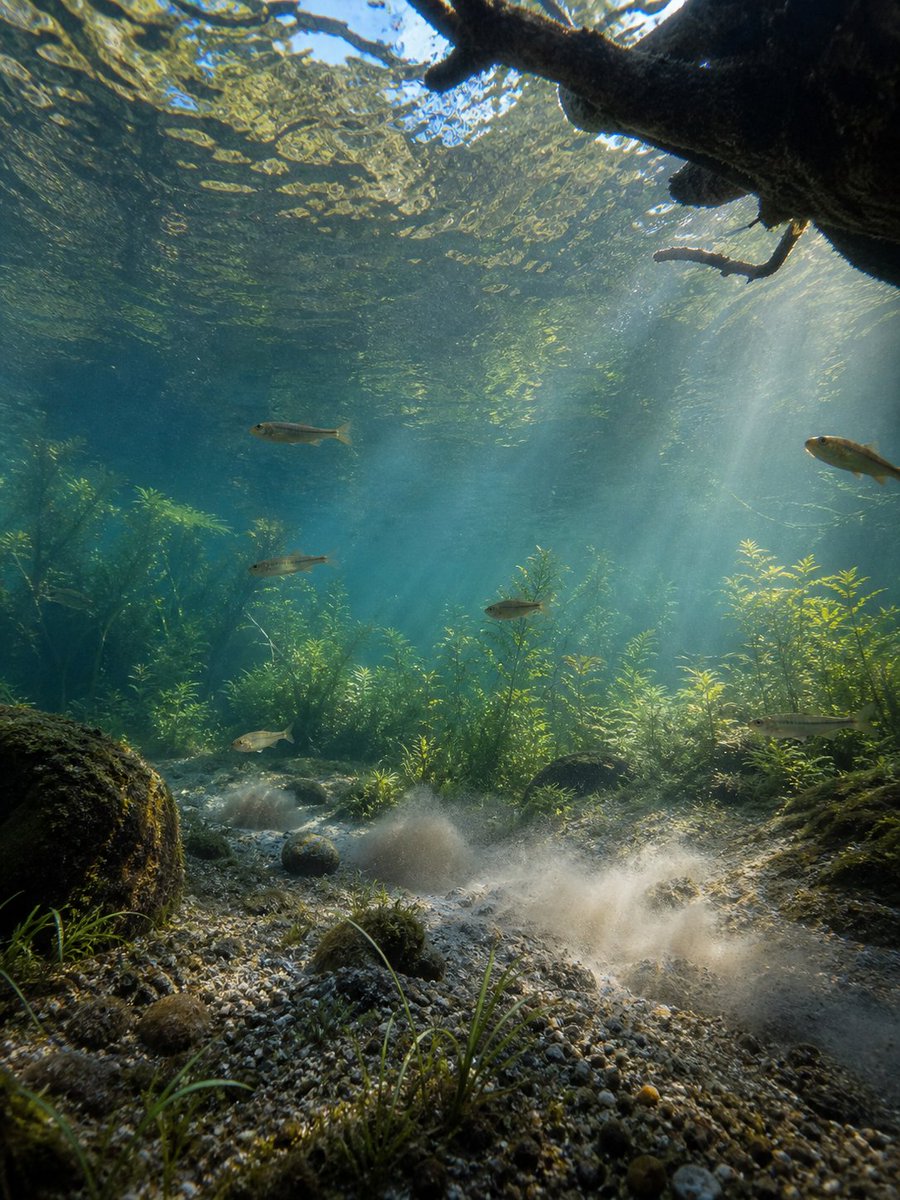
Infographic / Edu Visual - Underwater Forest Stream Photography
Shot with a high-definition underwater camera, this prompt captures real underwater natural scenery in a {argument name="environment description" default="clear shallow stream next to a tropical primeval forest"}.

Vertical composition, 3:4 aspect ratio, medium-to-long shot. The lens is slightly below the water surface, showing the shimmering bottom of the water surface above with realistic water wave refraction and natural reflections.

Sunlight shines diagonally into the water from the top right, forming soft beams and underwater spots. Dark reflections and shadows of large tree branches occupy part of the composition in the upper right.

In the middle is clear and quiet stream water with slight suspended particles and {argument name="number of fish" default="5-8"} native freshwater small fish swimming naturally, mainly gray-silver and light brown, varying in size and distance, not forming an organized school. On the stream bed, deep green, yellow-green, and brownish-green water plants grow naturally, swaying gently with the current, distributed naturally unlike an artificial aquarium.

The bottom consists of gray-brown fine sand, gravel, pebbles, and several naturally shaped stones with slight algae marks and signs of water erosion. Multiple springs at the bottom show fine sand billowing slowly from small holes, creating light sand clouds and local water disturbances, not white smoke, steam, or large bubbles.

Natural landscape live-action photography, high-end natural documentary feel, close to National Geographic ecological photography. Features transparent water, natural lighting, restrained colors, realistic underwater optical effects, slight graininess, natural depth of field, and high-definition details.

No people, no buildings, no artificial traces, no text, no borders, no LOGO. Avoid CG feel, aquarium look, seabed coral, exaggerated fish schools, oversaturated greens, dreamy lighting effects, or plastic water plants.Related prompt guides and libraries
FAQ about Stable Diffusion Online vs Local
How do I use Stable Diffusion Online vs Local prompts from gptimages.dev?
Start with the examples that match your visual job, then copy the prompt structure rather than copying every adjective. Replace the subject, scene, channel, aspect ratio, and constraints with your own details. If the first result is close, keep the successful parts fixed and change one variable at a time. This makes the page useful as a prompt library, not just a keyword page.
What is the best prompt format for Stable Diffusion Online vs Local?
A dependable format is brief first, details second, checks last: describe the image goal, then the subject, scene, composition, style, reference rules, and output constraints. For models such as GPT-IMAGE-2, Nano Banana 2, Stable Diffusion, Midjourney, or Jimeng AI, keep the core prompt portable and add tool-specific settings only when the interface supports them.
Can I reuse these prompts across different AI image models?
Yes, but reuse the structure more than the exact syntax. A prompt that works in one generator may need different wording, reference strength, aspect ratio settings, or negative prompts in another. The safest workflow is to preserve the creative brief, then adapt only the model-specific layer after you inspect the first output.
How should I collect the best AI image prompts?
Save prompts with the final image, model or tool name, aspect ratio, reference images, and a short note explaining why the result worked. Group them by use case such as product photography, character consistency, UI mockups, posters, logos, or text-in-image prompts. That collection becomes much more useful than a flat list of attractive phrases.
Why do Stable Diffusion Online vs Local prompts fail?
Common causes include unclear subject hierarchy, too many styles in one prompt, vague quality words, unsupported text requirements, missing reference rules, and uncontrolled iteration. Fix the prompt by naming the production goal, protecting the details that cannot change, and testing one adjustment per generation instead of rewriting the whole prompt every time.
Are these prompt examples enough for commercial work?
They are a starting point, not legal or brand clearance. For commercial work, check the terms of the model or generator, review rights for reference images, verify text and logos manually, and keep a record of the prompt, source assets, and final edits. The page helps with prompt quality, while usage rights still depend on your workflow and provider terms.