
Social Media Ad Prompts
Social Media Ad Prompts connects find social media ad image prompts to a curated English SEO page with model notes, prompt patterns, FAQ coverage, real examples, and related internal links.
Editorially reviewed by GPT Images for prompt usefulness, internal links, FAQ coverage, and source-aware model context.
What this use-case library covers
Social Media Ad Prompts is designed for people trying to make a specific type of image for a product, brand, story, interface, or campaign. It targets the intent to find social media ad image prompts, but the page avoids thin keyword stuffing by connecting the topic to prompt structure, real prompt examples, internal links, and FAQ answers.
The practical goal is simple: help someone understand what to write next. The page explains how Social Media Ad prompts should define subject, constraints, references, style, and output checks before a model or generator is blamed for a weak result.
- Use this use-case library when the search intent is "find social media ad image prompts" and the visitor needs examples before writing from scratch.
- Choose it when Social Media Ad work requires visible constraints such as subject, angle, lighting, composition, text, aspect ratio, or editing target.
- Use the real prompt examples below to see how other prompts structure the same problem, then adapt one variable at a time.
- Keep it as an internal link target for related prompt collections so users can move from broad discovery into specific prompt pages.
Recommended Social Media Ad workflow
turn a visual job into reusable prompt recipes and examples. A good workflow should be repeatable, inspectable, and easy to adapt across tools. The same prompt can behave differently in GPT-IMAGE-2, Nano Banana 2, Stable Diffusion, Midjourney, Jimeng AI, or a local ComfyUI setup, so this page keeps the reusable structure separate from tool-specific adjustments.
- Start by defining the job: what the image must communicate, where it will be used, and what failure would make the result unusable.
- Translate the job into a prompt skeleton for Social Media Ad: subject, scene, medium, camera or composition, style constraints, and output constraints.
- Pick one example prompt from this page and copy only the structure that matches the job; avoid copying decorative phrases that do not serve the image.
- Run a first generation, then change one variable at a time: framing, lighting, color palette, reference strength, text content, or background density.
- Save the winning prompt with notes about model, tool, aspect ratio, and any reference images so the pattern can be reused later.
- define output constraints, choose references, specify scene details, and review production quality
Quality checks before publishing
Before using a generated image in production, review the output against the original job. The best prompt is not the longest prompt; it is the prompt that makes the model spend attention on the details that matter.
- Social Media Ad should have a clear subject and a visible hierarchy; if the prompt gives equal weight to every detail, the image often becomes noisy.
- The prompt should separate content from style, especially when moving between GPT-IMAGE-2, Nano Banana 2, Stable Diffusion, Midjourney, or other image models.
- If the output needs readable text, keep the phrase short, quote it exactly, and verify the final image rather than assuming the model handled typography perfectly.
- If the output must match a brand, character, room, product, or reference image, name the fixed traits and describe what is allowed to change.
- Avoid stacking too many model-specific shortcuts on a reusable prompt page; keep the main prompt portable, then add model notes as a final layer.
- Review whether the page sends visitors to deeper prompt examples, related use cases, and FAQ answers instead of trapping them in a generic SEO article.
Common mistakes to avoid
Most failed image generations are not caused by a missing magic word. They usually come from unclear hierarchy, mixed intent, unsupported text requirements, or a prompt that asks for too many changes at once.
- Writing a Social Media Ad prompt as a pile of keywords without a production goal.
- Changing model, tool, aspect ratio, and reference image at the same time, which makes it impossible to learn what improved the output.
- Using vague quality words such as beautiful or professional without defining the visible evidence of quality.
- Ignoring downstream use, such as ecommerce crop safety, ad text legibility, app store screenshots, or poster readability.
- Treating Social Media Ad Prompts as a final answer instead of a starting point connected to prompt examples and iteration notes.
Social Media Ad prompt patterns
Production brief prompt
Create a Social Media Ad image for [audience] that communicates [message]. Main subject: [subject]. Scene: [setting]. Composition: [camera angle, crop, spacing]. Style: [medium, lighting, color direction]. Constraints: [aspect ratio, readable text, brand colors, negative space]. Avoid: [visual mistakes, clutter, wrong mood].
It separates the job, subject, scene, style, and constraints, which makes the prompt easier to test across different image models.
Reference-aware prompt
Using the reference as the fixed source of truth, generate a Social Media Ad variation. Preserve [identity traits, product shape, logo placement, character features, room layout]. Change only [background, lighting, camera angle, outfit, color palette]. Keep the output consistent with [use case] and do not invent extra objects.
It tells the model what is fixed and what can change, which is critical for image editing, character consistency, product shots, and brand work.
Iteration prompt
Revise the previous Social Media Ad result by improving [one problem]. Keep [successful elements] unchanged. Adjust [single variable] to [specific direction]. The final image should feel [desired mood] and remain suitable for [placement or channel]. Do not change [protected details].
It controls iteration by changing one variable at a time, so you can learn which instruction improved or damaged the output.
Model transfer prompt
Rewrite this Social Media Ad prompt for [target model or tool]. Keep the core subject, composition, and constraints. Convert unsupported syntax into natural language. Add model-specific notes only at the end: [aspect ratio, style strength, reference strength, negative prompt, seed, or typography instruction].
It preserves the creative brief while allowing each model or tool to receive the instructions in a format it can use.
Prompt examples for Social Media Ad
These examples are selected from the current English prompt catalog so the page links visitors into real prompt detail pages instead of stopping at generic advice.
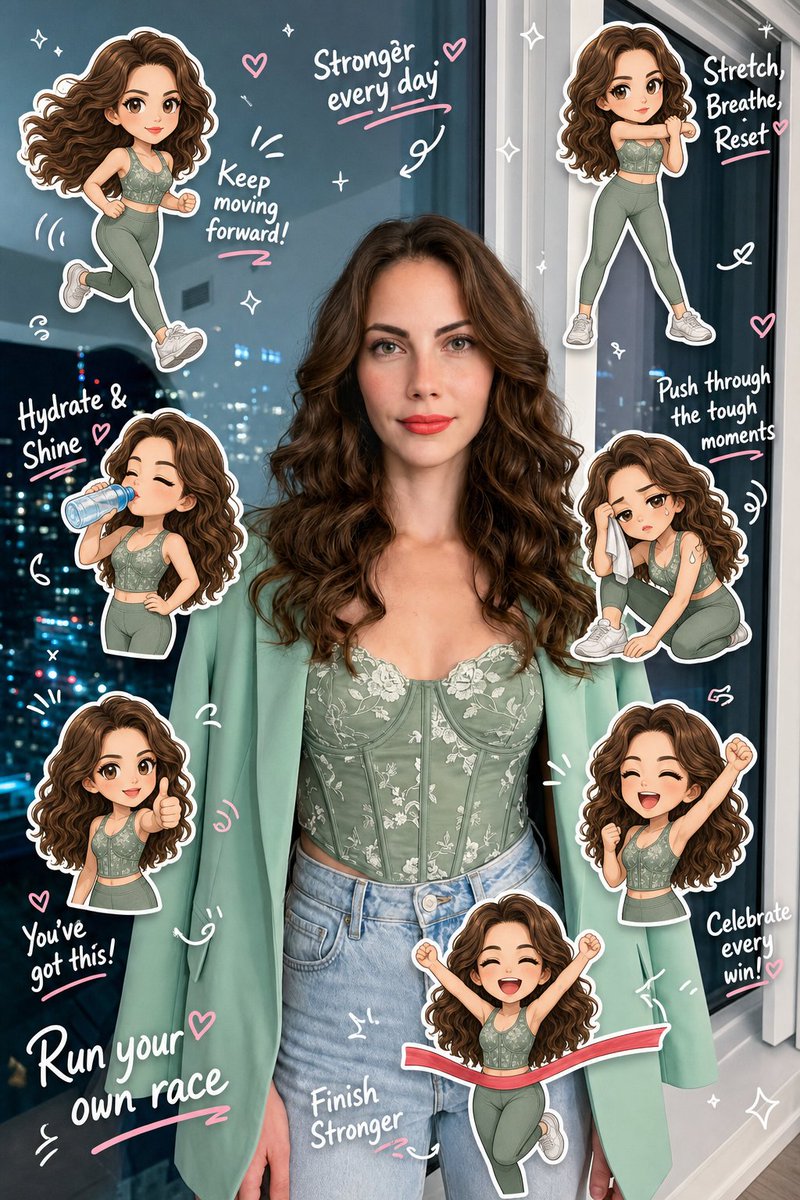
Social Media Post - Chibi Clone Sticker Diary
Create a high-quality “{argument name="style" default="chibi clone sticker diary photo"}” based on the uploaded real-life image. Preserve the original person’s identity, face, hairstyle, hair color, outfit, body proportions, pose, lighting, and background. Do not alter facial features or turn the subject into a full illustration—maintain a realistic photo look.
Analyze the scene as a {argument name="activity" default="fitness/running"} lifestyle moment. Add 5–8 chibi mini clones of the same person around the subject, designed in a consistent kawaii sticker style (big head, small body, large expressive eyes, clean digital finish). Each clone must clearly resemble the real person (same hair, outfit, colors).
Design each chibi with different {argument name="action theme" default="running-related actions"} and emotions: jogging, stretching, drinking water, feeling tired, cheering, giving thumbs up, celebrating completion. Ensure all poses are unique and contextually relevant.
Render each chibi as a sticker with white outlines, soft shadows, and a slightly floating effect. Arrange them around the subject and edges without covering the face or main body.
Add light hand-drawn doodles (hearts, sparkles, arrows, motion lines, circles) in white with subtle pink accents, keeping a clean scrapbook diary feel.
Include 5–8 short handwritten-style phrases matching a fitness mood (cute, energetic, encouraging). Use mostly white text with slight pink highlights and small decorative marks.
Composition: keep the real person as the central focus, surrounded by chibi stickers and doodles. The result should feel like a polished, playful, high-resolution social media lifestyle diary image—clean, balanced, and visually rich without clutter.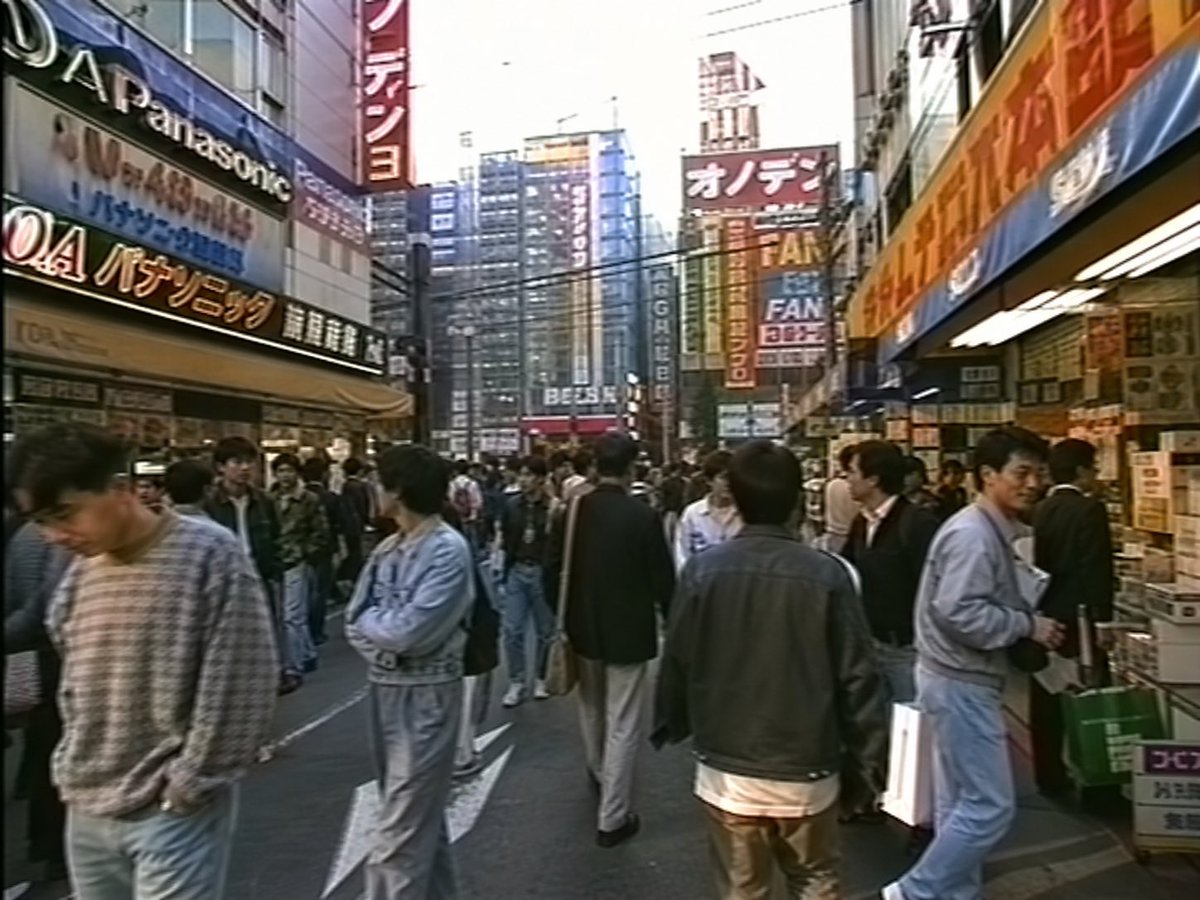
Social Media Post - 1990s Akihabara Street Photo
Create a photorealistic documentary street photograph of {argument name="location and era" default="Akihabara, Tokyo in the 1990s"}, shot from eye level in a narrow electronics shopping street at dusk or late afternoon. The scene contains about 30 visible pedestrians, mostly adult men in casual 1990s clothing such as denim jackets, plaid sweaters, light-wash jeans, bomber jackets, business suits, shoulder bags, and shopping bags; faces are soft, indistinct, or motion-blurred like an old candid TV still. The street is packed but not chaotic, with people standing, browsing, walking away from camera, and gathering near storefronts. Both sides of the street are lined with tall commercial buildings covered in dense Japanese electronics-store signage, including large vertical and horizontal signs with readable fragments such as {argument name="main sign text" default="オノデン"}, {argument name="store brand text" default="Panasonic"}, “FAN,” “BEST,” and other katakana shop signs. The left side has a prominent blue and yellow electronics storefront canopy, while the right side has an orange-and-blue shop awning, shelves, posters, and boxed merchandise displayed at the entrance. Overhead utility wires crisscross the bright washed-out sky between mid-rise buildings. Use a realistic 1990s Japanese consumer camcorder or VHS broadcast aesthetic: 4:3 aspect ratio, slightly low resolution, interlaced softness, muted colors, mild film grain, blown highlights in the sky, subtle barrel distortion, natural crowd clutter, and no modern smartphones, LED billboards, contemporary fashion, or futuristic elements.
Social Media Post - Blue Pen Campaign Poster
A dramatic Brazilian political campaign poster in a square social-media format, hyper-stylized and cinematic, with a dark blue and black color grade, intense contrast, gritty textures, and heroic propaganda-poster composition. On the right half, a middle-aged man wearing a bright royal-blue polo shirt faces the camera from the chest up, extending one hand toward the viewer and prominently holding a blue ballpoint pen upright as the central symbolic object. His pose is confident, assertive, and campaign-like, with the pen close to the lens for forced perspective. Behind him, two large waving flags fill the upper background: the Puerto Rico flag on the upper left side behind the subject and the Brazil flag on the upper right side. The lower background shows a dark crowd silhouette and a distant city skyline at sunset with glowing orange light on the horizon, adding a rally atmosphere. On the left side, create a vertical stack of 4 bold campaign statements, each preceded by a large blue X marker. The 4 text blocks must read exactly: "ELE NÃO TEM A MIDIA", "ELE NÃO TEM PROJETOS", "ELE TAMBÉM NÃO TEM O POVO", and "O RESTO ELE VAI DESCOBRIR NA HORA". Use condensed uppercase typography, mixing white and electric blue emphasis words, with each statement separated by thin horizontal blue divider lines. At the bottom, place an oversized distressed headline in uppercase reading "CANETA AZUL", with "CANETA" in weathered white and "AZUL" in vivid blue, spanning almost the full width. Below it, add a secondary subtitle in uppercase blue italic condensed text reading "PARA DEPUTADO", flanked by thin blue horizontal lines. The overall design should feel like a viral meme campaign ad, bold, satirical, aggressive, and highly shareable, with dramatic rim lighting, sharpened details, realistic skin and fabric texture, and polished poster-quality compositing.
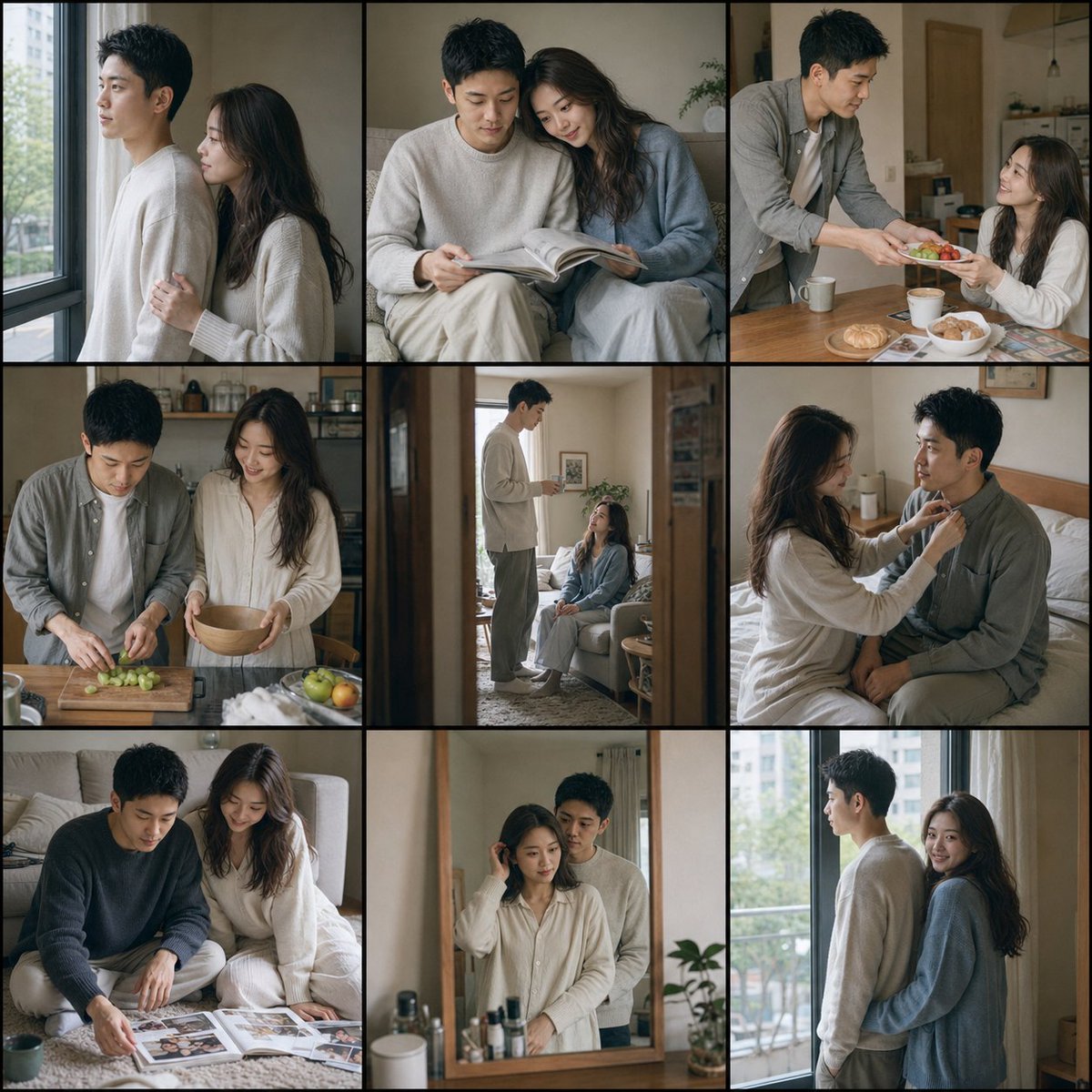
Social Media Post - Fujifilm Style Home Couple Portraits
Based on the real photos of two adult couples uploaded by the user, generate a "{argument name="photo style" default="Fujifilm-style Japanese home couple portrait"} 3x3 grid album collage".

Strictly preserve the real identity characteristics of the two people. Both the girl and the boy must clearly look like the original people in the uploaded photos, including face shape, facial proportions, eye/brow structure, nose, lips, jawline, skin tone, age, hairline, hairstyle features, and overall temperament. Do not turn them into Western faces, Korean studio styles, influencers, or over-beautified strangers. All 9 final small photos must feature the same real Chinese couple, captured from different angles, distances, and moments during the same home session.

## Visual Format
Generate a 3x3 collage with 9 small photos, overall 1:1 ratio. Use narrow {argument name="border color" default="black"} separator lines between photos, all placed on a {argument name="background color" default="black"} background, like a curated home photo album. Not a commercial poster or studio layout; avoid repetitive templates.

## Core Visual Style
Overall style: Japanese lifestyle photography, Fujifilm camera texture, real home couple portrait, candid shots, gentle, relaxed, quiet, and storytelling.
Focus on the colors and atmosphere of Fujifilm stocks like Superia, Pro 400H, or C200. The images should have low saturation without looking gray, soft natural highlights, transparent but restrained skin tones, slight film grain, slight shadow noise, and soft contrast. It should look like an air-filled, layered Fujifilm lifestyle photo.
Avoid: old iPhone texture, mobile compression, digital sharpness, heavy retro filters, commercial ads, or e-commerce styles.

## Character Relationship
The two are a {argument name="relationship" default="real, intimate, and natural young Chinese couple"}. Each frame should clearly show they are a couple with a sense of familiarity and companionship. Interactions should be realistic and relaxed: leaning in, making eye contact, looking down and laughing, leaning on a shoulder, reading together, passing things, preparing food, adjusting clothes, seeing each other in the mirror, or watching from a doorway. Intimate but restrained—no grease, no eroticism, and no staged wedding-style acting.

## Expressions and Angles
The 9 photos should not all look at the camera or just smile slightly. Expressions must be rich and varied: giggling, being teased, looking down laughing, quiet, daydreaming, gentle staring, relaxed chatting, focused on a task, responding with a look back, closing eyes laughing, looking out the window, or looking at each other.
Facial angles must vary significantly. Do not repeat the same template. Use a mix of: front, semi-front, profile, looking down, looking back, looking up slightly, near-back, mirror angles, distant observation, and close-up life details. Each frame should have a new head direction and visual rhythm.

## Clothing Requirements
Do not use the original clothes from the uploaded photos. Change them into natural Japanese lifestyle outfits: low saturation, neutral colors, soft materials. Colors like creamy white, oatmeal, light gray, pale coffee, misty blue, or charcoal. Items include knit cardigans, soft T-shirts, linen shirts, loungewear, long skirts, or socks. Should look like comfortable clothes a real couple wears at home.

## Home Setting
A clean, tidy apartment with real life traces (not a model home). Include elements like curtains, wood floors, sofas, pillows, blankets, books, albums, cups, plates, plants, bed lamps, mirrors, or tables—all as subtle aids to focus on the couple.

## Content of the 9 Frames
1. Quiet by the window: Boy looks out; girl leans in naturally. Quiet atmosphere.
2. Reading on the sofa: Reading a book together; one leans on the other's shoulder.
3. Passing a plate: At the dining table, passing fruit; active movement and eye contact.
4. Kitchen prep: Preparing food; one cuts fruit while the other watches and laughs.
5. Doorway view: Observer's perspective through a door frame into the living room.
6. Bedroom touch: Sitting on the bed; girl adjusts the boy's collar gently.
7. Floor photos: Sitting on the carpet looking at magazines together; candid sitting poses.
8. Mirror fragment: Captured through a dressing mirror; adjusting hair or a brief look in the mirror.
9. Balcony pause: Standing by the sliding door; one looks out while the other approaches with a smile.

## Consistency and Stability
Keep facial consistency across all 9 frames. Avoid complex hand gestures (no face-touching or finger-crossing). The quality should include slight film grain and scanning texture to feel like a real set, not a perfect AI grid. Avoid digital artifacts, extra limbs, or strange text.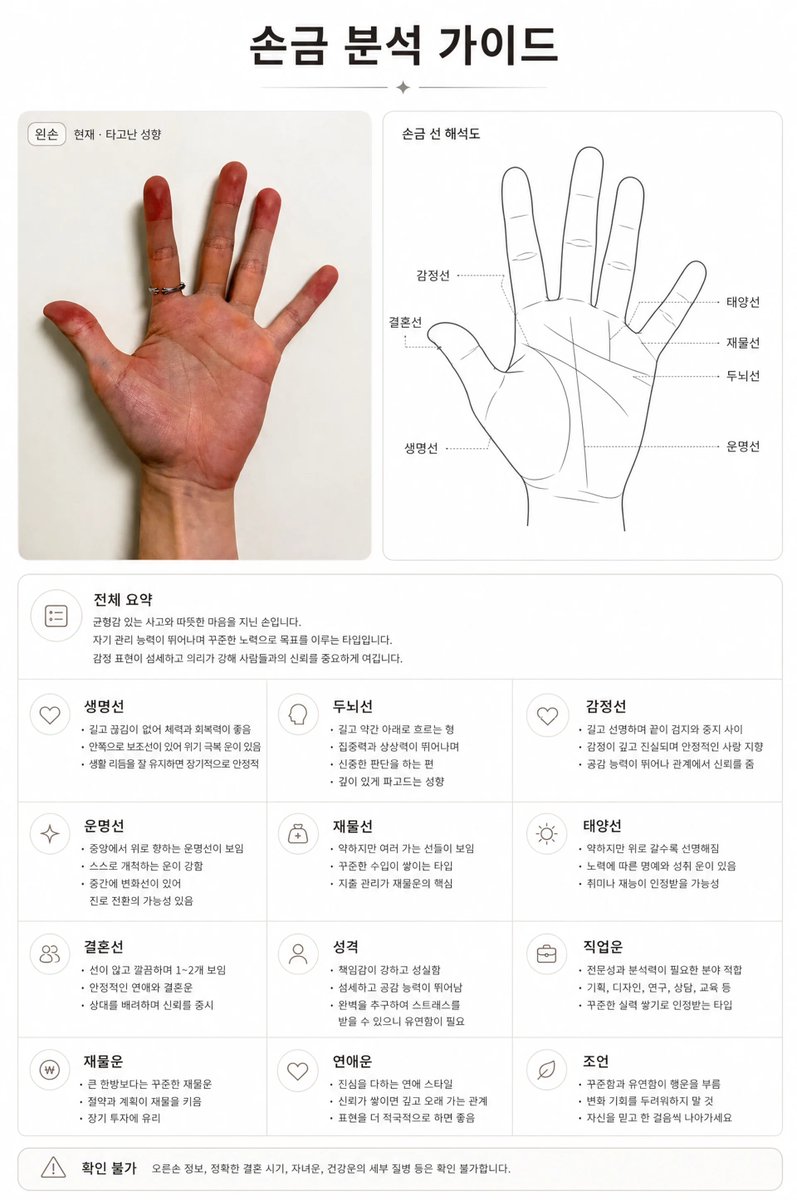
Infographic / Edu Visual - Premium Korean Palm Reading Guide
Create a premium Korean palm reading guide image based on the uploaded palm photo.

All visible text in the final image must be Korean only. Use clean Korean sans-serif typography. The title must be exactly “손금 분석 가이드”.

Create a refined two-panel layout:
Left panel: place the uploaded real palm photo inside a clean rounded card. Preserve the original hand shape, palm lines, skin texture, and natural details. Do not distort or redraw the hand.
Right panel: create a separate black-and-white palm contour interpretation diagram based on the same hand. Highlight the main palm lines with thin precise lines and label them in Korean.

Include Korean labels and sections:
“손금 분석 가이드”, “전체 요약”, “생명선”, “두뇌선”, “감정선”, “운명선”, “재물선”, “태양선”, “결혼선”, “성격”, “직업운”, “재물운”, “연애운”, “조언”, “확인 불가”.

Analyze palm shape, finger proportions, life line, head line, heart line, fate line, wealth line, sun line, marriage line, line depth, length, direction, breaks, branches, and overlaps. If something is unclear, write “확인 불가”. Keep the Korean interpretation short, realistic, calm, and advisory.

Design style:
1:1 square format, white background, black and warm dark gray text, thin hairline dividers, rounded cards, subtle shadows, large margins, generous negative space, precise grid, minimal line pictograms, luxury editorial report, high-end wellness analysis, elegant and expensive-looking.

No English text, no roman letters, no broken Korean, no random glyphs, no colorful decoration, no cartoon style, no occult symbols, no tarot imagery, no horror mood, no messy background, no watermark.
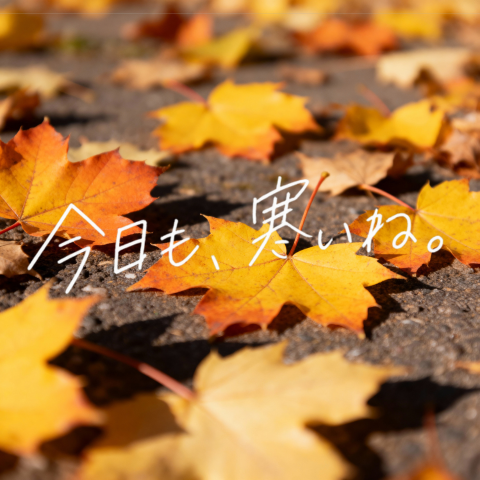
Social Media Post - Autumn Leaves with Handwritten Japanese Text
A warm, shallow-depth-of-field autumn photograph of multiple fallen maple leaves scattered across dark asphalt pavement in bright golden sunlight. The leaves are mostly yellow, orange, and amber, with one prominent vivid orange leaf in the left foreground and several yellow leaves stretching diagonally into the distance. The camera is low to the ground, close-up, with crisp focus on the central foreground leaves and soft bokeh blur in the background and extreme foreground. Across the middle of the image, overlay large delicate handwritten Japanese text in white, thin brush-pen style, slightly irregular and emotional, reading {argument name="overlay text" default="今日も、寒いね。"}. Natural outdoor lighting, cozy seasonal mood, realistic textures, high contrast between sunlit leaves and rough pavement, square composition, poetic social-media aesthetic.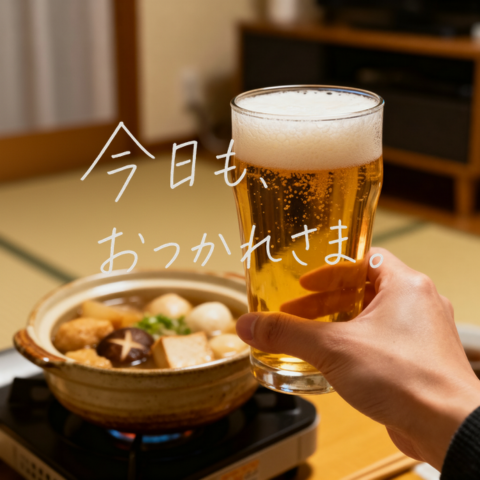
Social Media Post - Cozy Beer Toast with Oden
A warm, cozy Japanese home evening scene photographed in a natural lifestyle style. In the foreground, a right hand holds up a tall clear pint glass of golden beer with a thick creamy white foam head, positioned slightly right of center as if making a solo toast. In the softly blurred background, a small clay pot of oden simmers on a portable tabletop gas stove, with clearly visible ingredients including 1 shiitake mushroom, 2 round white items, several tofu pieces, and other assorted simmered items in broth. The setting is a tatami room with warm ambient indoor lighting, shallow depth of field, and a relaxed intimate atmosphere. Overlay large white handwritten Japanese text across the image reading {argument name="message text" default="今日も\nおつかれさま。"}, in an emotional hand-drawn marker style with uneven strokes, casual spacing, and a personal note-like feel. Emphasize comforting colors, soft bokeh, realistic skin tones, and the contrast between the crisp beer glass and the gently out-of-focus hot pot behind it.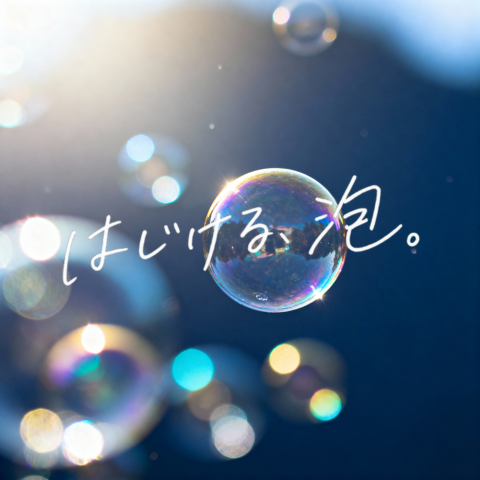
Social Media Post - Dreamy Bubble with Handwritten Japanese Text
A dreamy minimalist square image of a single iridescent soap bubble floating in the center against a deep blue soft-focus background, with bright natural sunlight pouring from the upper left and creating delicate lens flare, circular bokeh, and glowing highlights. The main bubble is sharply rendered with rainbow reflections and a tiny star-like sparkle on its lower right edge, while 6 additional out-of-focus bubbles appear around the frame: 1 large partial bubble at the lower left corner, 1 small bubble near the upper center, 1 faint bubble at the left middle, and 3 soft glowing bubbles clustered along the lower middle to lower right area. Across the center, overlay large handwritten Japanese brush-style text in white that reads {argument name="headline text" default="はじける泡。"}, with an emotional hand-drawn ink feel, slightly uneven strokes, and natural organic spacing. The overall mood is poetic, airy, luminous, and nostalgic, with shallow depth of field, premium photography aesthetics, clean composition, and strong contrast between the crisp central bubble and the blurred dreamy background.Related prompt guides and libraries
FAQ about Social Media Ad
How do I use Social Media Ad prompts from gptimages.dev?
Start with the examples that match your visual job, then copy the prompt structure rather than copying every adjective. Replace the subject, scene, channel, aspect ratio, and constraints with your own details. If the first result is close, keep the successful parts fixed and change one variable at a time. This makes the page useful as a prompt library, not just a keyword page.
What is the best prompt format for Social Media Ad?
A dependable format is brief first, details second, checks last: describe the image goal, then the subject, scene, composition, style, reference rules, and output constraints. For models such as GPT-IMAGE-2, Nano Banana 2, Stable Diffusion, Midjourney, or Jimeng AI, keep the core prompt portable and add tool-specific settings only when the interface supports them.
Can I reuse these prompts across different AI image models?
Yes, but reuse the structure more than the exact syntax. A prompt that works in one generator may need different wording, reference strength, aspect ratio settings, or negative prompts in another. The safest workflow is to preserve the creative brief, then adapt only the model-specific layer after you inspect the first output.
How should I collect the best AI image prompts?
Save prompts with the final image, model or tool name, aspect ratio, reference images, and a short note explaining why the result worked. Group them by use case such as product photography, character consistency, UI mockups, posters, logos, or text-in-image prompts. That collection becomes much more useful than a flat list of attractive phrases.
Why do Social Media Ad prompts fail?
Common causes include unclear subject hierarchy, too many styles in one prompt, vague quality words, unsupported text requirements, missing reference rules, and uncontrolled iteration. Fix the prompt by naming the production goal, protecting the details that cannot change, and testing one adjustment per generation instead of rewriting the whole prompt every time.
Are these prompt examples enough for commercial work?
They are a starting point, not legal or brand clearance. For commercial work, check the terms of the model or generator, review rights for reference images, verify text and logos manually, and keep a record of the prompt, source assets, and final edits. The page helps with prompt quality, while usage rights still depend on your workflow and provider terms.