
Infographic Prompts
Infographic Prompts connects find infographic AI image prompts to a curated English SEO page with model notes, prompt patterns, FAQ coverage, real examples, and related internal links.
Editorially reviewed by GPT Images for prompt usefulness, internal links, FAQ coverage, and source-aware model context.
What this use-case library covers
Infographic Prompts is designed for people trying to make a specific type of image for a product, brand, story, interface, or campaign. It targets the intent to find infographic AI image prompts, but the page avoids thin keyword stuffing by connecting the topic to prompt structure, real prompt examples, internal links, and FAQ answers.
The practical goal is simple: help someone understand what to write next. The page explains how Infographic prompts should define subject, constraints, references, style, and output checks before a model or generator is blamed for a weak result.
- Use this use-case library when the search intent is "find infographic AI image prompts" and the visitor needs examples before writing from scratch.
- Choose it when Infographic work requires visible constraints such as subject, angle, lighting, composition, text, aspect ratio, or editing target.
- Use the real prompt examples below to see how other prompts structure the same problem, then adapt one variable at a time.
- Keep it as an internal link target for related prompt collections so users can move from broad discovery into specific prompt pages.
Recommended Infographic workflow
turn a visual job into reusable prompt recipes and examples. A good workflow should be repeatable, inspectable, and easy to adapt across tools. The same prompt can behave differently in GPT-IMAGE-2, Nano Banana 2, Stable Diffusion, Midjourney, Jimeng AI, or a local ComfyUI setup, so this page keeps the reusable structure separate from tool-specific adjustments.
- Start by defining the job: what the image must communicate, where it will be used, and what failure would make the result unusable.
- Translate the job into a prompt skeleton for Infographic: subject, scene, medium, camera or composition, style constraints, and output constraints.
- Pick one example prompt from this page and copy only the structure that matches the job; avoid copying decorative phrases that do not serve the image.
- Run a first generation, then change one variable at a time: framing, lighting, color palette, reference strength, text content, or background density.
- Save the winning prompt with notes about model, tool, aspect ratio, and any reference images so the pattern can be reused later.
- define output constraints, choose references, specify scene details, and review production quality
Quality checks before publishing
Before using a generated image in production, review the output against the original job. The best prompt is not the longest prompt; it is the prompt that makes the model spend attention on the details that matter.
- Infographic should have a clear subject and a visible hierarchy; if the prompt gives equal weight to every detail, the image often becomes noisy.
- The prompt should separate content from style, especially when moving between GPT-IMAGE-2, Nano Banana 2, Stable Diffusion, Midjourney, or other image models.
- If the output needs readable text, keep the phrase short, quote it exactly, and verify the final image rather than assuming the model handled typography perfectly.
- If the output must match a brand, character, room, product, or reference image, name the fixed traits and describe what is allowed to change.
- Avoid stacking too many model-specific shortcuts on a reusable prompt page; keep the main prompt portable, then add model notes as a final layer.
- Review whether the page sends visitors to deeper prompt examples, related use cases, and FAQ answers instead of trapping them in a generic SEO article.
Common mistakes to avoid
Most failed image generations are not caused by a missing magic word. They usually come from unclear hierarchy, mixed intent, unsupported text requirements, or a prompt that asks for too many changes at once.
- Writing a Infographic prompt as a pile of keywords without a production goal.
- Changing model, tool, aspect ratio, and reference image at the same time, which makes it impossible to learn what improved the output.
- Using vague quality words such as beautiful or professional without defining the visible evidence of quality.
- Ignoring downstream use, such as ecommerce crop safety, ad text legibility, app store screenshots, or poster readability.
- Treating Infographic Prompts as a final answer instead of a starting point connected to prompt examples and iteration notes.
Infographic prompt patterns
Production brief prompt
Create a Infographic image for [audience] that communicates [message]. Main subject: [subject]. Scene: [setting]. Composition: [camera angle, crop, spacing]. Style: [medium, lighting, color direction]. Constraints: [aspect ratio, readable text, brand colors, negative space]. Avoid: [visual mistakes, clutter, wrong mood].
It separates the job, subject, scene, style, and constraints, which makes the prompt easier to test across different image models.
Reference-aware prompt
Using the reference as the fixed source of truth, generate a Infographic variation. Preserve [identity traits, product shape, logo placement, character features, room layout]. Change only [background, lighting, camera angle, outfit, color palette]. Keep the output consistent with [use case] and do not invent extra objects.
It tells the model what is fixed and what can change, which is critical for image editing, character consistency, product shots, and brand work.
Iteration prompt
Revise the previous Infographic result by improving [one problem]. Keep [successful elements] unchanged. Adjust [single variable] to [specific direction]. The final image should feel [desired mood] and remain suitable for [placement or channel]. Do not change [protected details].
It controls iteration by changing one variable at a time, so you can learn which instruction improved or damaged the output.
Model transfer prompt
Rewrite this Infographic prompt for [target model or tool]. Keep the core subject, composition, and constraints. Convert unsupported syntax into natural language. Add model-specific notes only at the end: [aspect ratio, style strength, reference strength, negative prompt, seed, or typography instruction].
It preserves the creative brief while allowing each model or tool to receive the instructions in a format it can use.
Prompt examples for Infographic
These examples are selected from the current English prompt catalog so the page links visitors into real prompt detail pages instead of stopping at generic advice.
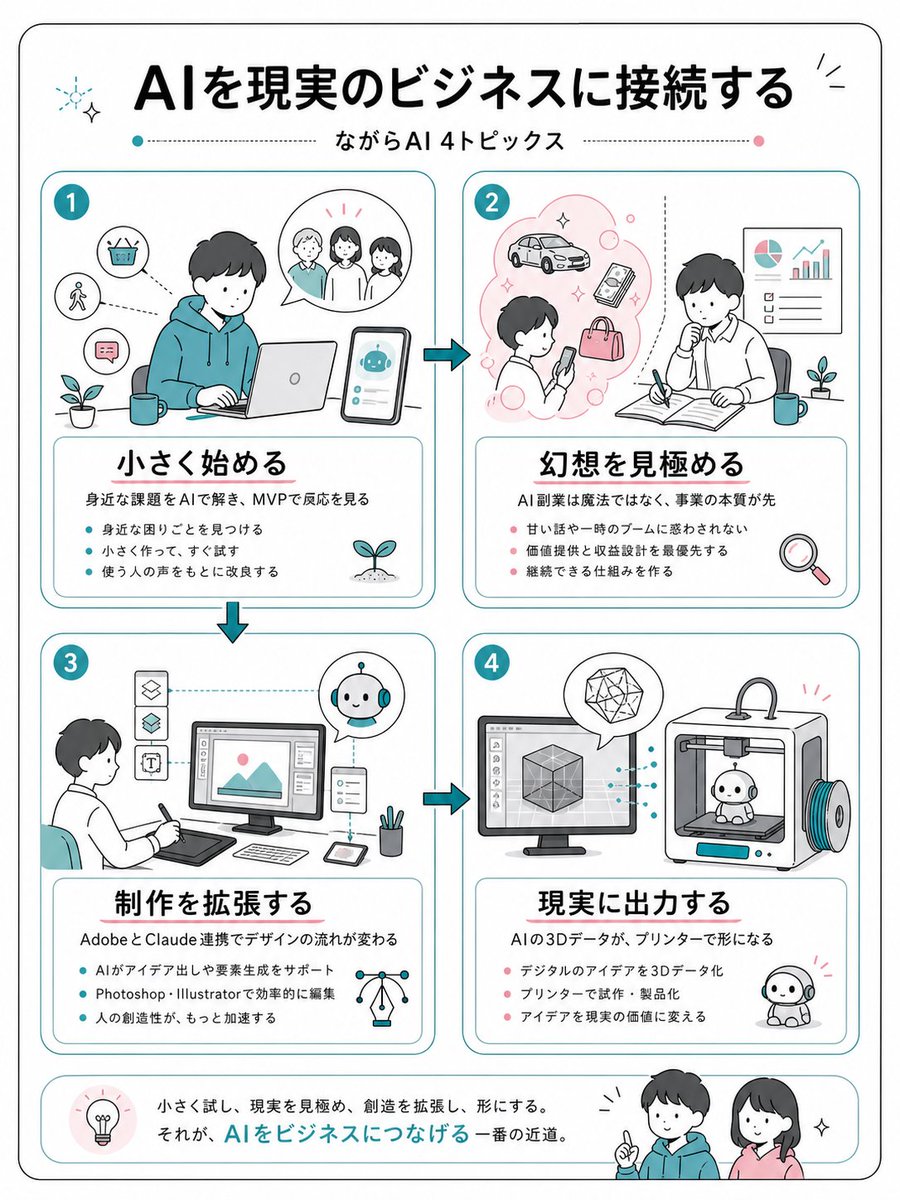
Infographic / Edu Visual - Japanese AI Business Infographic
{"type":"clean Japanese business infographic poster","format":"vertical A4-like page with rounded black outer border on white background","style":"friendly flat line illustration, minimal teal and coral accent colors, soft rounded rectangles, hand-drawn business sketch feel, black Japanese gothic headline typography, thin teal dividers, small sparkle and plant icons","language":"Japanese","headline":"{argument name=\"headline text\" default=\"AIを現実のビジネスに接続する\"}","subtitle":"{argument name=\"subtitle text\" default=\"ながらAI 4トピックス\"}","layout":{"top":"large centered headline with small decorative sparkles, subtitle below between dotted horizontal lines with teal and pink dots","main_grid":"four equal rounded cards arranged in a 2 by 2 grid, connected by teal arrow icons showing flow from 1 to 2, down to 3, across to 4","bottom_banner":"rounded summary strip with a lightbulb icon at left, Japanese closing sentence in the center, and two friendly characters at right"},"sections":[{"number":"1","position":"top left","title":"{argument name=\"section 1 title\" default=\"小さく始める\"}","main_illustration":"young person in teal hoodie working on a laptop at a desk, smartphone beside them showing a cute AI robot chat interface, speech bubble with three people, small icons for basket, walking person, chat message, plant and mug","description":"身近な課題をAIで解き、MVPで反応を見る","bullet_count":3,"bullets":["身近な困りごとを見つける","小さく作って、すぐ試す","使う人の声をもとに改良する"]},{"number":"2","position":"top right","title":"{argument name=\"section 2 title\" default=\"幻想を見極める\"}","main_illustration":"person looking at a smartphone inside a pink idea cloud with car, phone, bag and bubbles; second person thinking while writing in an open notebook, wall chart with pie chart and rising bar graph, plant, mug, magnifying glass icon","description":"AI副業は魔法ではなく、事業の本質が先","bullet_count":3,"bullets":["甘い話や一時のブームに惑わされない","価値提供と収益設計を最優先する","継続できる仕組みを作る"]},{"number":"3","position":"bottom left","title":"{argument name=\"section 3 title\" default=\"制作を拡張する\"}","main_illustration":"designer seated with pen tablet facing a desktop monitor showing an image editing interface, vertical tool icons at left, small AI robot assistant in circular bubble, tablet, stylus, pen cup, network lightbulb icon","description":"AdobeとClaude連携でデザインの流れが変わる","bullet_count":3,"bullets":["AIがアイデア出しや要素生成をサポート","Photoshop・Illustratorで効率的に編集","人の創造性が、もっと加速する"]},{"number":"4","position":"bottom right","title":"{argument name=\"section 4 title\" default=\"現実に出力する\"}","main_illustration":"desktop monitor with 3D cube modeling software connected by dotted teal lines to a 3D printer printing a small cute robot figure, geometric crystal in speech bubble, finished robot mascot on the floor","description":"AIの3Dデータが、プリンターで形になる","bullet_count":3,"bullets":["デジタルのアイデアを3Dデータ化","プリンターで試作・製品化","アイデアを現実の価値に変える"]}],"bottom_summary":{"icon":"lightbulb in a pale pink circle","text":"小さく試し、現実を見極め、創造を拡張し、形にする。\nそれが、AIをビジネスにつなげる一番の近道。","characters":"two smiling young people, one in teal hoodie pointing upward and one woman in pink top, with small sparkle marks"},"visual_requirements":"Use exactly 4 numbered topic cards, exactly 3 bullet points in each card, Japanese text must be crisp and readable, maintain generous margins, rounded corners, teal card borders, coral bullet dots in sections 2 and 4, teal bullet dots in sections 1 and 3, no photorealism."}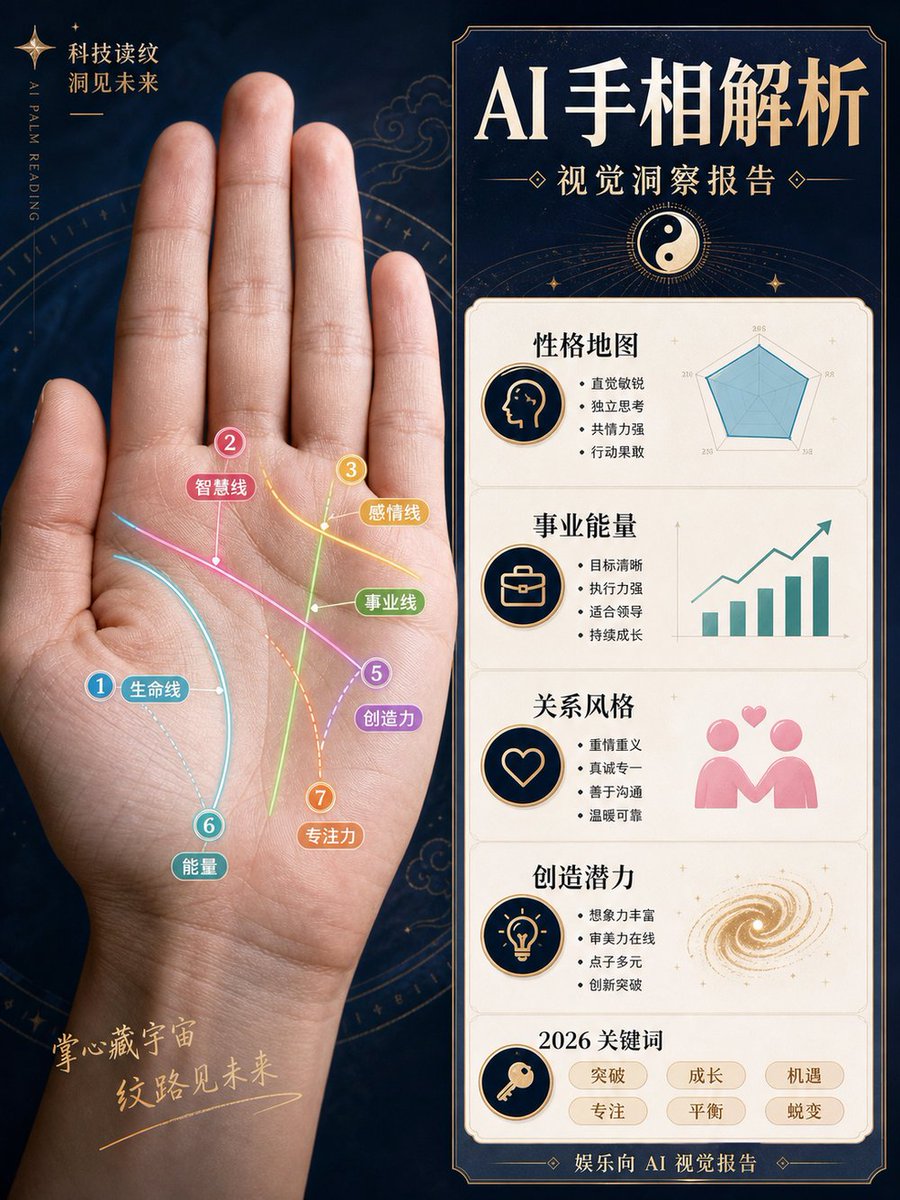
Infographic / Edu Visual - AI Palm Reading Report Poster
{"type":"Chinese magazine-style AI palm reading visual analysis report poster","format":"vertical 3:4 infographic poster","overall_style":"luxury mystic technology aesthetic, dark navy starry background, antique gold borders, clean editorial layout, high-end Chinese magazine typography, realistic photo mixed with flat infographic graphics, not fortune-telling but a visual observation report","main_subject":{"position":"left half","description":"a large realistic open human palm facing forward, wrist visible at bottom, fingers extended upward, softly lit skin texture, centered within a faint golden astrological compass circle","hand_photo":"{argument name="hand photo description" default="realistic left palm photo, open hand, fingers upright, natural skin tone"}"},"left_palm_overlay":{"count":7,"description":"seven colorful annotated palm lines drawn directly on the palm with glowing curved strokes, numbered circular markers, small rounded Chinese labels, thin connector dots","lines":[{"number":1,"label":"生命线","color":"cyan blue","position":"curving around the thumb mound"},{"number":2,"label":"智慧线","color":"pink","position":"diagonal line across the upper palm"},{"number":3,"label":"感情线","color":"yellow","position":"upper right palm near finger bases"},{"number":4,"label":"事业线","color":"green","position":"vertical line rising through the center palm"},{"number":5,"label":"创造力","color":"purple","position":"diagonal line toward lower right palm"},{"number":6,"label":"能量","color":"teal","position":"lower left palm near wrist"},{"number":7,"label":"专注力","color":"orange","position":"dotted vertical curve near lower center palm"}]},"left_background_text":{"top_left":"科技读纹\n洞见未来","vertical_english":"AI PALM READING","bottom_left":"掌心藏宇宙\n纹路见未来"},"right_panel":{"position":"right half","description":"tall bordered report card with dark navy header and cream content panels, gold trim and art deco corners","headline":"{argument name="headline text" default="AI 手相解析"}","subtitle":"{argument name="subtitle text" default="视觉洞察报告"}","header_icon":"yin-yang symbol in a golden circle with radiating lines","sections_count":5,"sections":[{"title":"性格地图","icon":"profile head silhouette in a navy-and-gold circle","text_bullets_count":4,"text_bullets":["直觉敏锐","独立思考","共情力强","行动果敢"],"visual":"teal radar chart with five axes"},{"title":"事业能量","icon":"briefcase in a navy-and-gold circle","text_bullets_count":4,"text_bullets":["目标清晰","执行力强","适合领导","持续成长"],"visual":"teal rising bar chart with upward arrow"},{"title":"关系风格","icon":"heart outline in a navy-and-gold circle","text_bullets_count":4,"text_bullets":["重情重义","真诚专一","善于沟通","温暖可靠"],"visual":"pink two-person relationship icon with floating hearts"},{"title":"创造潜力","icon":"light bulb in a navy-and-gold circle","text_bullets_count":4,"text_bullets":["想象力丰富","审美力在线","点子多元","创新突破"],"visual":"golden spiral galaxy swirl"},{"title":"2026 关键词","icon":"key in a navy-and-gold circle","keywords_count":6,"keywords":["突破","成长","机遇","专注","平衡","蜕变"]}],"footer":"娱乐向 AI 视觉报告"},"color_palette":"deep navy, cream white, antique gold, cyan, pink, yellow, green, purple, orange, teal","typography":"large bold elegant Chinese serif headline, smaller Chinese sans-serif bullet text, decorative gold separators","customization_notes":"Keep all Chinese text sharp and legible, preserve the exact section layout and counts, emphasize the combination of realistic palm photography and polished infographic analysis."}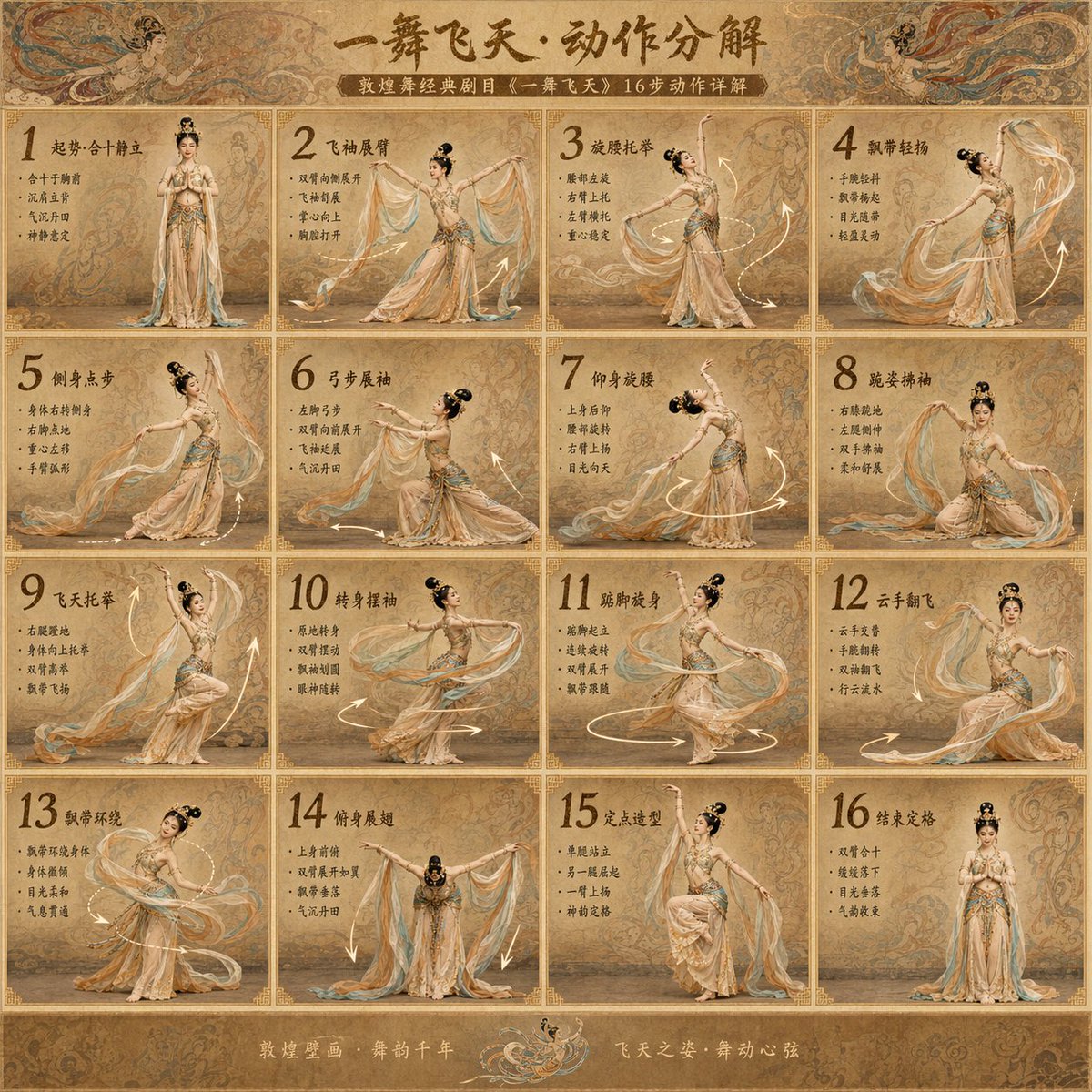
Infographic / Edu Visual - Dunhuang Dance Sequence Poster
Classical Beauty Dunhuang Dance "Flying to Heaven" Action Breakdown Poster
Generate a high-quality 16-grid action breakdown poster for "{argument name="theme" default="Dunhuang Dance 'Flying to Heaven'"}." Core requirements:
- Layout: 4x4 square grid with 16 cells, each corresponding to a continuous dance step numbered 1-16, following the original choreography logic of the Dunhuang dance.
- Aesthetic: Not a generic instructional chart, but a cinematic storyboard poster with a Dunhuang mural atmosphere, elegant classical style, and visual impact.
- Character: Features a {argument name="character_image" default="classical and elegant beauty"} (gentle features, slender build, graceful aura), remaining consistent across all cells without character swaps.
- Style: Dunhuang dance style, capturing the spirit of "Flying Apsaras" with flowing ribbons, graceful postures, and the original choreography's core movements like lifts, waist twists, and sleeve throws.
- Costume: {argument name="costume_style" default="Classical Dunhuang Flying Apsaras attire"} in nude and camel tones with gold and stone-blue patterns (clouds, floral scrolls), using lightweight airy fabrics (gauze/chiffon) with traditional headpieces and ribbons.
- Background: Mural-style background in earthy yellows and ochres, incorporating textures, auspicious clouds, and silhouettes with soft warm lighting to highlight the dancer.
- Content per cell: Large step number, Chinese action title (dance terminology), concise Chinese key points, and trajectory arrows for ribbon and body movement.
- Overall effect: Refined, consistent, and sophisticated, combining a tutorial feel with classical poster art and historical mural aesthetics.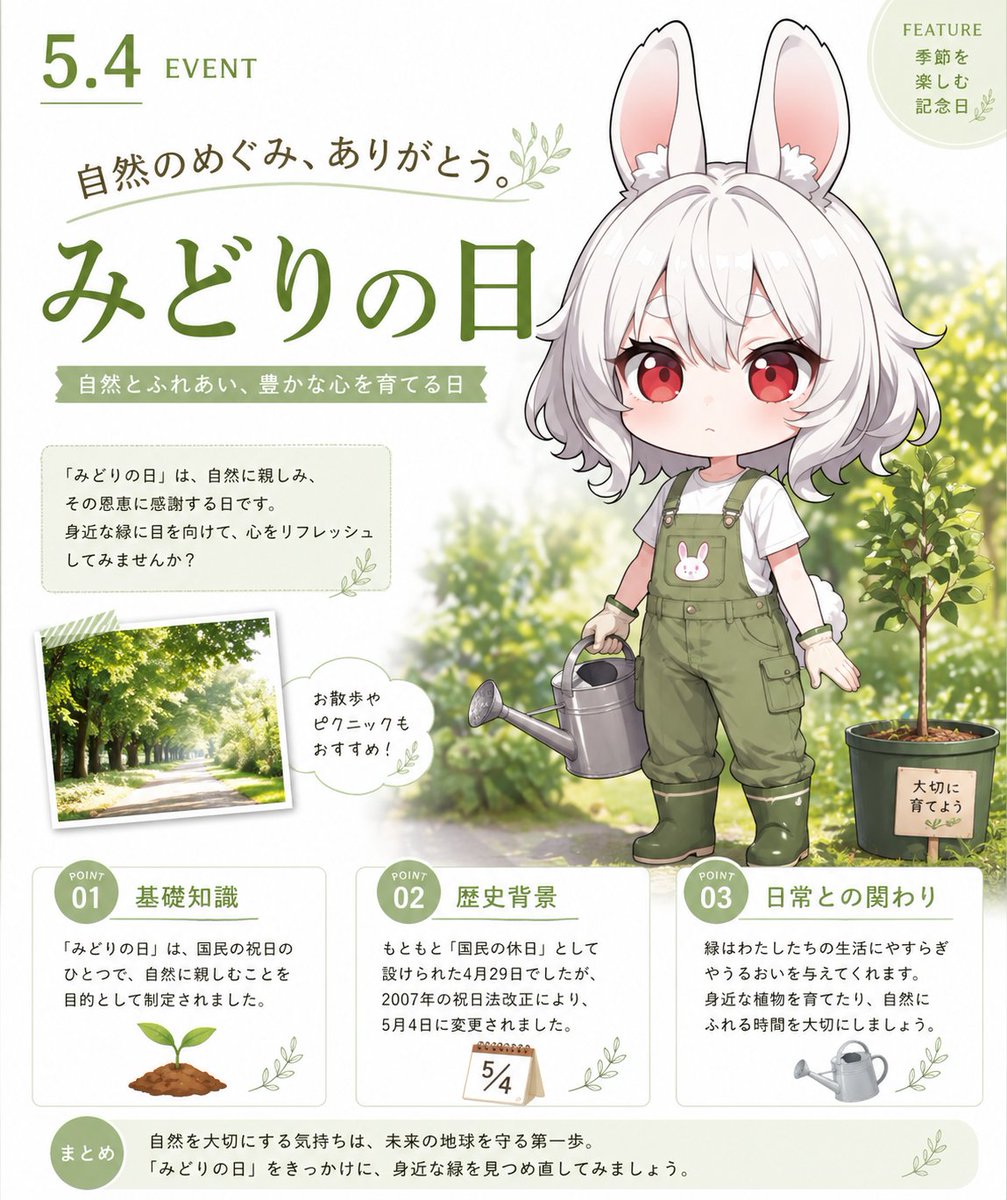
Infographic / Edu Visual - Greenery Day Chibi Infographic
{"type":"cute Japanese holiday infographic poster","theme":"Greenery Day / nature appreciation","format":"single vertical poster, clean magazine-style layout","canvas":{"aspect_ratio":"4:5","background":"warm off-white with soft green watercolor foliage and sunlight bokeh, airy margins, botanical leaf accents"},"headline":{"top_left_date":"{argument name=\"event date\" default=\"5.4\"}","small_label":"EVENT","main_title":"{argument name=\"main title\" default=\"みどりの日\"}","subtitle":"自然のめぐみ、ありがとう。","ribbon_text":"自然とふれあい、豊かな心を育てる日"},"main_character":{"position":"right half, standing full body","style":"adorable chibi anime mascot, soft cel shading, glossy eyes, polished GPT-image-2 illustration quality","description":"small white rabbit-eared girl with fluffy short white hair, long upright bunny ears with pink inner ears, red eyes, tiny serious expression, white T-shirt, olive green gardening overalls with a bunny patch on the chest, green rubber boots, wrist bands, small round tail visible, holding a silver watering can in one hand","customizable_outfit_color":"{argument name=\"outfit color\" default=\"olive green\"}"},"scene_props":{"count":2,"items":["silver watering can held by the character","potted young green tree at lower right with a small wooden sign reading 大切に育てよう"]},"layout":{"sections":[{"title":"feature badge","position":"top right circular badge","count":1,"labels":["FEATURE 季節を楽しむ記念日"]},{"title":"intro text box","position":"left middle under headline","count":1,"labels":["『みどりの日』は、自然に親しみ、その恩恵に感謝する日です。身近な緑に目を向けて、心をリフレッシュしてみませんか?"]},{"title":"photo card","position":"lower left-middle, tilted polaroid style","count":1,"labels":["sunlit tree-lined park path photograph"]},{"title":"speech bubble","position":"beside photo card","count":1,"labels":["お散歩やピクニックもおすすめ!"]},{"title":"information cards","position":"bottom row","count":3,"labels":["POINT 01 基礎知識","POINT 02 歴史背景","POINT 03 日常との関わり"]},{"title":"summary bar","position":"very bottom","count":1,"labels":["まとめ 自然を大切にする気持ちは、未来の地球を守る第一歩。『みどりの日』をきっかけに、身近な緑を見つめ直してみましょう。"]}]},"information_cards":[{"number":"01","heading":"基礎知識","body":"『みどりの日』は、国民の祝日のひとつで、自然に親しむことを目的として制定されました。","icon":"small green sprout growing from soil"},{"number":"02","heading":"歴史背景","body":"もともと『国民の休日』として設けられた4月29日でしたが、2007年の祝日法改正により、5月4日に変更されました。","icon":"small calendar page marked 5/4"},{"number":"03","heading":"日常との関わり","body":"緑はわたしたちの生活にやすらぎやうるおいを与えてくれます。身近な植物を育てたり、自然にふれる時間を大切にしましょう。","icon":"small gray watering can"}],"typography":{"style":"Japanese editorial design, rounded Mincho/Gothic mix","colors":"moss green, sage green, dark olive, soft beige","emphasis":"large brush-like green Japanese title, thin decorative rules, rounded white cards with pale green borders"},"mood":"gentle, educational, seasonal, wholesome, celebratory","rendering_notes":"high resolution, crisp readable Japanese text, balanced composition with character overlapping the soft garden background, no clutter, no extra sections beyond the counted elements","customizable_holiday":"{argument name=\"holiday name\" default=\"みどりの日\"}","customizable_summary":"{argument name=\"summary message\" default=\"自然を大切にする気持ちは、未来の地球を守る第一歩。『みどりの日』をきっかけに、身近な緑を見つめ直してみましょう。\"}"}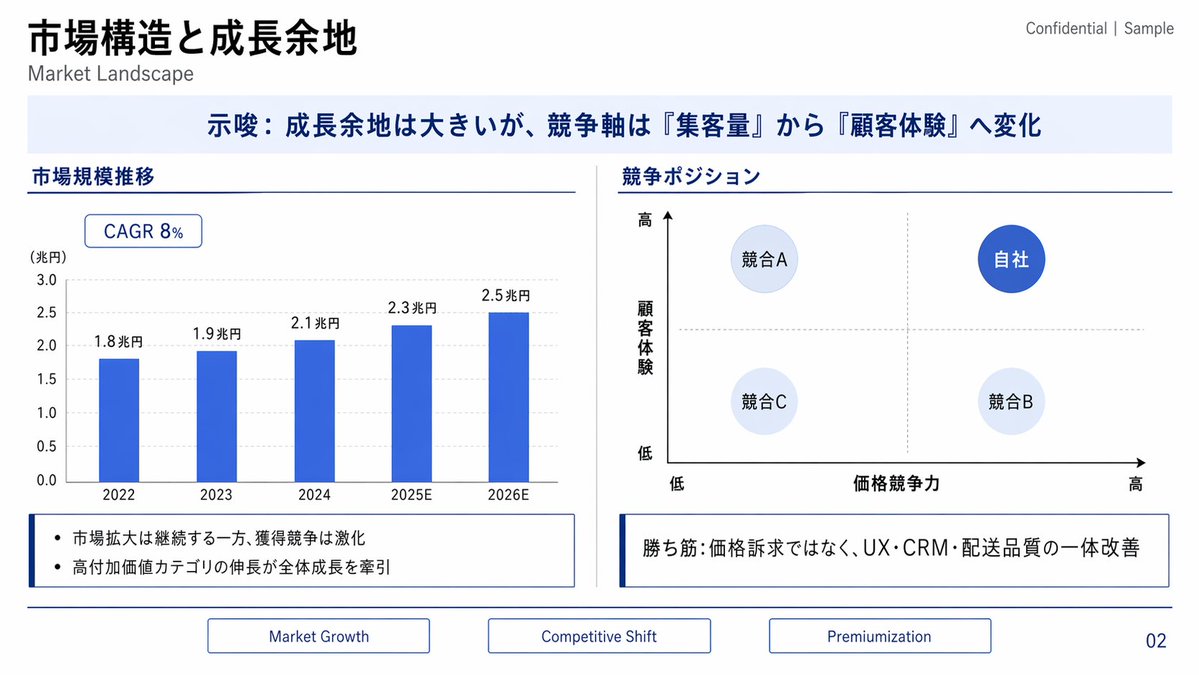
Infographic / Edu Visual - Japanese Market Landscape Slide
{"type":"corporate consulting presentation slide","language":"Japanese with small English subtitles","format":"16:9 widescreen slide, clean white background, navy and royal blue business style","title":"{argument name=\"main title\" default=\"市場構造と成長余地\"}","subtitle":"Market Landscape","top_right_label":"Confidential | Sample","page_number":"02","theme":{"primary_color":"deep navy","accent_color":"royal blue","secondary_color":"pale blue","lines":"thin navy divider lines","typography":"modern sans-serif, bold Japanese headings, restrained consulting-deck style"},"layout":{"top":{"position":"upper left","content":"large bold Japanese title with smaller English subtitle underneath; confidentiality label at upper right"},"key_message_banner":{"position":"full width below title","background":"very pale blue rectangle","text":"{argument name=\"key message\" default=\"示唆:成長余地は大きいが、競争軸は『集客量』から『顧客体験』へ変化\"}","style":"centered bold navy Japanese text"},"main_content":{"columns":2,"divider":"thin vertical gray line between columns","left_section":{"title":"市場規模推移","type":"bar chart","position":"left half","chart_details":{"badge":"CAGR 8%","y_axis_label":"(兆円)","y_axis_range":"0.0 to 3.0","gridlines":"light gray dotted horizontal gridlines","bar_count":5,"bars":[{"year":"2022","value_label":"1.8兆円"},{"year":"2023","value_label":"1.9兆円"},{"year":"2024","value_label":"2.1兆円"},{"year":"2025E","value_label":"2.3兆円"},{"year":"2026E","value_label":"2.5兆円"}],"bar_style":"solid royal blue vertical bars"},"note_box":{"count":2,"bullets":["市場拡大は継続する一方、獲得競争は激化","高付加価値カテゴリの伸長が全体成長を牽引"],"style":"outlined white box with navy left accent line"}},"right_section":{"title":"競争ポジション","type":"2x2 positioning matrix","position":"right half","matrix_details":{"x_axis":"価格競争力","x_axis_left":"低","x_axis_right":"高","y_axis":"顧客体験","y_axis_bottom":"低","y_axis_top":"高","axis_arrows":"black arrows pointing right and upward","crosshair":"light gray dotted vertical and horizontal midpoint lines","bubble_count":4,"bubbles":[{"label":"競合A","position":"upper left","style":"pale blue circle"},{"label":"自社","position":"upper right","style":"dark royal blue circle with white text"},{"label":"競合C","position":"lower left","style":"very pale blue circle"},{"label":"競合B","position":"lower right","style":"very pale blue circle"}]},"note_box":{"text":"{argument name=\"right insight text\" default=\"勝ち筋:価格訴求ではなく、UX・CRM・配送品質の一体改善\"}","style":"outlined white box with navy left accent line"}}},"bottom_navigation":{"position":"bottom center","tab_count":3,"tabs":["Market Growth","Competitive Shift","Premiumization"],"style":"three thin outlined rectangular tabs in navy, evenly spaced"}},"composition":"precise slide grid, generous margins, horizontal navy rules separating header/content/footer, polished strategy-consulting PowerPoint aesthetic, no photos or illustrations, sharp vector graphics"}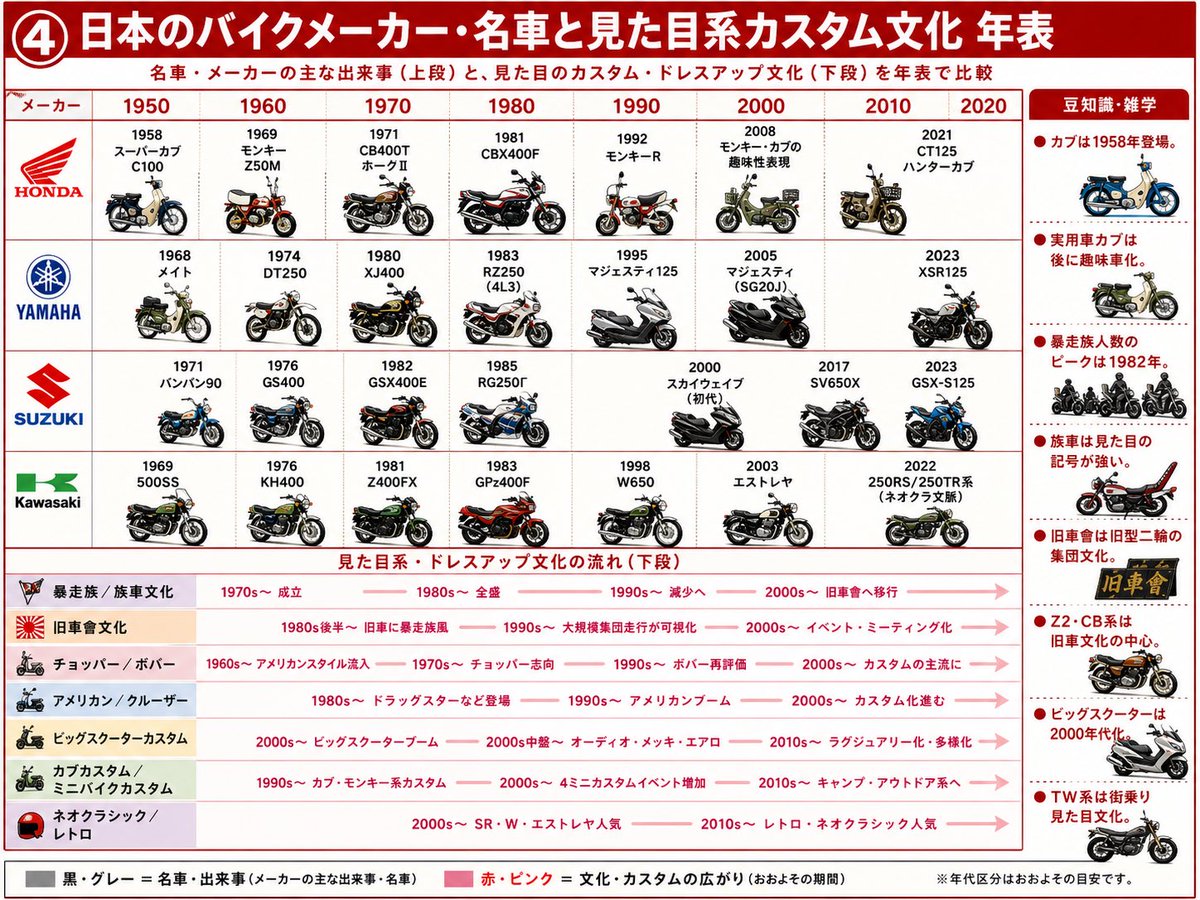
Infographic / Edu Visual - Japanese Motorcycle Culture Timeline
{"type":"Japanese infographic timeline poster","language":"Japanese","canvas":"landscape 4:3 educational chart with a clean white background, red grid lines, bold red title bar, small motorcycle illustrations, and dense Japanese annotations","headline":"{argument name=\"headline text\" default=\"④ 日本のバイクメーカー・名車と見た目系カスタム文化 年表\"}","subtitle":"名車・メーカーの主な出来事(上段)と、見た目のカスタム・ドレスアップ文化(下段)を年表で比較","layout":{"top_timeline":{"position":"upper two thirds","description":"matrix comparing 4 Japanese motorcycle manufacturers across 8 decade columns, with each cell showing a year, model name, and small detailed side-view motorcycle illustration","columns_count":8,"columns":["1950","1960","1970","1980","1990","2000","2010","2020"],"rows_count":4,"rows":[{"maker":"HONDA","logo_style":"red wing logo and HONDA text","entries_count":8,"entries":["1958 スーパーカブ C100","1969 モンキー Z50M","1971 CB400T ホークⅡ","1981 CBX400F","1992 モンキーR","2008 モンキー・カブの趣味性表現","2010 custom-style small bike illustration","2021 CT125 ハンターカブ"]},{"maker":"YAMAHA","logo_style":"blue tuning-fork circle logo and YAMAHA text","entries_count":7,"entries":["1968 メイト","1974 DT250","1980 XJ400","1983 RZ250 (4L3)","1995 マジェスティ125","2005 マジェスティ (SG20J)","2023 XSR125"]},{"maker":"SUZUKI","logo_style":"red S logo and SUZUKI text","entries_count":8,"entries":["1971 バンバン90","1976 GS400","1982 GSX400E","1985 RG250Γ","2000 スカイウェイブ(初代)","2017 SV650X","2023 GSX-S125","one empty/spacing decade cell to preserve grid alignment"]},{"maker":"Kawasaki","logo_style":"green Kawasaki mark and text","entries_count":8,"entries":["1969 500SS","1976 KH400","1981 Z400FX","1983 GPz400F","1998 W650","2003 エストレヤ","2022 250RS/250TR系(ネオクラ系譜)","one empty/spacing decade cell to preserve grid alignment"]}]},"bottom_culture_timeline":{"position":"lower third","section_title":"見た目系・ドレスアップ文化の流れ(下段)","description":"7 horizontal culture rows with pale colored category labels on the left and pink arrows showing approximate periods of popularity","rows_count":7,"rows":[{"label":"暴走族/族車文化","icon":"small aggressive motorcycle emblem","timeline":"1970s〜成立 → 1980s〜全盛 → 1990s〜減少へ → 2000s〜旧車會へ移行"},{"label":"旧車會文化","icon":"rising-sun style icon","timeline":"1980s後半〜旧車に暴走族風 → 1990s〜大規模集団走行が可視化 → 2000s〜イベント・ミーティング化"},{"label":"チョッパー/ボバー","icon":"chopper motorcycle silhouette","timeline":"1960s〜アメリカンスタイル流入 → 1970s〜チョッパー志向 → 1990s〜ボバー再評価 → 2000s〜カスタムの主流に"},{"label":"アメリカン/クルーザー","icon":"cruiser motorcycle silhouette","timeline":"1980s〜ドラッグスターなど登場 → 1990s〜アメリカンブーム → 2000s〜カスタム化進む"},{"label":"ビッグスクーターカスタム","icon":"large scooter silhouette","timeline":"2000s〜ビッグスクーターブーム → 2000s中盤〜オーディオ・メッキ・エアロ → 2010s〜ラグジュアリー化・多様化"},{"label":"カブカスタム/ミニバイクカスタム","icon":"green small bike silhouette","timeline":"1990s〜カブ・モンキー系カスタム → 2000s〜4ミニカスタムイベント増加 → 2010s〜キャンプ・アウトドア系へ"},{"label":"ネオクラシック/レトロ","icon":"red helmet icon","timeline":"2000s〜SR・W・エストレヤ人気 → 2010s〜レトロ・ネオクラシック人気"}]},"right_sidebar":{"position":"right edge","title":"豆知識・雑学","style":"vertical column with red bullet dots, dotted separators, and 8 small motorcycle or emblem illustrations","facts_count":8,"facts":["カブは1958年登場。","実用車カブは後に趣味車化。","暴走族人数のピークは1982年。","族車は見た目の記号が強い。","旧車會は旧型二輪の集団文化。","Z2・CB系は旧車文化の中心。","ビッグスクーターは2000年代に。","TW系は街乗り見た目文化。"]},"footer":{"legend_count":2,"legend":["黒・グレー=名車・出来事(メーカーの主な出来事・名車)","赤・ピンク=文化・カスタムの広がり(おおよその期間)"],"note":"※年代区分はおおよその目安です。"}},"visual_style":{"typography":"bold Japanese sans-serif, red headings, compact black labels, clear chart hierarchy","colors":"dominant red and white, pale pink arrows, light beige/pink/green/lavender category strips, maker logos in brand colors","illustration_style":"small crisp semi-realistic side-view motorcycle drawings with shadows, varied colors and eras, infographic clarity rather than photorealism","rendering":"high-resolution print-ready poster, sharp legible text, neat grid alignment, educational magazine style"}}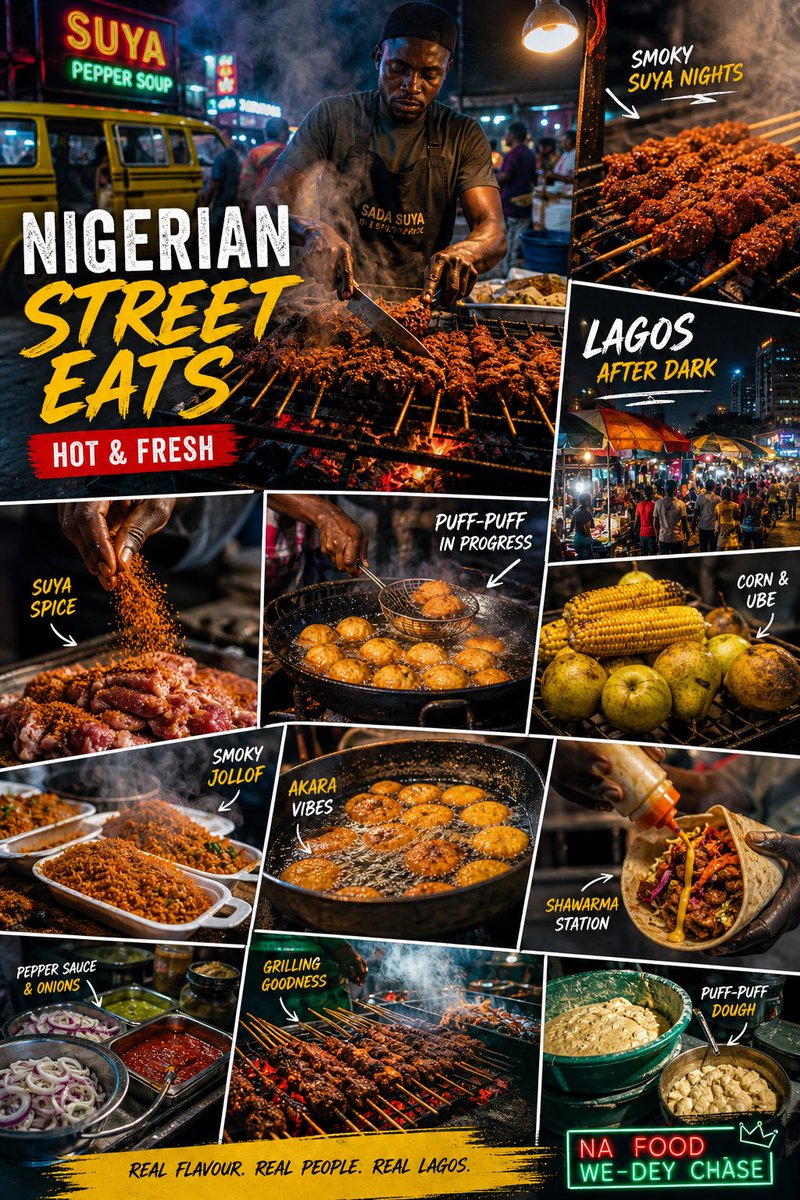
Infographic / Edu Visual - Nigerian Street Eats Collage
{"type":"vibrant Nigerian street food collage poster","format":"vertical editorial travel-food montage","style":"high-contrast cinematic night photography mixed with hand-painted street poster typography, smoky atmosphere, saturated neon colors, gritty documentary realism, white comic-panel borders, yellow brush lettering, handwritten annotation arrows","main_title":{"text":"{argument name=\"main title\" default=\"NIGERIAN STREET EATS\"}","position":"left-center over main grill scene","typography":"large distressed white block letters for first word, oversized yellow brush-script words below"},"subtitle":{"text":"{argument name=\"subtitle text\" default=\"HOT & FRESH\"}","position":"under main title on red paint-stroke banner","typography":"condensed white uppercase letters"},"scene":{"location":"busy Lagos night market street with food stalls, crowds, headlights, neon signs, smoke, open flames, and warm work lamps","mood":"energetic, smoky, late-night, authentic street-food adventure","lighting":"dramatic orange firelight and grill glow contrasted with blue-green neon and dark urban background"},"central_panel":{"position":"top-left and center, largest panel","description":"street vendor grilling many skewers of spicy suya over open charcoal flames; vendor wears dark cap, grey shirt, black apron, and black gloves; face obscured by shadow; smoke curls around the meat; yellow bus and neon food stall sign in background","visible_signs":["SUYA","PEPPER SOUP"],"apron_text":"SADA SUYA"},"panels":{"total_count":13,"items":[{"label":"main suya grill hero panel","position":"upper-left to center","content":"vendor tending rows of suya skewers over glowing charcoal, with the large poster title overlay"},{"label":"SMOKY SUYA NIGHTS","position":"top-right","content":"close-up of heavily seasoned suya skewers on a grill, smoke rising, handwritten white and yellow label with arrow"},{"label":"LAGOS AFTER DARK","position":"right-middle","content":"wide night street-market scene with umbrellas, food stalls, traffic lights, crowds, and city buildings"},{"label":"SUYA SPICE","position":"middle-left","content":"hands sprinkling orange-red spice over raw marinated meat, white arrow pointing to seasoning"},{"label":"PUFF-PUFF IN PROGRESS","position":"middle-center","content":"round golden puff-puff dough balls frying in bubbling oil, one lifted in a wire skimmer"},{"label":"CORN & UBE","position":"middle-right","content":"grilled yellow corn cobs beside round greenish-brown African pears, with arrow label"},{"label":"SMOKY JOLLOF","position":"lower-left","content":"foil trays filled with reddish jollof rice, steam and smoke drifting upward"},{"label":"AKARA VIBES","position":"lower-center","content":"golden bean cakes frying in a deep pan of hot oil, arrow label"},{"label":"SHAWARMA STATION","position":"lower-right","content":"gloved hands holding an open wrap stuffed with meat, cabbage, carrots, and sauces being drizzled from squeeze bottles"},{"label":"PEPPER SAUCE & ONIONS","position":"bottom-left","content":"metal trays of sliced red onions, bright red pepper sauce, and green sauce at a condiment station"},{"label":"GRILLING GOODNESS","position":"bottom-center","content":"many skewers grilling over flames and smoke, close-up of charred meat with orange fire glow"},{"label":"PUFF-PUFF DOUGH","position":"bottom-right","content":"large green bowl and smaller pot filled with pale dough pieces or batter, arrow pointing to dough"},{"label":"neon slogan sign","position":"bottom-right corner","content":"glowing red, green, and white neon sign with crown doodle reading NA FOOD WE-DEY CHASE"}]},"footer":{"text":"{argument name=\"footer slogan\" default=\"REAL FLAVOUR. REAL PEOPLE. REAL LAGOS.\"}","position":"bottom across yellow paint-stroke strip","typography":"black handwritten uppercase text"},"color_palette":"charcoal black, flame orange, spice red, neon green, electric cyan, warm yellow, smoky grey, white panel borders","composition":"dense magazine-cover collage with tilted rectangular panels separated by thick white borders; main hero image dominates, supporting food close-ups arranged around it; handwritten labels and arrows add street-guide energy","rendering_instructions":"make it look like a finished food-tour poster, not a flat infographic; include realistic steam, oil bubbles, smoke, glowing coals, busy market depth, gritty textures, and legible stylized English labels","negative_prompt":"no clean studio background, no empty panels, no minimalist layout, no washed-out colors, no generic Western fast food, no misspelled main title"}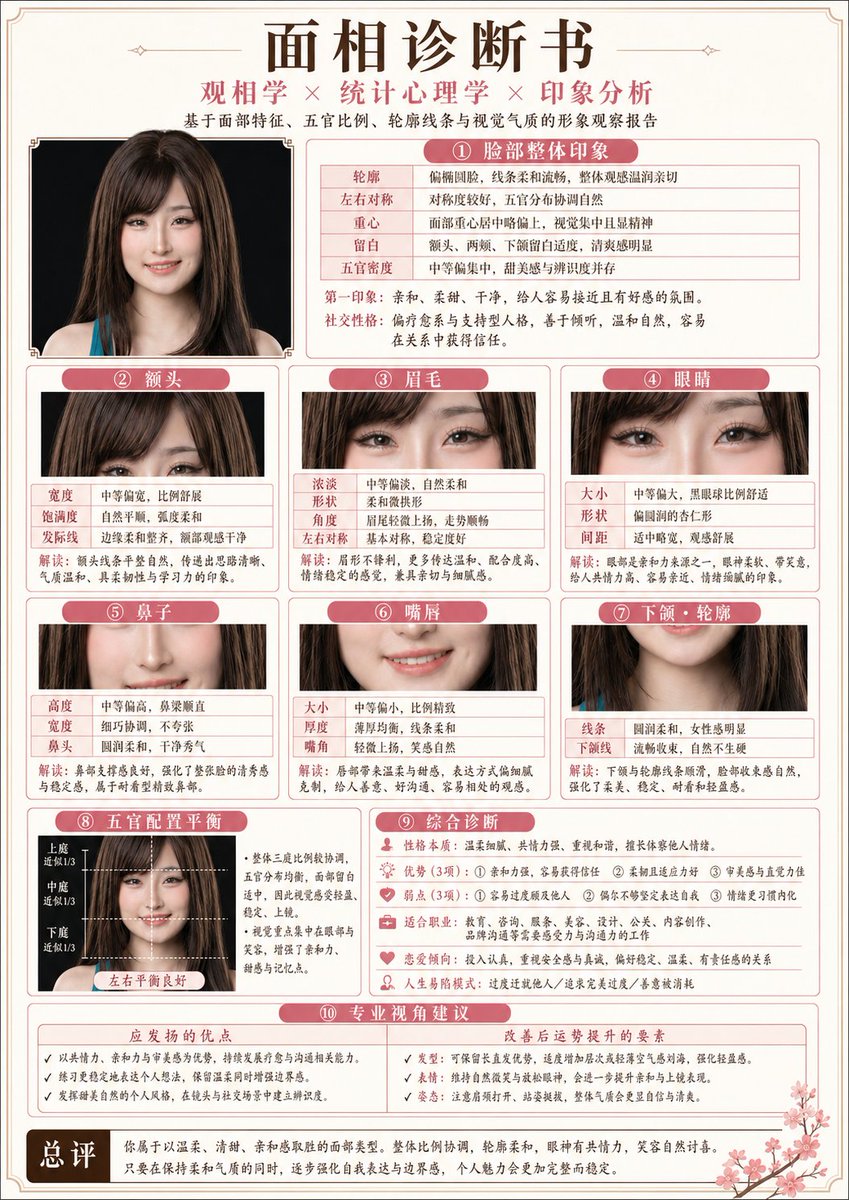
Infographic / Edu Visual - Japanese-Style Facial Analysis Diagnostic Poster
{
  "type": "Vertical Physiognomy Diagnosis Report Card Infographic",
  "style": "{argument name="report style" default="Japanese professional diagnosis document style"}, warm cream background, rose pink title bars, fine line borders, mix of Serif and Sans-serif fonts, medical report layout feel, soft warm tones, exquisite typography, no illustration decoration",
  "layout": {
    "Header Section": {
      "Main Title": "{argument name="diagnosis title" default="Physiognomy Diagnosis Certificate"}",
      "Main Title Font": "Large bold Serif, centered, dark brown",
      "Subtitle": "Physiognomy × Statistical Psychology × Impression Analysis",
      "Subtitle Font": "Small fine Sans-serif, centered, gray-brown"
    },
    "First Block": {
      "Layout": "Two columns",
      "Left Column": {
        "Content": "{argument name="portrait content" default="A realistic portrait photo of a young Asian woman with slightly wavy brown hair, delicate features, wearing a light-colored jacket, resting her hand on her cheek, natural expression, in-car background, warm natural light, film photograph quality"}",
        "Size": "Approx 1/3 width, spans two rows high"
      },
      "Right Column": {
        "Block Title": "① Overall Facial Impression",
        "Block Title Style": "Rose pink background, white text, rounded rectangle title bar",
        "Table Content": {
          "count": 5,
          "Row Data": [
            ["Outline", "Slightly oval, rounded, giving a gentle impression"],
            ["Symmetry", "Symmetrical, coordinated proportions"],
            ["Center of Gravity", "Centered, friendly and natural"],
            ["Negative Space", "Moderate space on forehead, cheeks, and jaw; strong sense of cleanliness"],
            ["Feature Density", "Features neatly arranged, blending cuteness and elegance"]
          ]
        },
        "First Impression Text": "First Impression: Friendly and natural, strong sense of cleanliness, an aura that makes people want to protect you.",
        "Social Character": "Social Character: Healing-type popular figure. Good at listening, gains trust in a supportive role."
      }
    },
    "Second Block (Three Columns)": {
      "Layout": "Three equal horizontal sections",
      "Column 1": {
        "Block Title": "② Forehead",
        "Small Portrait Insert": "Forehead area highlighted",
        "Table": [
          ["Width", "Slightly wide, rounded"],
          ["Roundness", "Natural arc, soft"],
          ["Tilt", "Slightly backward, steady impression"]
        ],
        "Interpretation": "Interpretation: Possesses intellectual sense and flexible thinking. Naturally lucky and favored by the environment."
      },
      "Column 2": {
        "Block Title": "③ Eyebrows",
        "Small Portrait Insert": "Eyebrow area highlighted",
        "Table": [
          ["Density", "Slightly light, natural"],
          ["Shape", "Soft arch"],
          ["Angle", "Slightly upturned"],
          ["Symmetry", "Basically symmetrical, stable"]
        ],
        "Interpretation": "Interpretation: Willpower is not overly rigid, possesses flexibility. High coordination, medium to high stress resistance."
      },
      "Column 3": {
        "Block Title": "④ Eyes",
        "Small Portrait Insert": "Eye area highlighted",
        "Table": [
          ["Size", "Slightly large, high iris ratio"],
          ["Shape", "Rounded almond shape"],
          ["Spanning", "Slightly wide, sense of leisure"]
        ],
        "Interpretation": "Interpretation: Strong perception, sharp intuition. High empathy, good at reading minds."
      }
    },
    "Third Block (Three Columns)": {
      "Layout": "Three equal horizontal sections",
      "Column 1": {
        "Block Title": "⑤ Nose",
        "Table": [
          ["Height", "Slightly high, upright"],
          ["Width", "Delicate, sense of nobility"],
          ["Tip", "Rounded, soft"]
        ],
        "Interpretation": "Interpretation: Possesses realistic judgment, financial fortune belongs to the steady accumulation type."
      },
      "Column 2": {
        "Block Title": "⑥ Lips",
        "Table": [
          ["Size", "Slightly small, exquisite"],
          ["Thickness", "Balanced thickness"],
          ["Corners", "Slightly upturned"]
        ],
        "Interpretation": "Interpretation: Affectionate, good at listening. Words have the power to heal others."
      },
      "Column 3": {
        "Block Title": "⑦ Jaw/Outline",
        "Table": [
          ["Line", "Rounded, feminine"],
          ["Jawline", "Smooth and soft"]
        ],
        "Interpretation": "Interpretation: Steady personality, stable aspirations. Good fortune in later life, supported by others."
      }
    },
    "Fourth Block (Two Columns)": {
      "Layout": "Two columns",
      "Left Column": {
        "Block Title": "⑧ Facial Proportions Balance",
        "Proportion Diagram": "A frontal female face diagram marking equal thirds for upper/middle/lower face, each labeled '1/3 each', with 'good left-right balance' noted at the bottom",
        "Description": "Close to golden ratio, stable flow of luck. Success depends on broad social relationships."
      },
      "Right Column": {
        "Block Title": "⑨ Comprehensive Diagnosis",
        "Personality Essence": "Personality Essence: Gentle and delicate, good at sensing others' emotions. Pacifist, values harmony.",
        "Strengths (3 Items)": {
          "Label": "Strengths (3 Items)",
          "items": ["Strong empathy, gains others' trust", "Flexible and adaptable", "High sense of beauty and intuition"]
        },
        "Weaknesses (3 Items)": {
          "Label": "Weaknesses (3 Items)",
          "items": ["Too considerate of others, leading to fatigue", "Tends to be overly modest", "Personal opinions tend to recede"]
        },
        "Suitable Careers": "Hospitality, Sales, Beauty, Medical, Education, Consulting, PR, Design, Planning, etc. Work involving people and utilizing sensitivity ◎",
        "Romantic Tendencies": "The type to dive in fully once in love. Values security, attracted to sincere partners. Not good with restrictiveness, values trust.",
        "Pattern to Avoid": "Over-accommodating others"
      }
    }
  }
}Related prompt guides and libraries
FAQ about Infographic
How do I use Infographic prompts from gptimages.dev?
Start with the examples that match your visual job, then copy the prompt structure rather than copying every adjective. Replace the subject, scene, channel, aspect ratio, and constraints with your own details. If the first result is close, keep the successful parts fixed and change one variable at a time. This makes the page useful as a prompt library, not just a keyword page.
What is the best prompt format for Infographic?
A dependable format is brief first, details second, checks last: describe the image goal, then the subject, scene, composition, style, reference rules, and output constraints. For models such as GPT-IMAGE-2, Nano Banana 2, Stable Diffusion, Midjourney, or Jimeng AI, keep the core prompt portable and add tool-specific settings only when the interface supports them.
Can I reuse these prompts across different AI image models?
Yes, but reuse the structure more than the exact syntax. A prompt that works in one generator may need different wording, reference strength, aspect ratio settings, or negative prompts in another. The safest workflow is to preserve the creative brief, then adapt only the model-specific layer after you inspect the first output.
How should I collect the best AI image prompts?
Save prompts with the final image, model or tool name, aspect ratio, reference images, and a short note explaining why the result worked. Group them by use case such as product photography, character consistency, UI mockups, posters, logos, or text-in-image prompts. That collection becomes much more useful than a flat list of attractive phrases.
Why do Infographic prompts fail?
Common causes include unclear subject hierarchy, too many styles in one prompt, vague quality words, unsupported text requirements, missing reference rules, and uncontrolled iteration. Fix the prompt by naming the production goal, protecting the details that cannot change, and testing one adjustment per generation instead of rewriting the whole prompt every time.
Are these prompt examples enough for commercial work?
They are a starting point, not legal or brand clearance. For commercial work, check the terms of the model or generator, review rights for reference images, verify text and logos manually, and keep a record of the prompt, source assets, and final edits. The page helps with prompt quality, while usage rights still depend on your workflow and provider terms.