
Text in Image Prompts
Text in Image Prompts connects render text inside AI images to a curated English SEO page with model notes, prompt patterns, FAQ coverage, real examples, and related internal links.
Editorially reviewed by GPT Images for prompt usefulness, internal links, FAQ coverage, and source-aware model context.
What this use-case library covers
Text in Image Prompts is designed for people trying to make a specific type of image for a product, brand, story, interface, or campaign. It targets the intent to render text inside AI images, but the page avoids thin keyword stuffing by connecting the topic to prompt structure, real prompt examples, internal links, and FAQ answers.
The practical goal is simple: help someone understand what to write next. The page explains how Text in Image prompts should define subject, constraints, references, style, and output checks before a model or generator is blamed for a weak result.
- Use this use-case library when the search intent is "render text inside AI images" and the visitor needs examples before writing from scratch.
- Choose it when Text in Image work requires visible constraints such as subject, angle, lighting, composition, text, aspect ratio, or editing target.
- Use the real prompt examples below to see how other prompts structure the same problem, then adapt one variable at a time.
- Keep it as an internal link target for related prompt collections so users can move from broad discovery into specific prompt pages.
Recommended Text in Image workflow
turn a visual job into reusable prompt recipes and examples. A good workflow should be repeatable, inspectable, and easy to adapt across tools. The same prompt can behave differently in GPT-IMAGE-2, Nano Banana 2, Stable Diffusion, Midjourney, Jimeng AI, or a local ComfyUI setup, so this page keeps the reusable structure separate from tool-specific adjustments.
- Start by defining the job: what the image must communicate, where it will be used, and what failure would make the result unusable.
- Translate the job into a prompt skeleton for Text in Image: subject, scene, medium, camera or composition, style constraints, and output constraints.
- Pick one example prompt from this page and copy only the structure that matches the job; avoid copying decorative phrases that do not serve the image.
- Run a first generation, then change one variable at a time: framing, lighting, color palette, reference strength, text content, or background density.
- Save the winning prompt with notes about model, tool, aspect ratio, and any reference images so the pattern can be reused later.
- define output constraints, choose references, specify scene details, and review production quality
Quality checks before publishing
Before using a generated image in production, review the output against the original job. The best prompt is not the longest prompt; it is the prompt that makes the model spend attention on the details that matter.
- Text in Image should have a clear subject and a visible hierarchy; if the prompt gives equal weight to every detail, the image often becomes noisy.
- The prompt should separate content from style, especially when moving between GPT-IMAGE-2, Nano Banana 2, Stable Diffusion, Midjourney, or other image models.
- If the output needs readable text, keep the phrase short, quote it exactly, and verify the final image rather than assuming the model handled typography perfectly.
- If the output must match a brand, character, room, product, or reference image, name the fixed traits and describe what is allowed to change.
- Avoid stacking too many model-specific shortcuts on a reusable prompt page; keep the main prompt portable, then add model notes as a final layer.
- Review whether the page sends visitors to deeper prompt examples, related use cases, and FAQ answers instead of trapping them in a generic SEO article.
Common mistakes to avoid
Most failed image generations are not caused by a missing magic word. They usually come from unclear hierarchy, mixed intent, unsupported text requirements, or a prompt that asks for too many changes at once.
- Writing a Text in Image prompt as a pile of keywords without a production goal.
- Changing model, tool, aspect ratio, and reference image at the same time, which makes it impossible to learn what improved the output.
- Using vague quality words such as beautiful or professional without defining the visible evidence of quality.
- Ignoring downstream use, such as ecommerce crop safety, ad text legibility, app store screenshots, or poster readability.
- Treating Text in Image Prompts as a final answer instead of a starting point connected to prompt examples and iteration notes.
Text in Image prompt patterns
Production brief prompt
Create a Text in Image image for [audience] that communicates [message]. Main subject: [subject]. Scene: [setting]. Composition: [camera angle, crop, spacing]. Style: [medium, lighting, color direction]. Constraints: [aspect ratio, readable text, brand colors, negative space]. Avoid: [visual mistakes, clutter, wrong mood].
It separates the job, subject, scene, style, and constraints, which makes the prompt easier to test across different image models.
Reference-aware prompt
Using the reference as the fixed source of truth, generate a Text in Image variation. Preserve [identity traits, product shape, logo placement, character features, room layout]. Change only [background, lighting, camera angle, outfit, color palette]. Keep the output consistent with [use case] and do not invent extra objects.
It tells the model what is fixed and what can change, which is critical for image editing, character consistency, product shots, and brand work.
Iteration prompt
Revise the previous Text in Image result by improving [one problem]. Keep [successful elements] unchanged. Adjust [single variable] to [specific direction]. The final image should feel [desired mood] and remain suitable for [placement or channel]. Do not change [protected details].
It controls iteration by changing one variable at a time, so you can learn which instruction improved or damaged the output.
Model transfer prompt
Rewrite this Text in Image prompt for [target model or tool]. Keep the core subject, composition, and constraints. Convert unsupported syntax into natural language. Add model-specific notes only at the end: [aspect ratio, style strength, reference strength, negative prompt, seed, or typography instruction].
It preserves the creative brief while allowing each model or tool to receive the instructions in a format it can use.
Prompt examples for Text in Image
These examples are selected from the current English prompt catalog so the page links visitors into real prompt detail pages instead of stopping at generic advice.
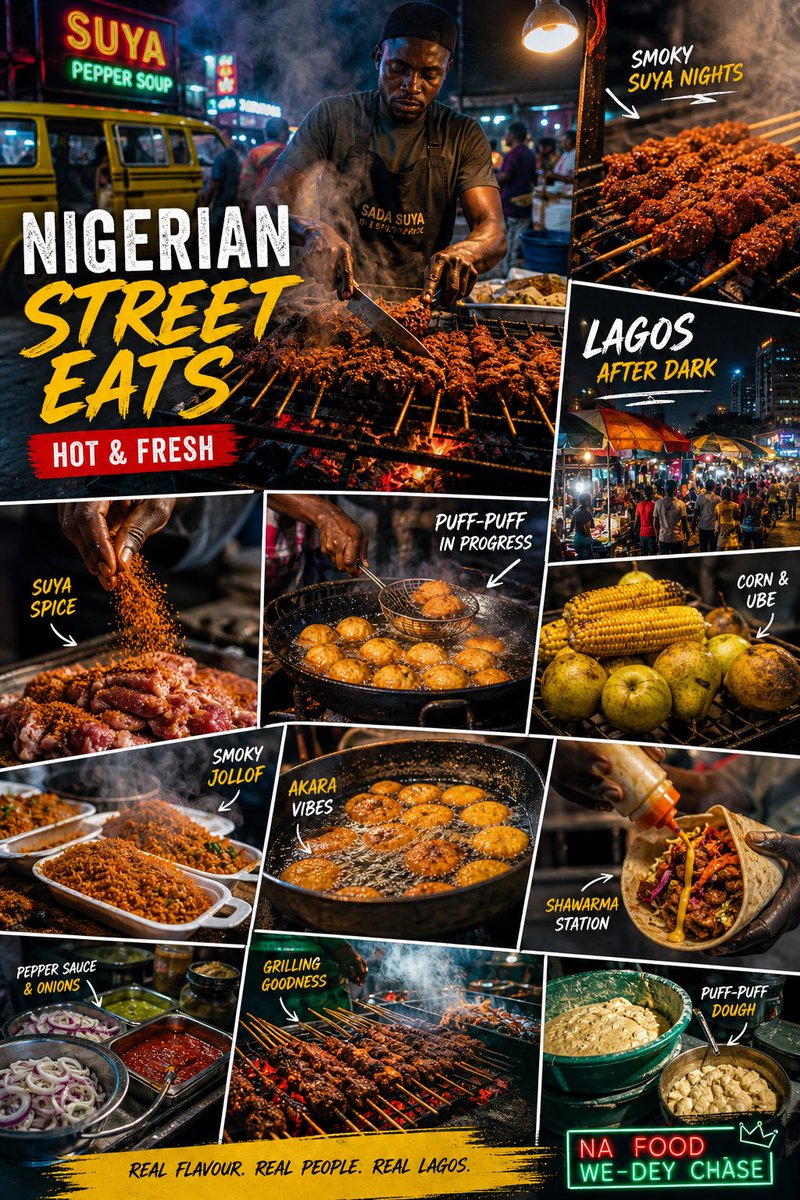
Infographic / Edu Visual - Nigerian Street Eats Collage
{"type":"vibrant Nigerian street food collage poster","format":"vertical editorial travel-food montage","style":"high-contrast cinematic night photography mixed with hand-painted street poster typography, smoky atmosphere, saturated neon colors, gritty documentary realism, white comic-panel borders, yellow brush lettering, handwritten annotation arrows","main_title":{"text":"{argument name=\"main title\" default=\"NIGERIAN STREET EATS\"}","position":"left-center over main grill scene","typography":"large distressed white block letters for first word, oversized yellow brush-script words below"},"subtitle":{"text":"{argument name=\"subtitle text\" default=\"HOT & FRESH\"}","position":"under main title on red paint-stroke banner","typography":"condensed white uppercase letters"},"scene":{"location":"busy Lagos night market street with food stalls, crowds, headlights, neon signs, smoke, open flames, and warm work lamps","mood":"energetic, smoky, late-night, authentic street-food adventure","lighting":"dramatic orange firelight and grill glow contrasted with blue-green neon and dark urban background"},"central_panel":{"position":"top-left and center, largest panel","description":"street vendor grilling many skewers of spicy suya over open charcoal flames; vendor wears dark cap, grey shirt, black apron, and black gloves; face obscured by shadow; smoke curls around the meat; yellow bus and neon food stall sign in background","visible_signs":["SUYA","PEPPER SOUP"],"apron_text":"SADA SUYA"},"panels":{"total_count":13,"items":[{"label":"main suya grill hero panel","position":"upper-left to center","content":"vendor tending rows of suya skewers over glowing charcoal, with the large poster title overlay"},{"label":"SMOKY SUYA NIGHTS","position":"top-right","content":"close-up of heavily seasoned suya skewers on a grill, smoke rising, handwritten white and yellow label with arrow"},{"label":"LAGOS AFTER DARK","position":"right-middle","content":"wide night street-market scene with umbrellas, food stalls, traffic lights, crowds, and city buildings"},{"label":"SUYA SPICE","position":"middle-left","content":"hands sprinkling orange-red spice over raw marinated meat, white arrow pointing to seasoning"},{"label":"PUFF-PUFF IN PROGRESS","position":"middle-center","content":"round golden puff-puff dough balls frying in bubbling oil, one lifted in a wire skimmer"},{"label":"CORN & UBE","position":"middle-right","content":"grilled yellow corn cobs beside round greenish-brown African pears, with arrow label"},{"label":"SMOKY JOLLOF","position":"lower-left","content":"foil trays filled with reddish jollof rice, steam and smoke drifting upward"},{"label":"AKARA VIBES","position":"lower-center","content":"golden bean cakes frying in a deep pan of hot oil, arrow label"},{"label":"SHAWARMA STATION","position":"lower-right","content":"gloved hands holding an open wrap stuffed with meat, cabbage, carrots, and sauces being drizzled from squeeze bottles"},{"label":"PEPPER SAUCE & ONIONS","position":"bottom-left","content":"metal trays of sliced red onions, bright red pepper sauce, and green sauce at a condiment station"},{"label":"GRILLING GOODNESS","position":"bottom-center","content":"many skewers grilling over flames and smoke, close-up of charred meat with orange fire glow"},{"label":"PUFF-PUFF DOUGH","position":"bottom-right","content":"large green bowl and smaller pot filled with pale dough pieces or batter, arrow pointing to dough"},{"label":"neon slogan sign","position":"bottom-right corner","content":"glowing red, green, and white neon sign with crown doodle reading NA FOOD WE-DEY CHASE"}]},"footer":{"text":"{argument name=\"footer slogan\" default=\"REAL FLAVOUR. REAL PEOPLE. REAL LAGOS.\"}","position":"bottom across yellow paint-stroke strip","typography":"black handwritten uppercase text"},"color_palette":"charcoal black, flame orange, spice red, neon green, electric cyan, warm yellow, smoky grey, white panel borders","composition":"dense magazine-cover collage with tilted rectangular panels separated by thick white borders; main hero image dominates, supporting food close-ups arranged around it; handwritten labels and arrows add street-guide energy","rendering_instructions":"make it look like a finished food-tour poster, not a flat infographic; include realistic steam, oil bubbles, smoke, glowing coals, busy market depth, gritty textures, and legible stylized English labels","negative_prompt":"no clean studio background, no empty panels, no minimalist layout, no washed-out colors, no generic Western fast food, no misspelled main title"}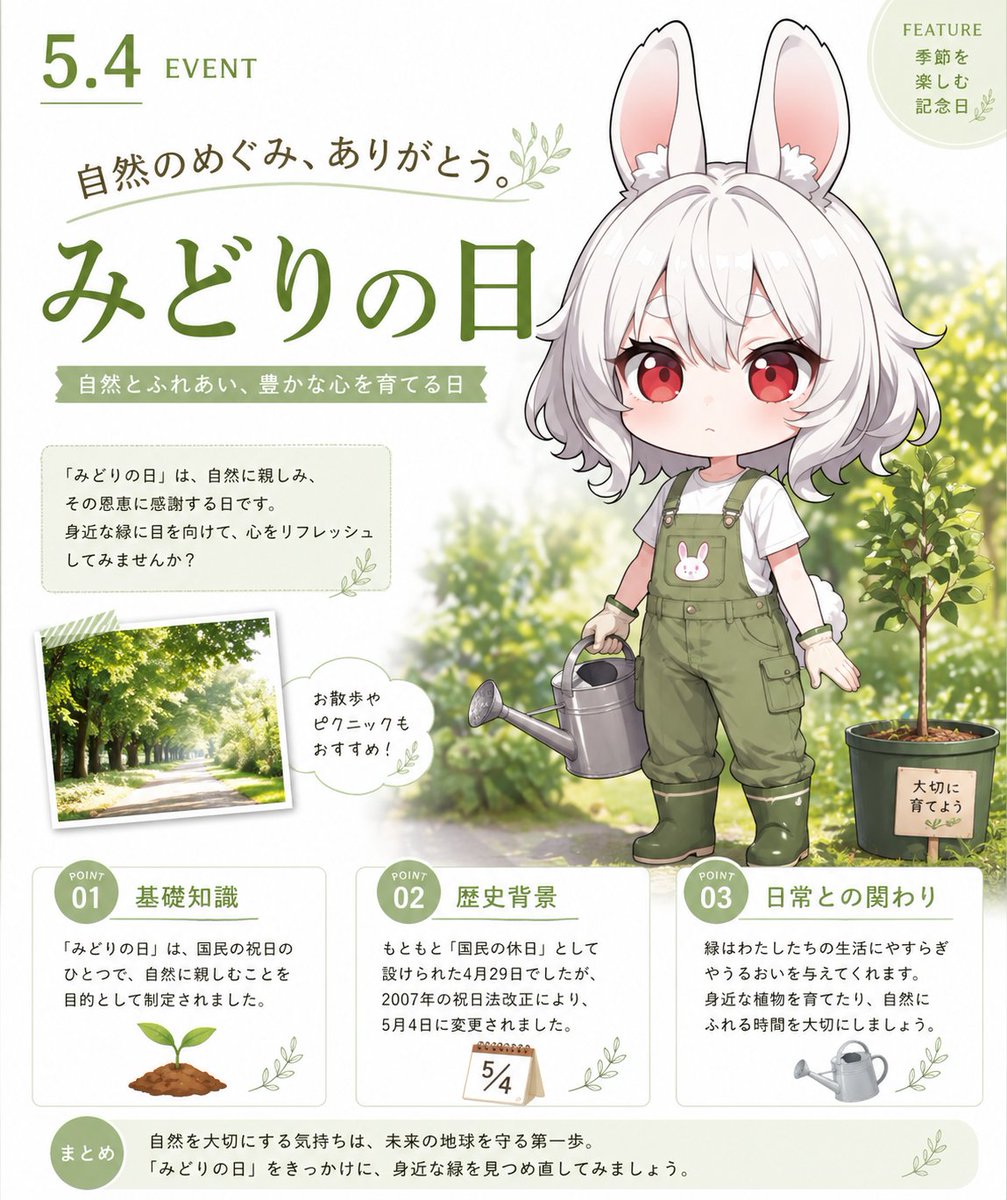
Infographic / Edu Visual - Greenery Day Chibi Infographic
{"type":"cute Japanese holiday infographic poster","theme":"Greenery Day / nature appreciation","format":"single vertical poster, clean magazine-style layout","canvas":{"aspect_ratio":"4:5","background":"warm off-white with soft green watercolor foliage and sunlight bokeh, airy margins, botanical leaf accents"},"headline":{"top_left_date":"{argument name=\"event date\" default=\"5.4\"}","small_label":"EVENT","main_title":"{argument name=\"main title\" default=\"みどりの日\"}","subtitle":"自然のめぐみ、ありがとう。","ribbon_text":"自然とふれあい、豊かな心を育てる日"},"main_character":{"position":"right half, standing full body","style":"adorable chibi anime mascot, soft cel shading, glossy eyes, polished GPT-image-2 illustration quality","description":"small white rabbit-eared girl with fluffy short white hair, long upright bunny ears with pink inner ears, red eyes, tiny serious expression, white T-shirt, olive green gardening overalls with a bunny patch on the chest, green rubber boots, wrist bands, small round tail visible, holding a silver watering can in one hand","customizable_outfit_color":"{argument name=\"outfit color\" default=\"olive green\"}"},"scene_props":{"count":2,"items":["silver watering can held by the character","potted young green tree at lower right with a small wooden sign reading 大切に育てよう"]},"layout":{"sections":[{"title":"feature badge","position":"top right circular badge","count":1,"labels":["FEATURE 季節を楽しむ記念日"]},{"title":"intro text box","position":"left middle under headline","count":1,"labels":["『みどりの日』は、自然に親しみ、その恩恵に感謝する日です。身近な緑に目を向けて、心をリフレッシュしてみませんか?"]},{"title":"photo card","position":"lower left-middle, tilted polaroid style","count":1,"labels":["sunlit tree-lined park path photograph"]},{"title":"speech bubble","position":"beside photo card","count":1,"labels":["お散歩やピクニックもおすすめ!"]},{"title":"information cards","position":"bottom row","count":3,"labels":["POINT 01 基礎知識","POINT 02 歴史背景","POINT 03 日常との関わり"]},{"title":"summary bar","position":"very bottom","count":1,"labels":["まとめ 自然を大切にする気持ちは、未来の地球を守る第一歩。『みどりの日』をきっかけに、身近な緑を見つめ直してみましょう。"]}]},"information_cards":[{"number":"01","heading":"基礎知識","body":"『みどりの日』は、国民の祝日のひとつで、自然に親しむことを目的として制定されました。","icon":"small green sprout growing from soil"},{"number":"02","heading":"歴史背景","body":"もともと『国民の休日』として設けられた4月29日でしたが、2007年の祝日法改正により、5月4日に変更されました。","icon":"small calendar page marked 5/4"},{"number":"03","heading":"日常との関わり","body":"緑はわたしたちの生活にやすらぎやうるおいを与えてくれます。身近な植物を育てたり、自然にふれる時間を大切にしましょう。","icon":"small gray watering can"}],"typography":{"style":"Japanese editorial design, rounded Mincho/Gothic mix","colors":"moss green, sage green, dark olive, soft beige","emphasis":"large brush-like green Japanese title, thin decorative rules, rounded white cards with pale green borders"},"mood":"gentle, educational, seasonal, wholesome, celebratory","rendering_notes":"high resolution, crisp readable Japanese text, balanced composition with character overlapping the soft garden background, no clutter, no extra sections beyond the counted elements","customizable_holiday":"{argument name=\"holiday name\" default=\"みどりの日\"}","customizable_summary":"{argument name=\"summary message\" default=\"自然を大切にする気持ちは、未来の地球を守る第一歩。『みどりの日』をきっかけに、身近な緑を見つめ直してみましょう。\"}"}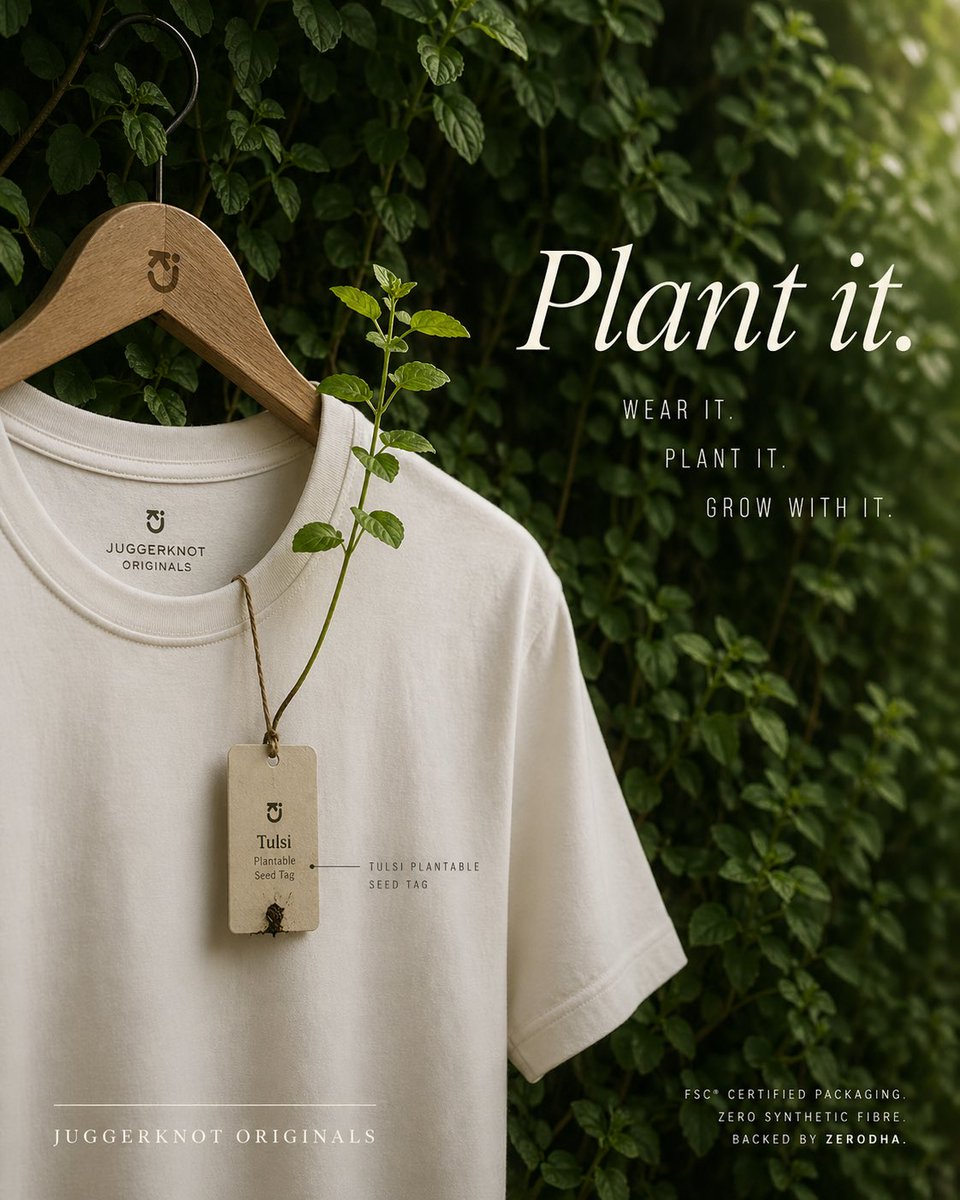
E-commerce Main Image - Sustainable T-Shirt Plantable Tag Ad
A premium eco-conscious fashion advertisement, shot as a refined editorial product photo. A single off-white or natural cream crew-neck T-shirt hangs on a smooth wooden hanger with a black metal hook, placed against a lush wall of dense green leaves and climbing vines. The hanger has a small minimalist brand monogram engraved near the neck. The shirt is shown from the upper torso down to part of the hem, slightly angled, with soft natural folds and high-quality cotton texture. Printed inside the collar is a minimalist brand mark and the text "JUGGERKNOT ORIGINALS". Hanging from the neckline is 1 rectangular recycled-paper seed tag tied with rustic brown twine; the tag reads "Tulsi" and "Plantable Seed Tag" with a tiny sprouting seed detail near the bottom. From the tag, 1 real tulsi plant stem grows upward across the front of the shirt, with several fresh green leaves, visually demonstrating that the tag is plantable. Add a small fine-label annotation near the tag reading "TULSI PLANTABLE SEED TAG". On the right side, large elegant white serif typography says {argument name="headline text" default="Plant it."}. Beneath it, place 3 stacked lines of narrow uppercase sans-serif copy: "WEAR IT.", "PLANT IT.", and "GROW WITH IT.". At the lower left, add the brand name in spaced uppercase serif text: {argument name="brand name" default="JUGGERKNOT ORIGINALS"}, with a thin horizontal line above it. At the lower right, add 3 lines of small uppercase sans-serif text: "FSC® CERTIFIED PACKAGING.", "ZERO SYNTHETIC FIBRE", and "BACKED BY ZERODHA.". Use soft diffused daylight, shallow depth of field, moody green-and-cream color grading, luxury sustainable-brand aesthetics, clean composition, vertical poster layout, subtle shadows, and a calm organic atmosphere. Keep the design minimal, premium, and photorealistic, with the shirt occupying the left half and the typography balanced on the right.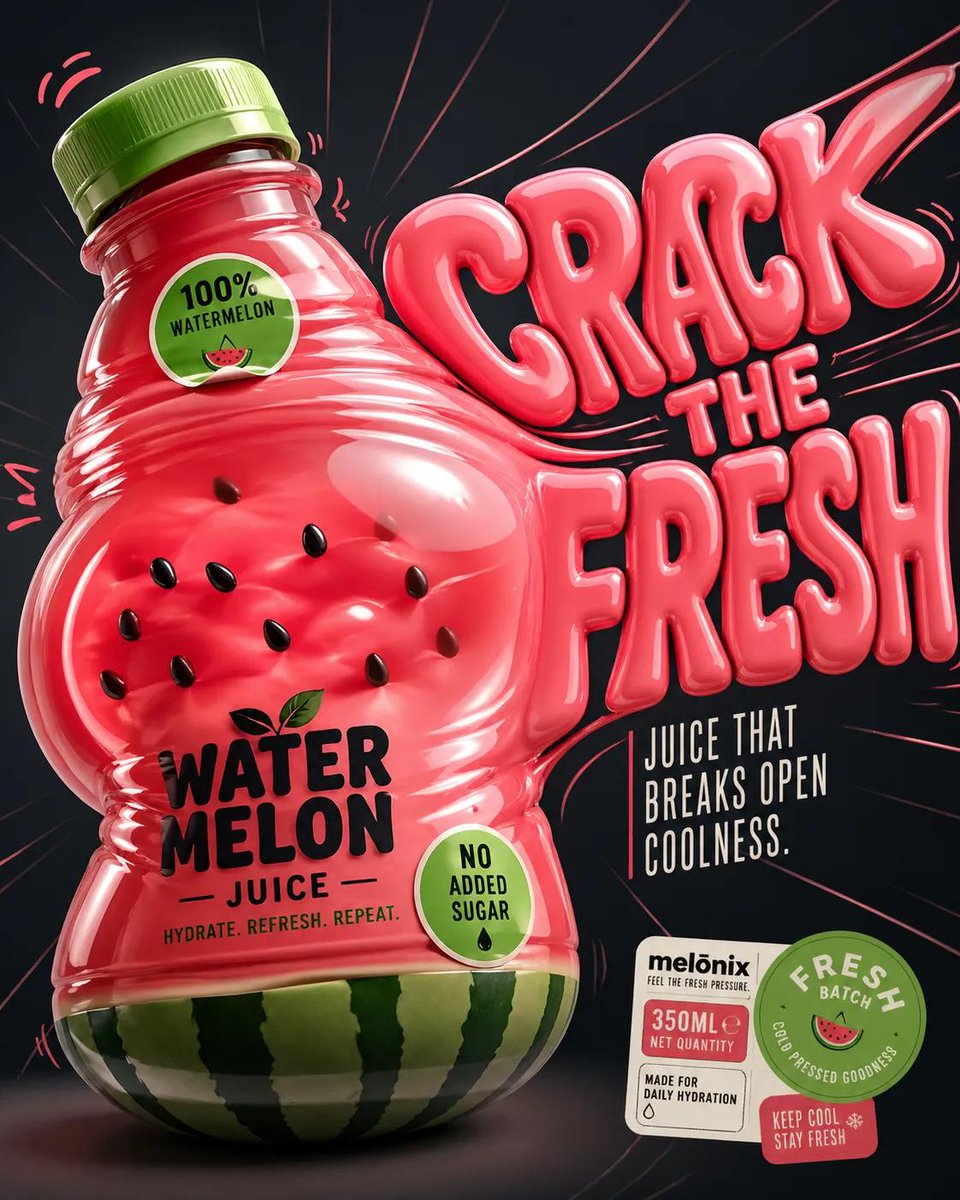
Inflatable Orange Juice Poster
Perfect for the summers GPT Image 2 on ChatGPT Prompt: Design a '4:5' product poster for an 'orange' juice 3d bottle using playful inflatable-plastic packaging surrealism where the bottle behaves like a squeezed toy object mid-pressure. The poster should communicate juiciness, tension, and tactile freshness through a bottle that visibly bulges, stretches, and compresses like a soft object being squeezed from the inside out. SUBJECT: A single bottle dominates the center-left, illustrated in a semi-3D stylized form (not photoreal). The bottle is visibly distorted—its midsection bulges outward while the neck is slightly compressed, as if internal juice pressure is pushing against the container walls. The liquid inside exaggerates this effect, forming rounded convex surfaces pressing against the plastic. The cap is slightly tilted from pressure. The bottle feels elastic, alive, and reactive rather than rigid. COMPOSITION: The composition mechanic is “internal pressure distortion”. The eye enters through the most inflated part of the bottle (center bulge), then follows curved tension lines outward toward stretched typography on the right side. The camera uses a slightly low, close-up perspective with mild fisheye distortion, amplifying the sense of pressure and expansion. The bottle leans diagonally into the frame as if pushing against invisible resistance. Negative space on the right is intentionally stretched and warped, echoing the bottle’s deformation. TYPOGRAPHY: Headline: “SQUEEZE BACK” in thick, rounded, inflated lettering that mimics air-filled plastic. The type is physically distorted—letters stretch horizontally near the bottle and compress toward the edges, as if affected by the same pressure force. The headline sits to the right of the bottle but partially overlaps its bulging edge. Subheadline: “Juice that pushes back.” in a narrow condensed sans, straight and rigid, contrasting the soft headline. Small circular microcopy labels (e.g., “100% organic”, “no added sugar”) appear like printed stickers slightly warped by the surface tension. LIGHTING / GRAPHIC TREATMENT: Soft studio lighting adapted for stylized rendering—broad diffused highlights across curved surfaces, subtle specular streaks that follow the deformation. No realistic reflections—only controlled, simplified highlight bands that emphasize volume and elasticity. COLORS: 'orange' juice bottle color and 3d header text. Small accents of 'bright lime green' for sticker elements. High contrast between glowing orange and dark surroundings. BACKGROUND: A smooth dark gradient field with subtle radial tension lines expanding outward from the bottle, like invisible pressure waves. No texture clutter—clean but dynamically warped space. STYLE: Neo-pop surreal product illustration with inflatable material logic, playful distortion, and high-impact commercial clarity. FINISH: Soft plastic-like rendering, clean edges, controlled gradient transitions, no noise or grain, polished but intentionally stylized surface behavior. FOOTER: A compact floating sticker cluster in the bottom-right corner containing a small brand placeholder, a circular “fresh batch” seal, and minimal product info arranged like packaging labels. NEGATIVE: Avoid realistic photography, static bottle poses, generic splash effects, centered symmetry, rigid typography, template layouts, clutter, excessive gloss, low detail, and stock advertising aesthetics.
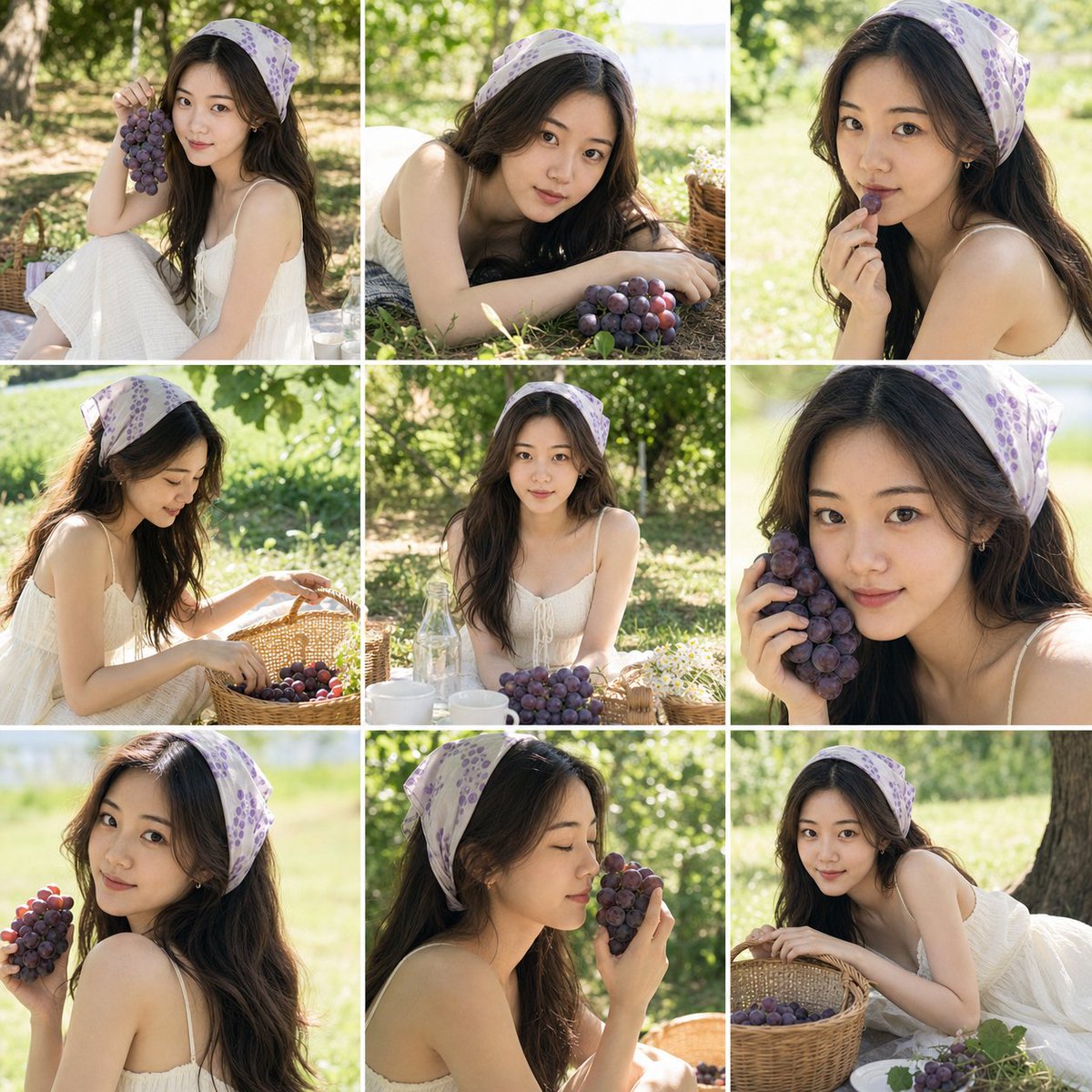
Profile / Avatar - Summer Grape Girl Photo Series
Based on 1-3 clear personal photos uploaded by the user, generate a 3x3 grid photo puzzle with the theme "{argument name="photo theme" default="Summer Grape Girl Photo Series"}".

Strictly preserve the subject's real identity characteristics, including face shape, facial proportions, eye/brow structure, nose, lips, skin tone, age, hairstyle features, and overall temperament. The person in all nine images must clearly look like the same real girl; she must not become a stranger, look Westernized, look like a generic influencer, be over-beautified, or have an AI-generated face.

The overall theme is a fresh and natural everyday girl's portrait. The character wears a {argument name="clothing description" default="creamy white or off-white soft dress / slip dress"} and a {argument name="accessory" default="purple vintage floral headscarf"}. The overall look is clean, natural, and daily, with a summer girl vibe. Accessories are simple, like small earrings, but not overly ornate.

Set the scene as a summer picnic portrait in an outdoor meadow, under tree shadows, or by a vineyard. Include elements like purple grapes, grape clusters, woven baskets, glass bottles, picnic blankets, and light-colored tableware to create a natural lifestyle feel. Sunlight filters through leaves, creating soft dappled shadows, with a naturally blurred background.

Design the final image as a 3x3 grid with white borders. All nine small photos must feature the same person, same outfit, and same scene, but each must be distinctly different: different expressions, different facial angles, different poses, different camera positions, and different compositions (wide vs. close-up). Do not just have nine slight variations of the same angle.

The nine photos can show: holding grapes and smiling, lying on the grass looking at the camera, holding a grape to the mouth, organizing the basket, sitting still facing forward, a close-up of a grape against the cheek, a candid turning shot, smelling the grapes with eyes closed, and lying on the grass holding the basket. Expressions should be varied, including quiet, playful, gentle, smiling with eyes closed, naturally daydreaming, and candid laughter.

The style is Fujifilm camera texture, Japanese film photography style, realistic shooting feel, soft natural light, shallow depth of field, slight film grain, and fresh natural tones. Purple grapes should be the visual focus. The image is clean, durable, and has a sense of life and youth.

Avoid: Western faces, influencer faces, over-beautification, plastic skin, fake faces, repetitive expressions, repetitive angles, hand deformities, distorted props, messy backgrounds, studio style, illustration style, or CG feel.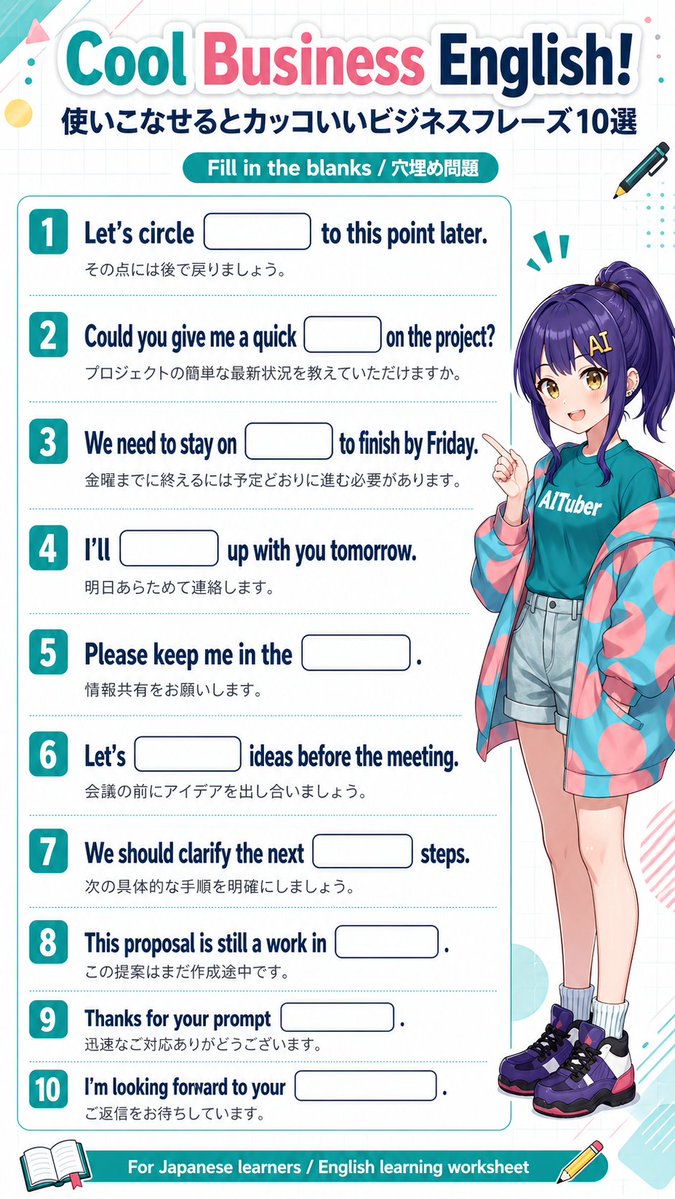
Infographic / Edu Visual - Anime Business English Worksheet
{"type":"bilingual English learning worksheet poster","style":"clean educational infographic with anime character mascot, bright pastel stationery theme, white graph-paper background, rounded shapes, glossy headline lettering, print-friendly vertical A4 layout","topic":"business English fill-in-the-blank quiz","language":"Japanese and English","audience":"Japanese learners of English","layout":{"orientation":"portrait","sections":[{"title":"Cool Business English!","position":"top header","count":2,"labels":["Cool Business English!","使いこなせるとカッコいいビジネスフレーズ10選"]},{"title":"Fill in the blanks / 穴埋め問題","position":"below header","count":1,"labels":["Fill in the blanks / 穴埋め問題"]},{"title":"worksheet items","position":"left and center main panel","count":10,"labels":["1","2","3","4","5","6","7","8","9","10"]},{"title":"footer banner","position":"bottom","count":1,"labels":["For Japanese learners / English learning worksheet"]}],"main_panel":"large rounded white worksheet box with thin teal outline and dotted divider lines between each question","right_panel":"full-body anime girl standing along the right side, partially overlapping the worksheet","decorations":{"count":10,"labels":["top-left teal corner ribbon","pink triangle","yellow circle","small teal dots","right-side pen icon","bottom-left open book icon","bottom-right pencil icon","teal exclamation marks near character","pastel geometric scribbles","light cyan and pink abstract corner accents"]}},"text":{"headline":"{argument name=\"headline text\" default=\"Cool Business English!\"}","subheadline":"使いこなせるとカッコいいビジネスフレーズ10選","badge":"Fill in the blanks / 穴埋め問題","footer":"For Japanese learners / English learning worksheet","questions":[{"number":1,"english":"Let’s circle ____ to this point later.","japanese":"その点には後で戻りましょう。"},{"number":2,"english":"Could you give me a quick ____ on the project?","japanese":"プロジェクトの簡単な最新状況を教えていただけますか。"},{"number":3,"english":"We need to stay on ____ to finish by Friday.","japanese":"金曜までに終えるには予定どおりに進む必要があります。"},{"number":4,"english":"I’ll ____ up with you tomorrow.","japanese":"明日あらためて連絡します。"},{"number":5,"english":"Please keep me in the ____.","japanese":"情報共有をお願いします。"},{"number":6,"english":"Let’s ____ ideas before the meeting.","japanese":"会議の前にアイデアを出し合いましょう。"},{"number":7,"english":"We should clarify the next ____ steps.","japanese":"次の具体的な手順を明確にしましょう。"},{"number":8,"english":"This proposal is still a work in ____.","japanese":"この提案はまだ作成途中です。"},{"number":9,"english":"Thanks for your prompt ____.","japanese":"迅速なご対応ありがとうございます。"},{"number":10,"english":"I’m looking forward to your ____.","japanese":"ご返信をお待ちしています。"}]}},"character":{"type":"anime girl mascot","count":1,"appearance":{"age":"teenage or young adult","build":"slim","skin":"fair","hair":{"color":"{argument name=\"hair color\" default=\"deep purple\"}","style":"high side ponytail with long bangs and shiny strands"},"expression":"cheerful and helpful","pose":"standing, one hand raised with index finger pointing upward"},"outfit":{"count":5,"pieces":["teal T-shirt with white logo text reading {argument name=\"shirt text\" default=\"AITuber\"}","oversized pink-and-teal translucent hooded jacket worn open","light gray high-waisted shorts","white scrunched socks","chunky purple, black, and pink sneakers"]}},"color_palette":{"count":6,"labels":["teal","cyan","pink","navy","white","purple"]},"rendering":"crisp polished poster design, balanced typography, cute modern Japanese educational social-media graphic, high readability, subtle shadows, no answers filled into the blanks"}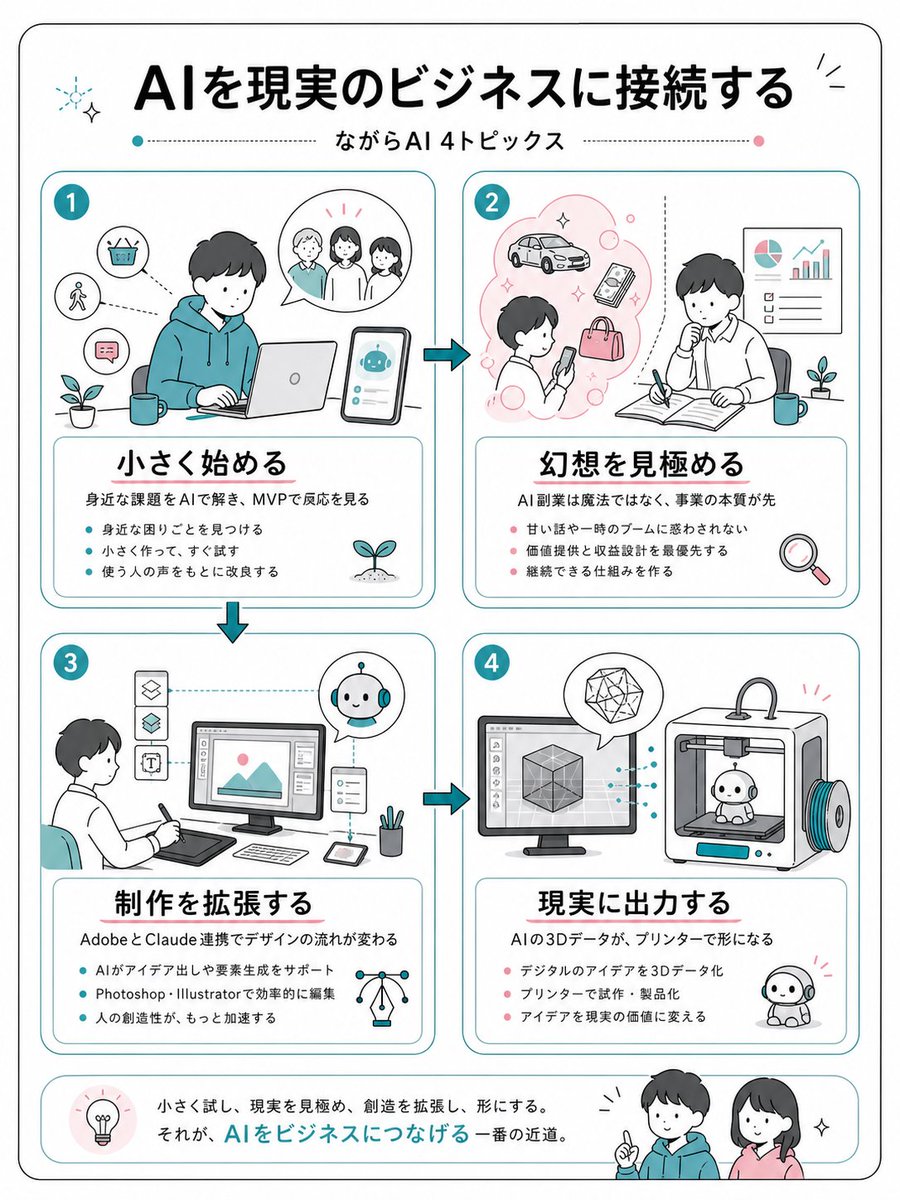
Infographic / Edu Visual - Japanese AI Business Infographic
{"type":"clean Japanese business infographic poster","format":"vertical A4-like page with rounded black outer border on white background","style":"friendly flat line illustration, minimal teal and coral accent colors, soft rounded rectangles, hand-drawn business sketch feel, black Japanese gothic headline typography, thin teal dividers, small sparkle and plant icons","language":"Japanese","headline":"{argument name=\"headline text\" default=\"AIを現実のビジネスに接続する\"}","subtitle":"{argument name=\"subtitle text\" default=\"ながらAI 4トピックス\"}","layout":{"top":"large centered headline with small decorative sparkles, subtitle below between dotted horizontal lines with teal and pink dots","main_grid":"four equal rounded cards arranged in a 2 by 2 grid, connected by teal arrow icons showing flow from 1 to 2, down to 3, across to 4","bottom_banner":"rounded summary strip with a lightbulb icon at left, Japanese closing sentence in the center, and two friendly characters at right"},"sections":[{"number":"1","position":"top left","title":"{argument name=\"section 1 title\" default=\"小さく始める\"}","main_illustration":"young person in teal hoodie working on a laptop at a desk, smartphone beside them showing a cute AI robot chat interface, speech bubble with three people, small icons for basket, walking person, chat message, plant and mug","description":"身近な課題をAIで解き、MVPで反応を見る","bullet_count":3,"bullets":["身近な困りごとを見つける","小さく作って、すぐ試す","使う人の声をもとに改良する"]},{"number":"2","position":"top right","title":"{argument name=\"section 2 title\" default=\"幻想を見極める\"}","main_illustration":"person looking at a smartphone inside a pink idea cloud with car, phone, bag and bubbles; second person thinking while writing in an open notebook, wall chart with pie chart and rising bar graph, plant, mug, magnifying glass icon","description":"AI副業は魔法ではなく、事業の本質が先","bullet_count":3,"bullets":["甘い話や一時のブームに惑わされない","価値提供と収益設計を最優先する","継続できる仕組みを作る"]},{"number":"3","position":"bottom left","title":"{argument name=\"section 3 title\" default=\"制作を拡張する\"}","main_illustration":"designer seated with pen tablet facing a desktop monitor showing an image editing interface, vertical tool icons at left, small AI robot assistant in circular bubble, tablet, stylus, pen cup, network lightbulb icon","description":"AdobeとClaude連携でデザインの流れが変わる","bullet_count":3,"bullets":["AIがアイデア出しや要素生成をサポート","Photoshop・Illustratorで効率的に編集","人の創造性が、もっと加速する"]},{"number":"4","position":"bottom right","title":"{argument name=\"section 4 title\" default=\"現実に出力する\"}","main_illustration":"desktop monitor with 3D cube modeling software connected by dotted teal lines to a 3D printer printing a small cute robot figure, geometric crystal in speech bubble, finished robot mascot on the floor","description":"AIの3Dデータが、プリンターで形になる","bullet_count":3,"bullets":["デジタルのアイデアを3Dデータ化","プリンターで試作・製品化","アイデアを現実の価値に変える"]}],"bottom_summary":{"icon":"lightbulb in a pale pink circle","text":"小さく試し、現実を見極め、創造を拡張し、形にする。\nそれが、AIをビジネスにつなげる一番の近道。","characters":"two smiling young people, one in teal hoodie pointing upward and one woman in pink top, with small sparkle marks"},"visual_requirements":"Use exactly 4 numbered topic cards, exactly 3 bullet points in each card, Japanese text must be crisp and readable, maintain generous margins, rounded corners, teal card borders, coral bullet dots in sections 2 and 4, teal bullet dots in sections 1 and 3, no photorealism."}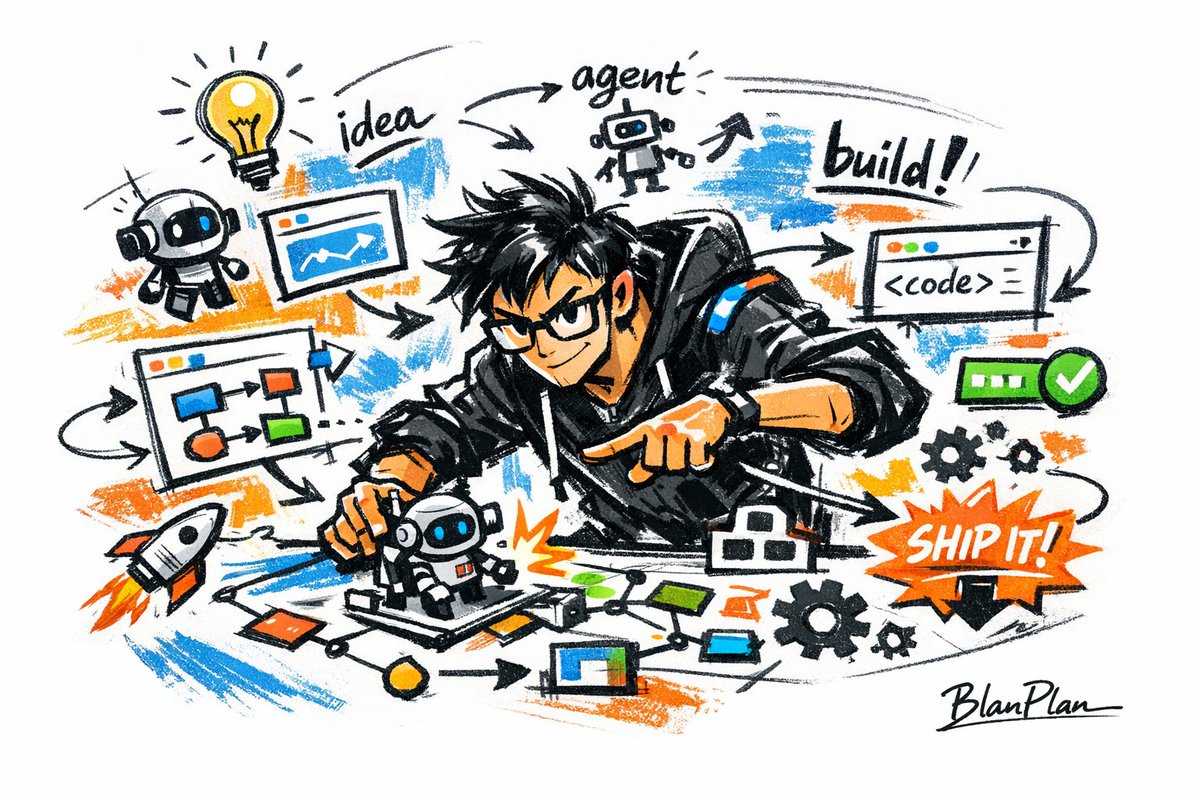
Realistic photography style image
Express {argument name="subject" default="a powerful AI builder"} in a graffiti sketch style, presenting an overall visual effect of quick outlines, free deformation, improvised hand-drawing, and draft-like sketches. The lines are casual, exaggerated, varying in thickness, and slightly messy but rhythmic and expressive, emphasizing generalization, exaggeration, fun, and spontaneity rather than rigorous realism or fine detail. The colors are expressed in rough blocks with a distinct dry-brush feel, retaining uneven smears, brush marks, fly-white, and layering. Colors automatically adapt to the {argument name="theme" default="powerful AI builder"}, but the overall expression remains graffiti-like, sketch-like, and generalized. No transparent watercolor smudging effects, no delicate watercolor transitions, no paper textures, no soft atomization, and no dreamy textures. The background is mainly white space, maintaining a sense of simplicity, ease, unfinishedness, and design. Small amounts of auxiliary symbols, arrows, marks, circles, repeated lines, handwritten text, or other graffiti elements can be added to enhance the sketchbook or essay-like visual language, but they should not be too crowded or destroy the subject and the white space atmosphere. The content of the picture does not need to be written in advance; {argument name="character image" default="a powerful AI builder"} will automatically deduce and generate the most suitable main image, actions, related elements, symbols, or simplified scenes. The overall style remains a unified graffiti sketch style and an exaggerated, generalized expression, avoiding complex realistic backgrounds and excessive detail. A special signature 'BlanPlan' should be naturally added as part of the picture, in a low-key but clear position such as the bottom left, bottom right, or near the title. The style should be unified with the overall layout, like an artist's signature or a design mark; the signature font should be exquisite, restrained, and high-end, not too large, and should not destroy the main composition or appear abrupt or cheap.Related prompt guides and libraries
FAQ about Text in Image
How do I use Text in Image prompts from gptimages.dev?
Start with the examples that match your visual job, then copy the prompt structure rather than copying every adjective. Replace the subject, scene, channel, aspect ratio, and constraints with your own details. If the first result is close, keep the successful parts fixed and change one variable at a time. This makes the page useful as a prompt library, not just a keyword page.
What is the best prompt format for Text in Image?
A dependable format is brief first, details second, checks last: describe the image goal, then the subject, scene, composition, style, reference rules, and output constraints. For models such as GPT-IMAGE-2, Nano Banana 2, Stable Diffusion, Midjourney, or Jimeng AI, keep the core prompt portable and add tool-specific settings only when the interface supports them.
Can I reuse these prompts across different AI image models?
Yes, but reuse the structure more than the exact syntax. A prompt that works in one generator may need different wording, reference strength, aspect ratio settings, or negative prompts in another. The safest workflow is to preserve the creative brief, then adapt only the model-specific layer after you inspect the first output.
How should I collect the best AI image prompts?
Save prompts with the final image, model or tool name, aspect ratio, reference images, and a short note explaining why the result worked. Group them by use case such as product photography, character consistency, UI mockups, posters, logos, or text-in-image prompts. That collection becomes much more useful than a flat list of attractive phrases.
Why do Text in Image prompts fail?
Common causes include unclear subject hierarchy, too many styles in one prompt, vague quality words, unsupported text requirements, missing reference rules, and uncontrolled iteration. Fix the prompt by naming the production goal, protecting the details that cannot change, and testing one adjustment per generation instead of rewriting the whole prompt every time.
Are these prompt examples enough for commercial work?
They are a starting point, not legal or brand clearance. For commercial work, check the terms of the model or generator, review rights for reference images, verify text and logos manually, and keep a record of the prompt, source assets, and final edits. The page helps with prompt quality, while usage rights still depend on your workflow and provider terms.