
One Scene, Ten Styles: AI Image Prompts
One Scene, Ten Styles: AI Image Prompts connects turn one scene into ten AI image styles with style-swap prompts to a curated English SEO page with model notes, prompt patterns, FAQ coverage, real examples, and related internal links.
Editorially reviewed by GPT Images for prompt usefulness, internal links, FAQ coverage, and source-aware model context.
What this guide covers
One Scene, Ten Styles: AI Image Prompts is designed for people learning how to get more dependable AI image outputs. It targets the intent to turn one scene into ten AI image styles with style-swap prompts, but the page avoids thin keyword stuffing by connecting the topic to prompt structure, real prompt examples, internal links, and FAQ answers.
The practical goal is simple: help someone understand what to write next. The page explains how One Scene, Ten Styles: AI Image prompts should define subject, constraints, references, style, and output checks before a model or generator is blamed for a weak result.
- Use this guide when the search intent is "turn one scene into ten AI image styles with style-swap prompts" and the visitor needs examples before writing from scratch.
- Choose it when One Scene, Ten Styles: AI Image work requires visible constraints such as subject, angle, lighting, composition, text, aspect ratio, or editing target.
- Use the real prompt examples below to see how other prompts structure the same problem, then adapt one variable at a time.
- Keep it as an internal link target for related prompt collections so users can move from broad discovery into specific prompt pages.
Recommended One Scene, Ten Styles: AI Image workflow
teach a repeatable prompting method connected to real prompt examples. A good workflow should be repeatable, inspectable, and easy to adapt across tools. The same prompt can behave differently in GPT-IMAGE-2, Nano Banana 2, Stable Diffusion, Midjourney, Jimeng AI, or a local ComfyUI setup, so this page keeps the reusable structure separate from tool-specific adjustments.
- Start by defining the job: what the image must communicate, where it will be used, and what failure would make the result unusable.
- Translate the job into a prompt skeleton for One Scene, Ten Styles: AI Image: subject, scene, medium, camera or composition, style constraints, and output constraints.
- Pick one example prompt from this page and copy only the structure that matches the job; avoid copying decorative phrases that do not serve the image.
- Run a first generation, then change one variable at a time: framing, lighting, color palette, reference strength, text content, or background density.
- Save the winning prompt with notes about model, tool, aspect ratio, and any reference images so the pattern can be reused later.
- diagnose the prompt, improve one variable at a time, and preserve reusable patterns
Quality checks before publishing
Before using a generated image in production, review the output against the original job. The best prompt is not the longest prompt; it is the prompt that makes the model spend attention on the details that matter.
- One Scene, Ten Styles: AI Image should have a clear subject and a visible hierarchy; if the prompt gives equal weight to every detail, the image often becomes noisy.
- The prompt should separate content from style, especially when moving between GPT-IMAGE-2, Nano Banana 2, Stable Diffusion, Midjourney, or other image models.
- If the output needs readable text, keep the phrase short, quote it exactly, and verify the final image rather than assuming the model handled typography perfectly.
- If the output must match a brand, character, room, product, or reference image, name the fixed traits and describe what is allowed to change.
- Avoid stacking too many model-specific shortcuts on a reusable prompt page; keep the main prompt portable, then add model notes as a final layer.
- Review whether the page sends visitors to deeper prompt examples, related use cases, and FAQ answers instead of trapping them in a generic SEO article.
Common mistakes to avoid
Most failed image generations are not caused by a missing magic word. They usually come from unclear hierarchy, mixed intent, unsupported text requirements, or a prompt that asks for too many changes at once.
- Writing a One Scene, Ten Styles: AI Image prompt as a pile of keywords without a production goal.
- Changing model, tool, aspect ratio, and reference image at the same time, which makes it impossible to learn what improved the output.
- Using vague quality words such as beautiful or professional without defining the visible evidence of quality.
- Ignoring downstream use, such as ecommerce crop safety, ad text legibility, app store screenshots, or poster readability.
- Treating One Scene, Ten Styles: AI Image Prompts as a final answer instead of a starting point connected to prompt examples and iteration notes.
One Scene, Ten Styles: AI Image prompt patterns
Production brief prompt
Create a One Scene, Ten Styles: AI Image image for [audience] that communicates [message]. Main subject: [subject]. Scene: [setting]. Composition: [camera angle, crop, spacing]. Style: [medium, lighting, color direction]. Constraints: [aspect ratio, readable text, brand colors, negative space]. Avoid: [visual mistakes, clutter, wrong mood].
It separates the job, subject, scene, style, and constraints, which makes the prompt easier to test across different image models.
Reference-aware prompt
Using the reference as the fixed source of truth, generate a One Scene, Ten Styles: AI Image variation. Preserve [identity traits, product shape, logo placement, character features, room layout]. Change only [background, lighting, camera angle, outfit, color palette]. Keep the output consistent with [use case] and do not invent extra objects.
It tells the model what is fixed and what can change, which is critical for image editing, character consistency, product shots, and brand work.
Iteration prompt
Revise the previous One Scene, Ten Styles: AI Image result by improving [one problem]. Keep [successful elements] unchanged. Adjust [single variable] to [specific direction]. The final image should feel [desired mood] and remain suitable for [placement or channel]. Do not change [protected details].
It controls iteration by changing one variable at a time, so you can learn which instruction improved or damaged the output.
Model transfer prompt
Rewrite this One Scene, Ten Styles: AI Image prompt for [target model or tool]. Keep the core subject, composition, and constraints. Convert unsupported syntax into natural language. Add model-specific notes only at the end: [aspect ratio, style strength, reference strength, negative prompt, seed, or typography instruction].
It preserves the creative brief while allowing each model or tool to receive the instructions in a format it can use.
Prompt examples for One Scene, Ten Styles: AI Image
These examples are selected from the current English prompt catalog so the page links visitors into real prompt detail pages instead of stopping at generic advice.
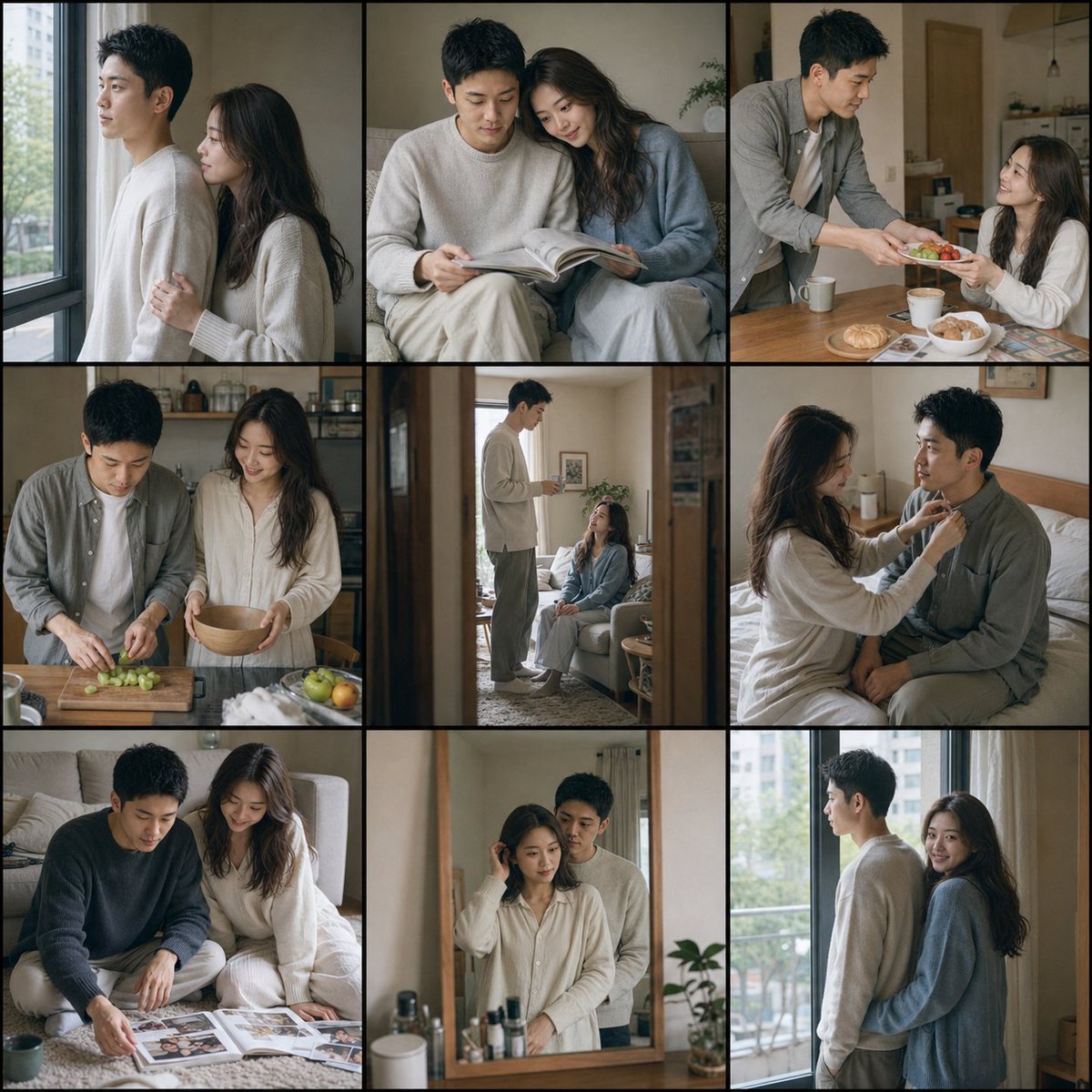
Social Media Post - Fujifilm Style Home Couple Portraits
Based on the real photos of two adult couples uploaded by the user, generate a "{argument name="photo style" default="Fujifilm-style Japanese home couple portrait"} 3x3 grid album collage".

Strictly preserve the real identity characteristics of the two people. Both the girl and the boy must clearly look like the original people in the uploaded photos, including face shape, facial proportions, eye/brow structure, nose, lips, jawline, skin tone, age, hairline, hairstyle features, and overall temperament. Do not turn them into Western faces, Korean studio styles, influencers, or over-beautified strangers. All 9 final small photos must feature the same real Chinese couple, captured from different angles, distances, and moments during the same home session.

## Visual Format
Generate a 3x3 collage with 9 small photos, overall 1:1 ratio. Use narrow {argument name="border color" default="black"} separator lines between photos, all placed on a {argument name="background color" default="black"} background, like a curated home photo album. Not a commercial poster or studio layout; avoid repetitive templates.

## Core Visual Style
Overall style: Japanese lifestyle photography, Fujifilm camera texture, real home couple portrait, candid shots, gentle, relaxed, quiet, and storytelling.
Focus on the colors and atmosphere of Fujifilm stocks like Superia, Pro 400H, or C200. The images should have low saturation without looking gray, soft natural highlights, transparent but restrained skin tones, slight film grain, slight shadow noise, and soft contrast. It should look like an air-filled, layered Fujifilm lifestyle photo.
Avoid: old iPhone texture, mobile compression, digital sharpness, heavy retro filters, commercial ads, or e-commerce styles.

## Character Relationship
The two are a {argument name="relationship" default="real, intimate, and natural young Chinese couple"}. Each frame should clearly show they are a couple with a sense of familiarity and companionship. Interactions should be realistic and relaxed: leaning in, making eye contact, looking down and laughing, leaning on a shoulder, reading together, passing things, preparing food, adjusting clothes, seeing each other in the mirror, or watching from a doorway. Intimate but restrained—no grease, no eroticism, and no staged wedding-style acting.

## Expressions and Angles
The 9 photos should not all look at the camera or just smile slightly. Expressions must be rich and varied: giggling, being teased, looking down laughing, quiet, daydreaming, gentle staring, relaxed chatting, focused on a task, responding with a look back, closing eyes laughing, looking out the window, or looking at each other.
Facial angles must vary significantly. Do not repeat the same template. Use a mix of: front, semi-front, profile, looking down, looking back, looking up slightly, near-back, mirror angles, distant observation, and close-up life details. Each frame should have a new head direction and visual rhythm.

## Clothing Requirements
Do not use the original clothes from the uploaded photos. Change them into natural Japanese lifestyle outfits: low saturation, neutral colors, soft materials. Colors like creamy white, oatmeal, light gray, pale coffee, misty blue, or charcoal. Items include knit cardigans, soft T-shirts, linen shirts, loungewear, long skirts, or socks. Should look like comfortable clothes a real couple wears at home.

## Home Setting
A clean, tidy apartment with real life traces (not a model home). Include elements like curtains, wood floors, sofas, pillows, blankets, books, albums, cups, plates, plants, bed lamps, mirrors, or tables—all as subtle aids to focus on the couple.

## Content of the 9 Frames
1. Quiet by the window: Boy looks out; girl leans in naturally. Quiet atmosphere.
2. Reading on the sofa: Reading a book together; one leans on the other's shoulder.
3. Passing a plate: At the dining table, passing fruit; active movement and eye contact.
4. Kitchen prep: Preparing food; one cuts fruit while the other watches and laughs.
5. Doorway view: Observer's perspective through a door frame into the living room.
6. Bedroom touch: Sitting on the bed; girl adjusts the boy's collar gently.
7. Floor photos: Sitting on the carpet looking at magazines together; candid sitting poses.
8. Mirror fragment: Captured through a dressing mirror; adjusting hair or a brief look in the mirror.
9. Balcony pause: Standing by the sliding door; one looks out while the other approaches with a smile.

## Consistency and Stability
Keep facial consistency across all 9 frames. Avoid complex hand gestures (no face-touching or finger-crossing). The quality should include slight film grain and scanning texture to feel like a real set, not a perfect AI grid. Avoid digital artifacts, extra limbs, or strange text.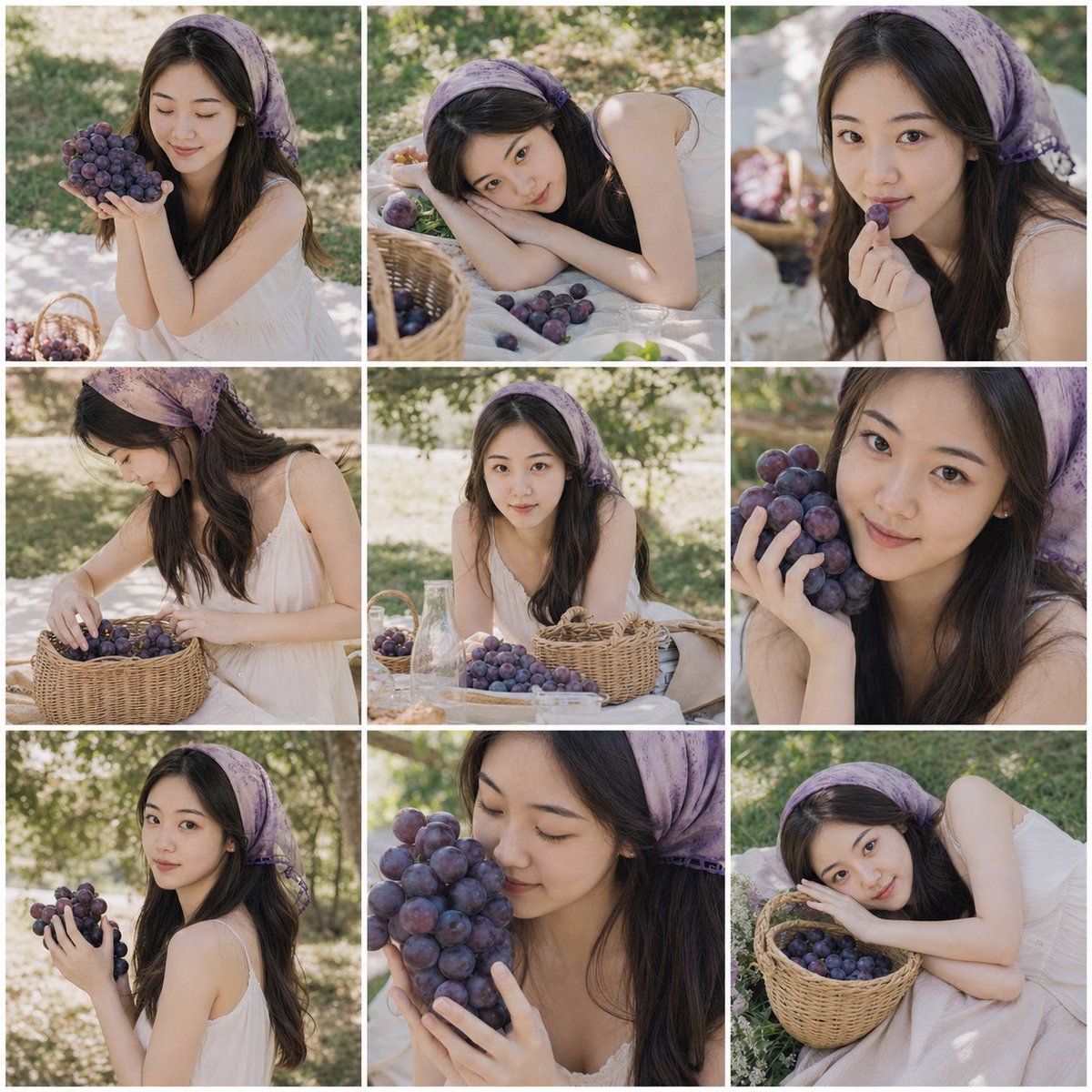
Profile / Avatar - Summer Grape Girl 3x3 Grid Portrait
# Summer Grape Girl Photo Series | 3x3 Grid Prompt

Based on **1-3 clear personal photos** uploaded by the user, generate a **3x3 grid photo puzzle** with the theme **"{argument name="photo theme" default="Summer Grape Girl Photo Series"}"**.

---

## 1. Character Requirements

Strictly preserve the user's real identity features, including but not limited to:

- Face shape
- Facial proportions
- Eye and brow structure
- Nose shape
- Lip shape
- Skin tone
- Age appearance
- Hairstyle features
- Overall temperament

The person in the final nine small photos must clearly look like the **same real girl**; she must not become a stranger, look Westernized, look like a generic influencer, be over-beautified, or have an AI-generated face.
Consistency of the person's identity must be maintained across all photos.

---

## 2. Theme Setting

The theme of the entire set is **"Grape Girl Photo Series"**, with an atmosphere that is:

- Fresh
- Natural
- Sweetly light
- Daily youthful vibe
- Summer outdoor feel
- Hint of Japanese film portrait style
- Still resembling a high-quality lifestyle photo set taken by an ordinary girl rather than exaggerated studio photography.

---

## 3. Styling Settings

Character clothing:

- **{argument name="clothing style" default="Creamy white / off-white dress or slip dress"}**, soft material, natural, youthful vibe.
- Wearing a **{argument name="headwear accessory" default="purple vintage floral headscarf"}** on the head, in soft purple tones like light purple, grape purple, or misty purple.
- Can be paired with simple small earrings; the overall accessories should not be complex or overly fashionable.

The overall look should be natural, clean, and feel like an ordinary girl's portrait, not overly polished or like a commercial advertisement.

---

## 4. Scene Settings

The scene is a **picnic setting on summer outdoor grass / by a vineyard / under tree shadows**.

Include the following elements in the image:

- Purple grapes
- Grape clusters
- Woven baskets
- Picnic blankets
- Glass bottles
- White plates or light-colored utensils
- Grass, tree shadows, natural sunlight
- Minimal tabletop or picnic arrangements

The background should be softly blurred, with a natural and realistic atmosphere featuring dappled light from sunlight passing through leaves.

---

## 5. 3x3 Grid Requirements

The output is a **3x3 grid collage**, separated by white borders.

The nine photos must feature the **same person, same outfit, and same theme/scene**, but each must have distinctly different:

- Facial angles
- Poses
- Camera distances
- Camera positions
- Expressions
- Hand movements
- Composition methods

### Key Requirements

- Do not have the face facing the same direction in all nine photos.
- Do not have almost identical expressions across the nine photos.
- Do not have only slight variations.

It should look like a set of behind-the-scenes candid shots captured continuously during a real photo shoot.

---

## 6. Pose Suggestions for the Nine Photos

The nine photos can include the following different states:

1. Sitting by the picnic blanket, holding a bunch of purple grapes with both hands, eyes closed and smiling.
2. Lying on the grass, head tilted slightly, looking at the camera with grapes scattered nearby.
3. Holding a single grape near the mouth, looking at the camera with a playful expression.
4. Half-body side shot, looking down naturally while organizing grapes in the woven basket.
5. Front-facing sitting pose with grapes, glass bottles, and a basket in front; expression is calm.
6. Close-up shot, holding a grape against the cheek with a relaxed smile.
7. Slightly turning back, holding a bunch of grapes with a natural candid expression.
8. Eyes closed, smelling or leaning close to the grapes, looking relaxed and happy.
9. Reclining on the grass or under a tree, holding the woven basket, looking at the camera with a gentle gaze.

---

## 7. Photography Style

The overall style is:

- Fujifilm camera texture
- Japanese film photography style
- Soft natural light
- Slight film grain
- Shallow depth of field
- Realistic shooting feel
- Fresh summer tones
- Purple grapes as the visual focus
- Clean imagery with a sense of life and youthfulness.

---

## 8. Visual Requirements

- High-fidelity portrait photography
- Natural skin texture
- No plastic skin
- No excessive smoothing
- No exaggerated beautification
- No over-sharpening
- No cartoon feel
- No illustration feel
- No CG feel
- No cheap studio photography look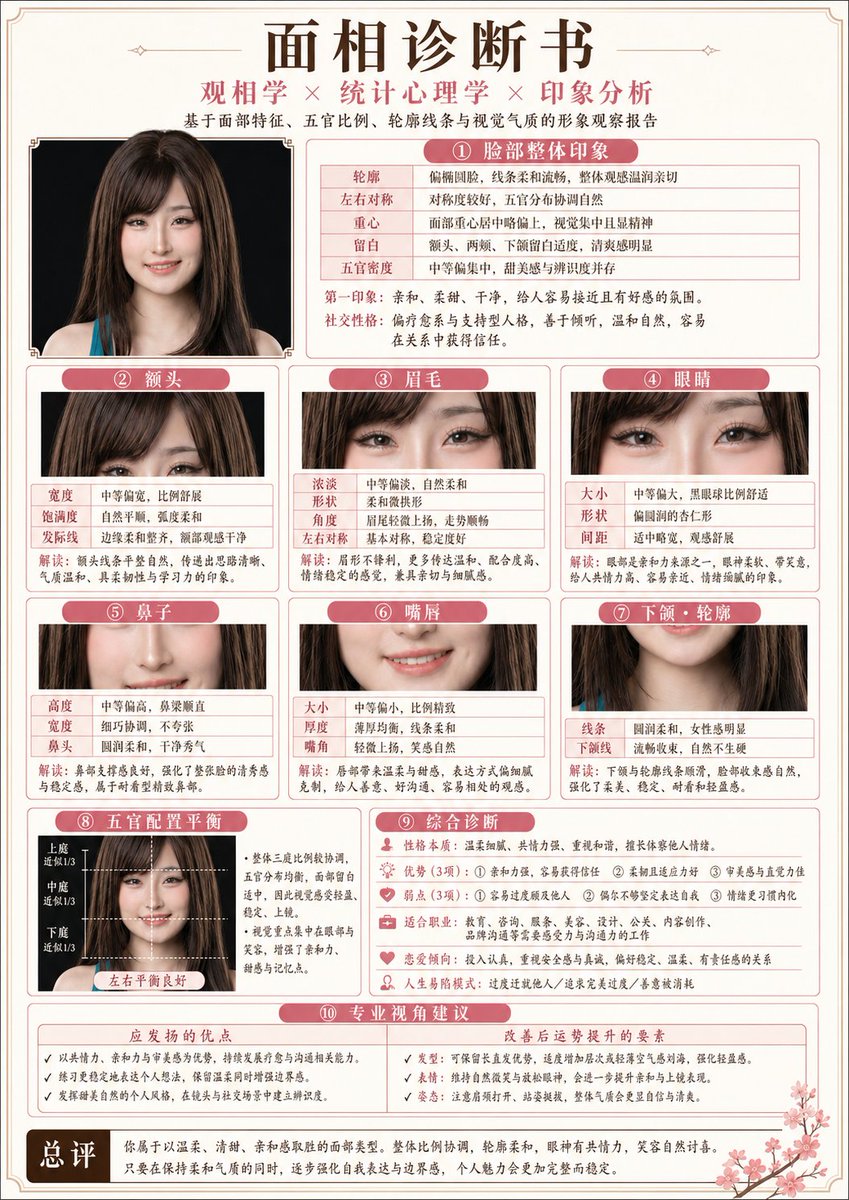
Infographic / Edu Visual - Japanese-Style Facial Analysis Diagnostic Poster
{
  "type": "Vertical Physiognomy Diagnosis Report Card Infographic",
  "style": "{argument name="report style" default="Japanese professional diagnosis document style"}, warm cream background, rose pink title bars, fine line borders, mix of Serif and Sans-serif fonts, medical report layout feel, soft warm tones, exquisite typography, no illustration decoration",
  "layout": {
    "Header Section": {
      "Main Title": "{argument name="diagnosis title" default="Physiognomy Diagnosis Certificate"}",
      "Main Title Font": "Large bold Serif, centered, dark brown",
      "Subtitle": "Physiognomy × Statistical Psychology × Impression Analysis",
      "Subtitle Font": "Small fine Sans-serif, centered, gray-brown"
    },
    "First Block": {
      "Layout": "Two columns",
      "Left Column": {
        "Content": "{argument name="portrait content" default="A realistic portrait photo of a young Asian woman with slightly wavy brown hair, delicate features, wearing a light-colored jacket, resting her hand on her cheek, natural expression, in-car background, warm natural light, film photograph quality"}",
        "Size": "Approx 1/3 width, spans two rows high"
      },
      "Right Column": {
        "Block Title": "① Overall Facial Impression",
        "Block Title Style": "Rose pink background, white text, rounded rectangle title bar",
        "Table Content": {
          "count": 5,
          "Row Data": [
            ["Outline", "Slightly oval, rounded, giving a gentle impression"],
            ["Symmetry", "Symmetrical, coordinated proportions"],
            ["Center of Gravity", "Centered, friendly and natural"],
            ["Negative Space", "Moderate space on forehead, cheeks, and jaw; strong sense of cleanliness"],
            ["Feature Density", "Features neatly arranged, blending cuteness and elegance"]
          ]
        },
        "First Impression Text": "First Impression: Friendly and natural, strong sense of cleanliness, an aura that makes people want to protect you.",
        "Social Character": "Social Character: Healing-type popular figure. Good at listening, gains trust in a supportive role."
      }
    },
    "Second Block (Three Columns)": {
      "Layout": "Three equal horizontal sections",
      "Column 1": {
        "Block Title": "② Forehead",
        "Small Portrait Insert": "Forehead area highlighted",
        "Table": [
          ["Width", "Slightly wide, rounded"],
          ["Roundness", "Natural arc, soft"],
          ["Tilt", "Slightly backward, steady impression"]
        ],
        "Interpretation": "Interpretation: Possesses intellectual sense and flexible thinking. Naturally lucky and favored by the environment."
      },
      "Column 2": {
        "Block Title": "③ Eyebrows",
        "Small Portrait Insert": "Eyebrow area highlighted",
        "Table": [
          ["Density", "Slightly light, natural"],
          ["Shape", "Soft arch"],
          ["Angle", "Slightly upturned"],
          ["Symmetry", "Basically symmetrical, stable"]
        ],
        "Interpretation": "Interpretation: Willpower is not overly rigid, possesses flexibility. High coordination, medium to high stress resistance."
      },
      "Column 3": {
        "Block Title": "④ Eyes",
        "Small Portrait Insert": "Eye area highlighted",
        "Table": [
          ["Size", "Slightly large, high iris ratio"],
          ["Shape", "Rounded almond shape"],
          ["Spanning", "Slightly wide, sense of leisure"]
        ],
        "Interpretation": "Interpretation: Strong perception, sharp intuition. High empathy, good at reading minds."
      }
    },
    "Third Block (Three Columns)": {
      "Layout": "Three equal horizontal sections",
      "Column 1": {
        "Block Title": "⑤ Nose",
        "Table": [
          ["Height", "Slightly high, upright"],
          ["Width", "Delicate, sense of nobility"],
          ["Tip", "Rounded, soft"]
        ],
        "Interpretation": "Interpretation: Possesses realistic judgment, financial fortune belongs to the steady accumulation type."
      },
      "Column 2": {
        "Block Title": "⑥ Lips",
        "Table": [
          ["Size", "Slightly small, exquisite"],
          ["Thickness", "Balanced thickness"],
          ["Corners", "Slightly upturned"]
        ],
        "Interpretation": "Interpretation: Affectionate, good at listening. Words have the power to heal others."
      },
      "Column 3": {
        "Block Title": "⑦ Jaw/Outline",
        "Table": [
          ["Line", "Rounded, feminine"],
          ["Jawline", "Smooth and soft"]
        ],
        "Interpretation": "Interpretation: Steady personality, stable aspirations. Good fortune in later life, supported by others."
      }
    },
    "Fourth Block (Two Columns)": {
      "Layout": "Two columns",
      "Left Column": {
        "Block Title": "⑧ Facial Proportions Balance",
        "Proportion Diagram": "A frontal female face diagram marking equal thirds for upper/middle/lower face, each labeled '1/3 each', with 'good left-right balance' noted at the bottom",
        "Description": "Close to golden ratio, stable flow of luck. Success depends on broad social relationships."
      },
      "Right Column": {
        "Block Title": "⑨ Comprehensive Diagnosis",
        "Personality Essence": "Personality Essence: Gentle and delicate, good at sensing others' emotions. Pacifist, values harmony.",
        "Strengths (3 Items)": {
          "Label": "Strengths (3 Items)",
          "items": ["Strong empathy, gains others' trust", "Flexible and adaptable", "High sense of beauty and intuition"]
        },
        "Weaknesses (3 Items)": {
          "Label": "Weaknesses (3 Items)",
          "items": ["Too considerate of others, leading to fatigue", "Tends to be overly modest", "Personal opinions tend to recede"]
        },
        "Suitable Careers": "Hospitality, Sales, Beauty, Medical, Education, Consulting, PR, Design, Planning, etc. Work involving people and utilizing sensitivity ◎",
        "Romantic Tendencies": "The type to dive in fully once in love. Values security, attracted to sincere partners. Not good with restrictiveness, values trust.",
        "Pattern to Avoid": "Over-accommodating others"
      }
    }
  }
}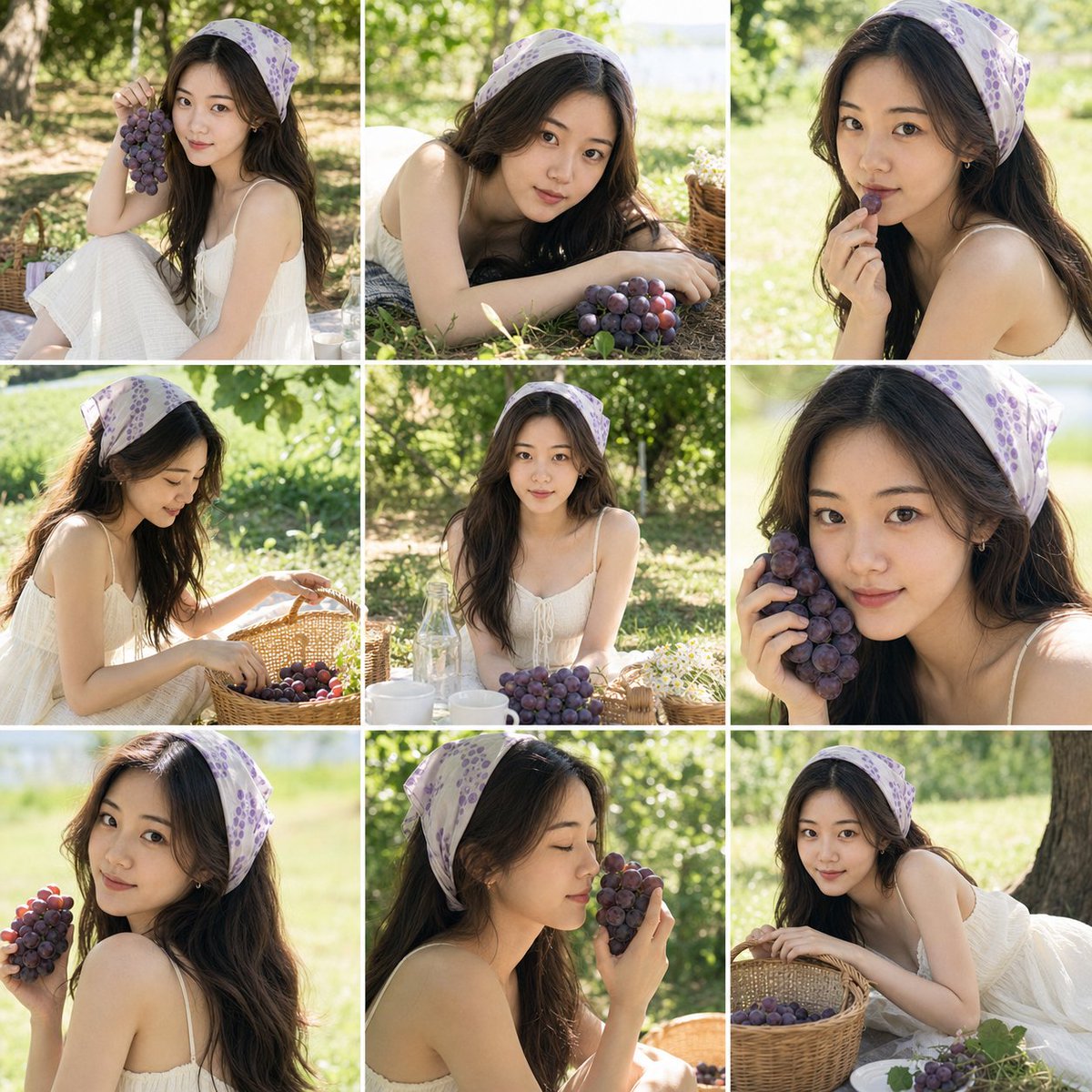
Profile / Avatar - Summer Grape Girl Photo Series
Based on 1-3 clear personal photos uploaded by the user, generate a 3x3 grid photo puzzle with the theme "{argument name="photo theme" default="Summer Grape Girl Photo Series"}".

Strictly preserve the subject's real identity characteristics, including face shape, facial proportions, eye/brow structure, nose, lips, skin tone, age, hairstyle features, and overall temperament. The person in all nine images must clearly look like the same real girl; she must not become a stranger, look Westernized, look like a generic influencer, be over-beautified, or have an AI-generated face.

The overall theme is a fresh and natural everyday girl's portrait. The character wears a {argument name="clothing description" default="creamy white or off-white soft dress / slip dress"} and a {argument name="accessory" default="purple vintage floral headscarf"}. The overall look is clean, natural, and daily, with a summer girl vibe. Accessories are simple, like small earrings, but not overly ornate.

Set the scene as a summer picnic portrait in an outdoor meadow, under tree shadows, or by a vineyard. Include elements like purple grapes, grape clusters, woven baskets, glass bottles, picnic blankets, and light-colored tableware to create a natural lifestyle feel. Sunlight filters through leaves, creating soft dappled shadows, with a naturally blurred background.

Design the final image as a 3x3 grid with white borders. All nine small photos must feature the same person, same outfit, and same scene, but each must be distinctly different: different expressions, different facial angles, different poses, different camera positions, and different compositions (wide vs. close-up). Do not just have nine slight variations of the same angle.

The nine photos can show: holding grapes and smiling, lying on the grass looking at the camera, holding a grape to the mouth, organizing the basket, sitting still facing forward, a close-up of a grape against the cheek, a candid turning shot, smelling the grapes with eyes closed, and lying on the grass holding the basket. Expressions should be varied, including quiet, playful, gentle, smiling with eyes closed, naturally daydreaming, and candid laughter.

The style is Fujifilm camera texture, Japanese film photography style, realistic shooting feel, soft natural light, shallow depth of field, slight film grain, and fresh natural tones. Purple grapes should be the visual focus. The image is clean, durable, and has a sense of life and youth.

Avoid: Western faces, influencer faces, over-beautification, plastic skin, fake faces, repetitive expressions, repetitive angles, hand deformities, distorted props, messy backgrounds, studio style, illustration style, or CG feel.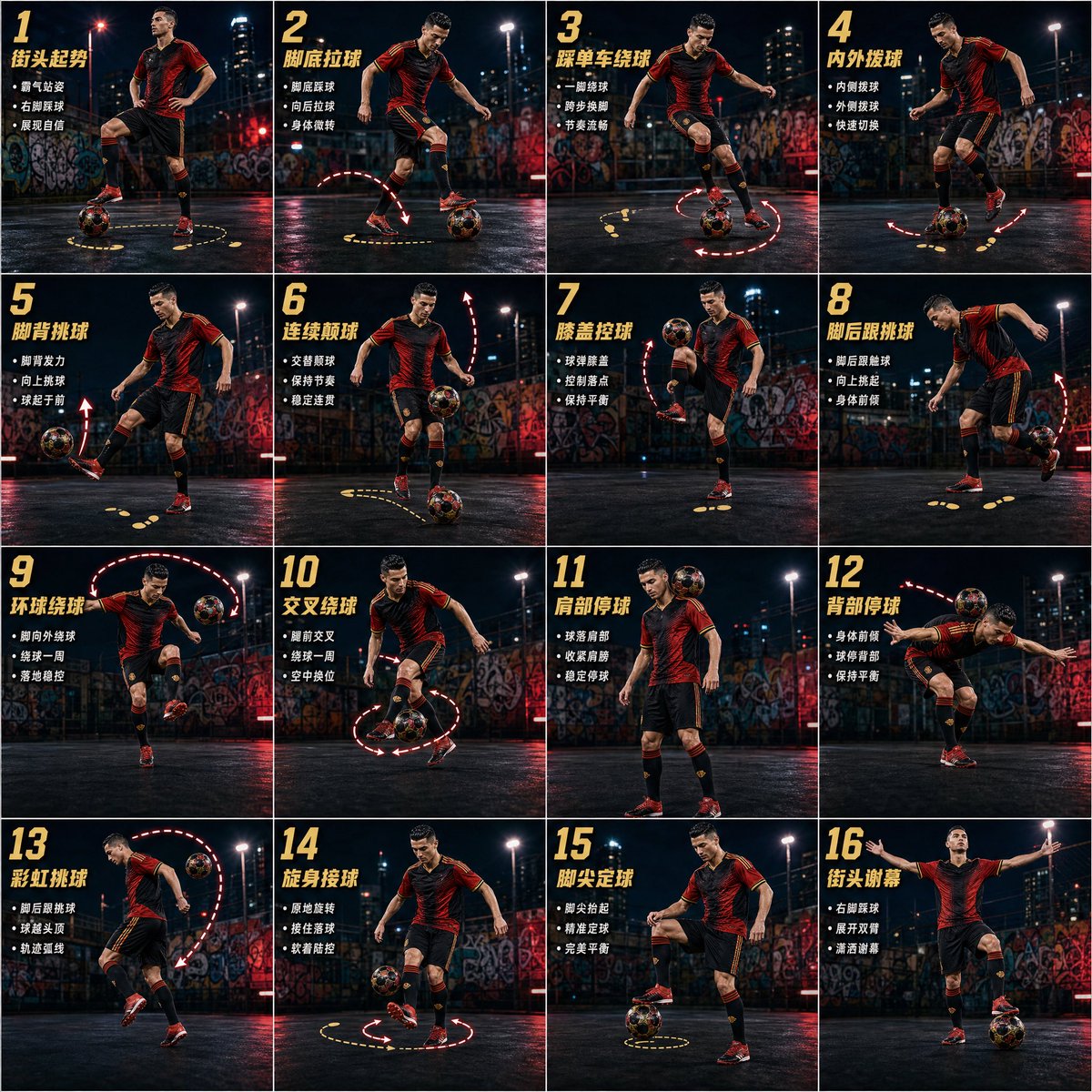
Infographic / Edu Visual - Freestyle Football 16-Step Action Poster
Please generate a high-quality, high-definition poster-style storyboard for "{argument name="subject" default="Street Freestyle Football"} · {argument name="action" default="16-Step Action Breakdown"}." The layout should be a square 4x4 grid, with each cell showing a consecutive action step of the same street football performer in the same setting. The entire image should look like a combination of a high-end sports poster and a technical breakdown instructional board, possessing both visual impact and a clear sense of movement explanation.

[Overall Setting]
Theme: Street freestyle football performance (not a match or drill), where one performer completes a continuous set of tricks.
Atmosphere: Street vibe, urban, cinematic, athletic, cool, and rhythmic.
Background: Set in a {argument name="background" default="nighttime urban small street pitch"} or city square football space, with graffiti walls, wire fences, distant building lights, street lamps, and slightly reflective ground. The environment must be consistent and have a trendy street aesthetic.

[Character Requirements]
Protagonist: A young, handsome male freestyle football expert with a light, coordinated, and athletic build, short black hair, confident aura, and fluid, controlled movements.
The same person must appear in all 16 cells; do not change the person per cell.
Outfit: Cool-looking football kit, but no words like "Champion" or specific country names. The clothing should feel like a professional team jersey.

[Layout Requirements]
The full image is a 4x4 grid of 16 cells. Each cell must contain:
1. Large step number (1-16)
2. Chinese action title
3. 2-4 brief Chinese action points
4. Clear full-body action shot of the person
5. Football trajectory arrows / footwork paths
6. The ball must be clearly visible and logically positioned.

Overall font style: Sporty poster aesthetic, clear and powerful. The image should be sharp, clean, and the person and ball must be complete, not cut off at the feet.

[Action Sequence]
Please design 16 continuous actions in order, each distinctly different, forming a complete freestyle routine: [Detailed steps 1-16 including Starting Pose, Sole Pull, Stepover, Flick-up, Knee Control, Around the World, Shoulder Stall, Rainbow Flick, and Final Bow].

[Visual Style]
- High-end sports poster style
- Cinematic night lighting and shadows
- Strong sense of motion with a trendy street aesthetic
- Clear arrows and trajectory lines to help understand the path of the ball
- Color palette dominated by red, black, and gold for a premium feel
- Eye-catching typography suitable for social media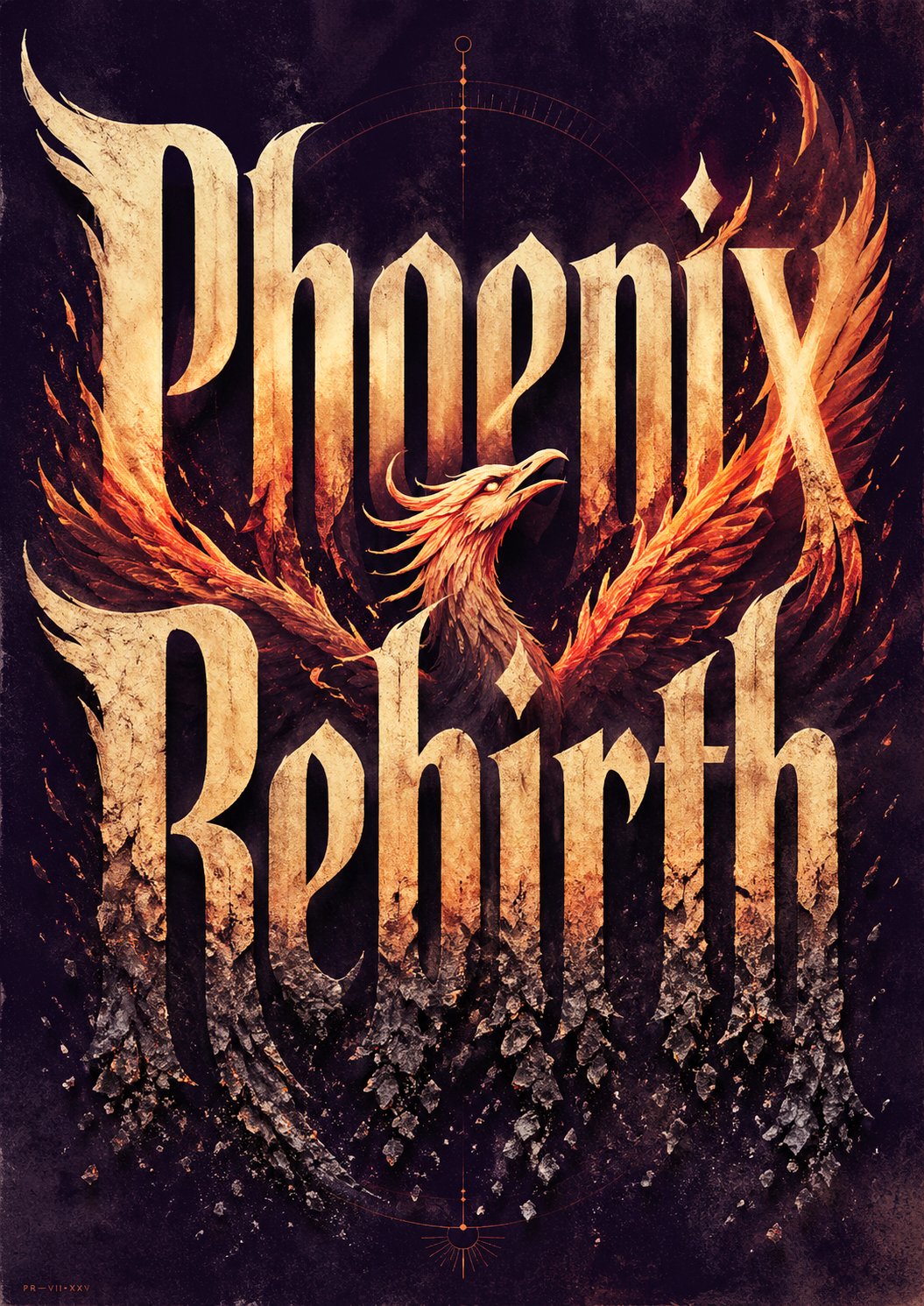
Concept Font Poster Prompt
Create ONE finished premium conceptual typography poster for the exact title:

"[INPUT_TEXT]"

Single poster only. No moodboard, grid, presentation board, mockup, captions, prompt text, process sheet, or sample labels.

The title "[INPUT_TEXT]" must be the dominant visual structure of the poster: huge, readable, powerful, and spelled exactly. Do not translate, shorten, replace, or misspell it. Do not add other large readable text. Optional micro catalog text is allowed only if it stays subtle and secondary.

Silently interpret the title's meaning, mood, cultural aura, symbolic associations, psychological tension, and visual rhythm. Turn that interpretation into one strong visual metaphor.

Typography is the hero. Design custom-looking letterforms whose weight, width, contrast, spacing, rhythm, distortion, negative space, edge quality, and ink texture express the temperament of the title. The type should feel intentionally designed, not like a default font.

If "[INPUT_TEXT]" refers to a widely known person, make a large editorial portrait or full / half-body figure a major visual presence, occupying roughly 40–70% of the composition. The figure should feel recognizable through aura, posture, styling, era, expression, lighting, and symbolic atmosphere, but should not copy a specific existing photograph, official poster, campaign image, logo, slogan, or copyrighted composition. The portrait must interact with the typography: overlapping the letters, emerging from them, being framed by them, casting shadows on them, breaking through them, or being partially hidden behind them.

For all other titles, use a human figure, landscape, object, or atmospheric setting only when it strengthens the meaning. It must interact with the typography and deepen the concept, not decorate it.

Use a rich but restrained 4–6 color system matched to the theme: dominant background color, primary typography color, figure / landscape tone, emotional accent color, muted support color, and subtle paper / ink texture tone. Avoid flat black-white-red defaults unless conceptually necessary.

Composition style: high-end editorial poster, museum-quality graphic design, dramatic scale, strong hierarchy, few elements, intelligent whitespace, bold flat color areas, sharp cropping, silkscreen / lithograph / risograph grain, paper fibers, subtle ink imperfections, refined visual tension.

The final image should feel like a complete visual sentence: the title, the figure or setting, the color, and the typography explain each other.

Avoid generic word art, glossy 3D lettering, random icons, stock-photo realism, cluttered collage, excessive grunge, tourist clichés, official logos, copied slogans, copied campaign aesthetics, unrelated text, and misspelled typography.

-----

INPUT_TEXT: Phoenix Rebirth

Anime Music Bootcamp Promo Poster
Create a dramatic Japanese anime-style promotional thumbnail poster for an event, vertical 4:5 composition, ultra-detailed, cinematic, neon-lit, high contrast, designed like a social media announcement image. The main subject is a beautiful anime girl centered slightly right, shown from the waist up, with long flowing {argument name="hair color" default="deep blue"} hair blowing in the wind, decorated with small star hairpins, wearing a dark hoodie and large studio headphones around her neck, against a glowing sunset-to-night city skyline filled with sparkling lights, music-energy particles, lens flares, and flying glowing petals. Her face area is obscured by a soft rectangular blur block. Use a vivid palette of electric blue, violet, magenta, gold, and sunset orange. Fill the design with layered Japanese typography that is crisp, readable, and integrated into the art like a polished event advertisement. Include exactly 8 major text groups: top left copy reading 「始まるのは、キミと創る 音楽の物語。」 with a smaller subcopy beneath reading 「AIを使って、みんなで音楽をつくる特別な3日間。」; top right a glowing marquee sign reading 「GW連休!」 and a smaller neon box below reading 「みんなで最高の音楽をつくろう!」; center main title with small English text 「AI MUSIC BOOTCAMP 2」 above huge Japanese title text 「AI音楽 ブートキャンプ 2」; a gigantic gold metallic announcement across the middle reading 「開催決定!」; a date bar reading 「開催期間」 followed by 「5.2 SAT 土」 and 「5.4 MON 月」; a hashtag callout near the bottom reading 「参加はカンタン!! #AI音楽ブートキャンプ2 をつけて投稿するだけ!」; a lower encouragement line reading 「初心者も大歓迎! みんなで最高の音楽体験を!」; and 3 bottom feature captions with icons reading 「一緒に学ぶ 仲間とつながる」, 「AIで創る 新しい音楽体験」, and 「想いをカタチに 自分だけの1曲を」. On the left edge, add a vertical filmstrip with exactly 4 inset panels showing the same girl in music-related scenes: 1) performing on a stage before a crowd, 2) working at a music production desk with screens and equipment, 3) singing into a microphone, 4) playing an acoustic guitar. Add exactly 2 neon music-themed icon illustrations in the lower area: a tilted smartphone with a music note on the lower left and a glowing microphone with musical notes on the lower right. Make the text effects glossy, luminous, and embossed with gold and white highlights, with energetic streaks and spark explosions around the headline. The overall feeling should be inspiring, celebratory, futuristic, and emotionally uplifting, like a high-impact Japanese Golden Week music bootcamp ad for {argument name="event name" default="AI音楽ブートキャンプ 2"}.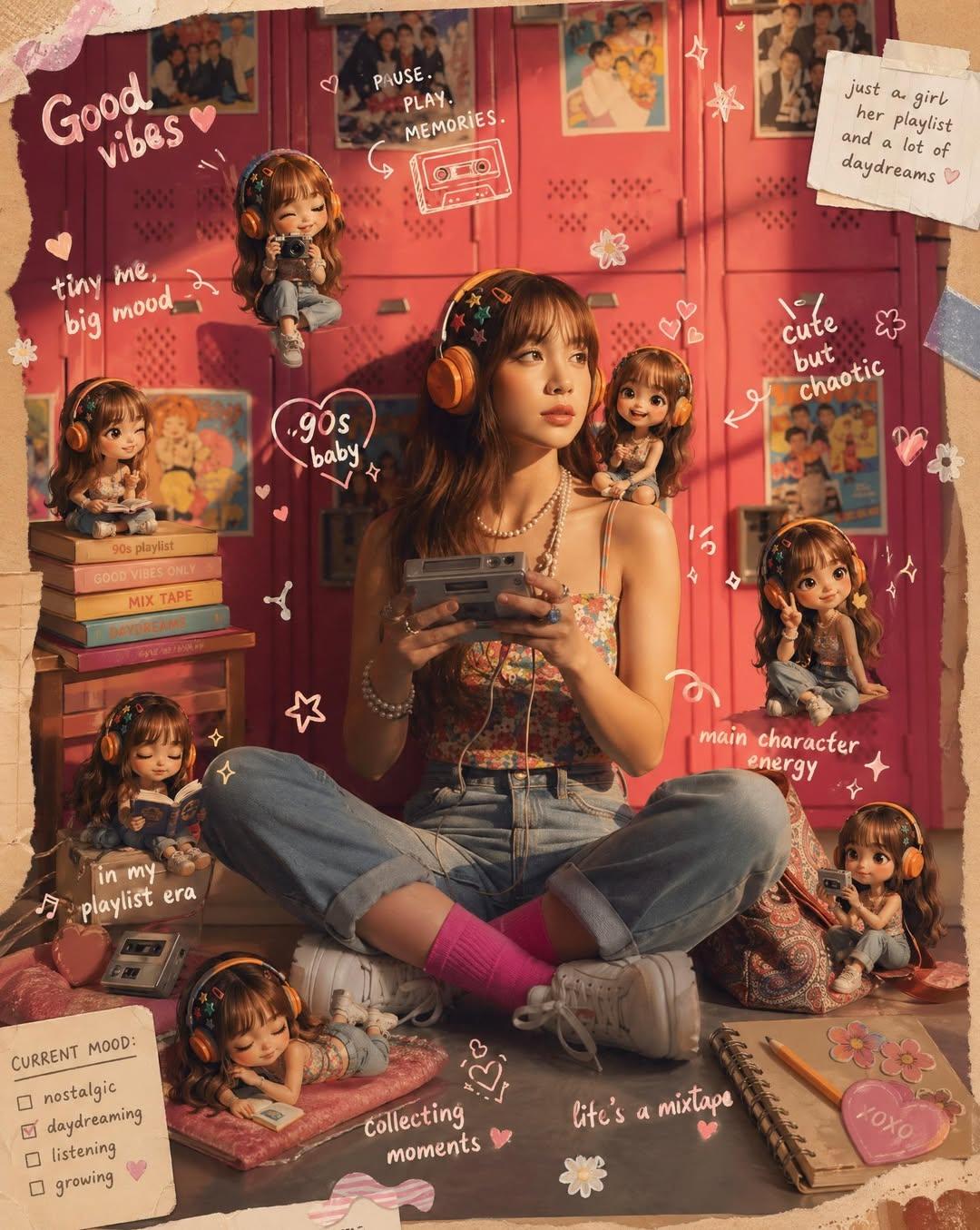
Scrapbook Real Photo with Mini Versions
Transform the provided reference image into a cozy aesthetic scrapbook-style composition while strictly preserving the original subject, identity, pose, lighting, and background.

Add multiple small "mini version" characters of the same person (chibi / doll-like style), placed naturally around the scene (on objects, table, shoulder, etc.). These mini figures must match the subject's face, hairstyle, outfit, and vibe consistently, styled as cute 3D collectible figurines. Show them doing different activities (reading, posing, taking photos, relaxing).

Overlay handwritten-style doodles and annotations across the image: arrows, hearts, stars, sparkles, icons, and playful captions connected to elements in the scene.

Use a soft pastel color palette (white base with pink, peach, blue accents).

Keep the frame visually rich and filled but balanced and clean.

Style: warm, cozy lighting, dreamy Instagram scrapbook aesthetic, soft depth of field, highly detailed, polished but playful.

The final result must look like the SAME original image enhanced with mini alter-egos and aesthetic annotations — not a recreated or different scene.
Related prompt guides and libraries
FAQ about One Scene, Ten Styles: AI Image
How do I turn one scene into ten styles without rewriting the prompt?
Keep the subject, scene, camera angle, and composition fixed and swap only the style block at the end of the prompt. For example, start with a cozy reading nook with a person, a lamp, and a bookshelf, then change only the style words: photorealistic portrait, soft watercolor, colorful 3D cartoon, anime illustration, retro poster, film photograph, GTA-style illustration, or blocky Minecraft-style scene. Changing the subject and the style at the same time makes it impossible to tell which change caused the difference.
Which styles should I try first in a style-swap test?
Start with three styles that are easy to tell apart: photorealistic, watercolor, and colorful 3D cartoon. Once the scene still reads as the same place in all three, add film photography, anime, retro poster, and game-inspired styles one at a time. If a style needs readable text, keep the text short and quoted, and check the final image instead of assuming the model rendered it correctly. When you use a reference photo, name the features that must stay the same, such as face, outfit, or product shape, before swapping the style.
How do I use One Scene, Ten Styles: AI Image prompts from gptimages.dev?
Start with the examples that match your visual job, then copy the prompt structure rather than copying every adjective. Replace the subject, scene, channel, aspect ratio, and constraints with your own details. If the first result is close, keep the successful parts fixed and change one variable at a time. This makes the page useful as a prompt library, not just a keyword page.
What is the best prompt format for One Scene, Ten Styles: AI Image?
A dependable format is brief first, details second, checks last: describe the image goal, then the subject, scene, composition, style, reference rules, and output constraints. For models such as GPT-IMAGE-2, Nano Banana 2, Stable Diffusion, Midjourney, or Jimeng AI, keep the core prompt portable and add tool-specific settings only when the interface supports them.
Can I reuse these prompts across different AI image models?
Yes, but reuse the structure more than the exact syntax. A prompt that works in one generator may need different wording, reference strength, aspect ratio settings, or negative prompts in another. The safest workflow is to preserve the creative brief, then adapt only the model-specific layer after you inspect the first output.
How should I collect the best AI image prompts?
Save prompts with the final image, model or tool name, aspect ratio, reference images, and a short note explaining why the result worked. Group them by use case such as product photography, character consistency, UI mockups, posters, logos, or text-in-image prompts. That collection becomes much more useful than a flat list of attractive phrases.
Why do One Scene, Ten Styles: AI Image prompts fail?
Common causes include unclear subject hierarchy, too many styles in one prompt, vague quality words, unsupported text requirements, missing reference rules, and uncontrolled iteration. Fix the prompt by naming the production goal, protecting the details that cannot change, and testing one adjustment per generation instead of rewriting the whole prompt every time.
Are these prompt examples enough for commercial work?
They are a starting point, not legal or brand clearance. For commercial work, check the terms of the model or generator, review rights for reference images, verify text and logos manually, and keep a record of the prompt, source assets, and final edits. The page helps with prompt quality, while usage rights still depend on your workflow and provider terms.